November 22, 2025 | 11:27 GMT +7
Hotline: 0913.378.918

November 22, 2025 | 11:27 GMT +7
Hotline: 0913.378.918
The forum shed light on the current status and future challenges of ensuring water security in the Mekong Delta, alongside discussing scientific and technological solutions for efficient water use.
The Mekong Delta remains Vietnam's cornerstone agricultural region, renowned for its rich natural resources and competitive advantages in agricultural production. However, the region faces pressing challenges due to external and internal factors, including upstream development, which leads to alterations to the Mekong River's flow and sediment dynamics; rising sea levels, more frequent extreme weather events, and unsustainable practices, which lead to subsidence and increasing vulnerabilities within the Delta.
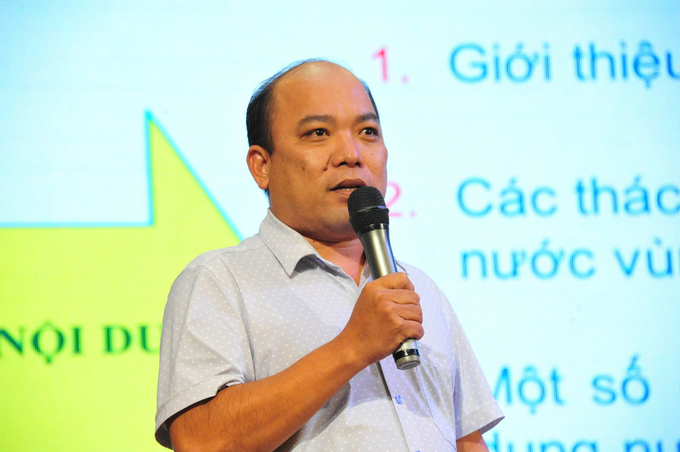
Mr. Tran Minh Tuan, Director of the Center of Irrigation Research and Water Supply at the Southern Institute of Water Resources Research speaking at the forum.
These compounding effects have drastically transformed the region, creating conditions far less favorable than its historical natural state.
Mr. Tran Minh Tuan, Director of the Center of Irrigation Research and Water Supply at the Southern Institute of Water Resources Research, emphasized that the Delta’s unique position at the lower end of the Mekong River system makes it highly dependent on upstream water resources. While the annual water flow into the Delta exceeds 400 billion cubic meters, local water sources contribute only about 5% (roughly 22 billion cubic meters). As a result, water availability during the dry season is heavily influenced by upstream dynamics.
“Mekong Delta does not face a total lack of water – whether fresh or saline – but is significantly affected by three main challenges: upstream water resource management, saline intrusion from the sea, and internal economic activities causing subsidence and critical water discharge,” Mr. Tuan explained.
The Mekong Delta boasts an extensive irrigation network with approximately 43,000 canals, serving as natural reservoirs that store and distribute water for agricultural activities. This system underpins the region’s transition to an agricultural economy while empowering proactive water management.
Mr. Tuan highlighted that past management strategies have yielded substantial benefits, mitigating the adverse effects of droughts and salinity intrusion through effective communication and coordination among stakeholders.
Future development should focus on controlled water management strategies that align with natural patterns, while also minimizing economic and social risks.
For the side of state management, he proposed that the policy and governance should enhance integrated management, including production planning, market forecasting, and improved monitoring and forecasting of saline intrusion. Besides, modernizing water resource monitoring systems to provide timely and accurate data.
For the side of farmers, Mr. Tuan urged farmers to adopt water-saving irrigation technologies, improve water storage practices, and implement measures to combat drought and salinity intrusion.
Despite advancements, the application of technology in water resource management remains inadequate. Efforts must be intensified to raise awareness and equip farmers with tools for efficient irrigation, particularly in fruit-growing areas.
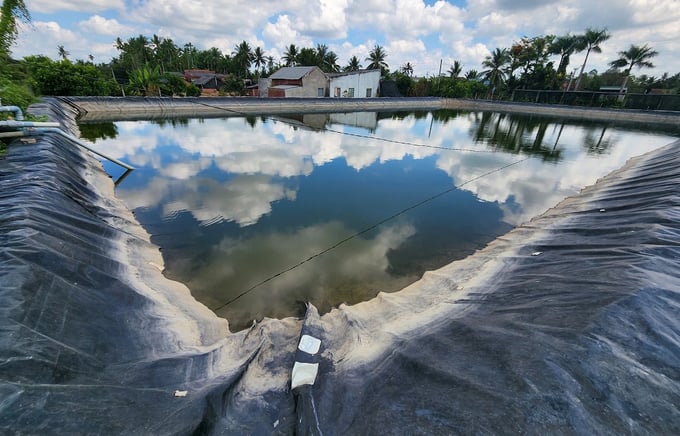
By adopting these innovations and fostering multi-stakeholder collaboration, the Mekong Delta can address its water challenges and sustain its role as Vietnam’s agricultural heartland. Photo: Bac Binh/ Bao Thanh nien.
The Southern Institute of Water Resources Research proposed a comprehensive disaster management approach, encompassing pre-disaster measures that focus in enhancing forecasting capabilities, public communication, and proactive planning for droughts and salinity intrusion. During the disaster, it proposed to prioritizing water allocation for domestic use, industrial needs, and agriculture. And for post-disaster recovey, the insitute focus on rehabilitating infrastructure, analyzing outcomes, and integrating lessons learned into future strategies.
Several advanced technologies have been introduced including smart water monitoring and management. The technology functions to leveraging IoT sensors, remote sensing, and machine learning to monitor water quality, quantity, and distribution in real time. This technology enables authorities to detect water losses, optimize treatment processes, and address issues promptly. The other should be SCADA system comprises of tools to facilitate efficient monitoring of water levels and controlling internal drainage systems, ensuring precise and timely interventions.
By adopting these innovations and fostering multi-stakeholder collaboration, the Mekong Delta can address its water challenges and sustain its role as Vietnam’s agricultural heartland.
According to Mr. Tran Minh Tuan, the total water requirement for domestic purposes is approximately 1 billion cubic meters. Subsequently, contamination with acidity, land subsidence, and groundwater degradation have surfaced as outcomes of excessive groundwater extraction. The Institute has designated specific zones for irrigation development, with a focus on the development of surface water resources to meet the requirements of domestic and agricultural users.
Reliance on groundwater is inevitable in demanding regions such as Ca Mau and Bac Lieu, where surface water sources have not yet been established. The Institute suggests that the government allocate resources to the construction of small, localized reservoirs that can capture and store rainwater. This water can subsequently be utilized to regulate water supplies during the drought season.
Water storage facilities constructed from alternative materials are recommended for residents of water-scarce and coastal regions. Furthermore, agricultural and policy institutions should be instrumental in helping to facilitate these initiatives by offering loans and financial assistance.
Although the costs are comparatively high, solutions such as desalinating seawater into freshwater are available for domestic water use. In order to optimize resource utilization, it is imperative to implement irrigation technologies that conserve water in agriculture.

(VAN) Water resources during the 2025–2026 dry season in the Mekong River Basin basically meet domestic use and production needs, but localized shortages may still occur due to saltwater intrusion.

(VAN) Vietnam and Japan have committed to deepening cooperation on projects under the Joint Crediting Mechanism (JCM), improving waste management, and advancing the circular economy.

(VAN) Digital transformation is becoming a core driver of proactive, precise, and safer management of dams and reservoirs nationwide.

(VAN) This assistance supports people who temporarily relocate or evacuate, as well as communities affected by major storms from late September to now.

(VAN) Viet Nam will host the 8th ASEAN Heritage Parks Conference, bringing together over 320 delegates and reaffirming its role in regional nature conservation.

(VAN) According to MAE, heavy rains and flooding from November 16-19 caused major losses in lives, homes, and agricultural production across the central provinces.

(VAN) Amid vast floodwaters, the spirit of sharing and helping others shown by many people in Gia Lai reached tens of thousands of residents stranded by raging floods.
