December 17, 2025 | 07:38 GMT +7
Hotline: 0913.378.918

December 17, 2025 | 07:38 GMT +7
Hotline: 0913.378.918
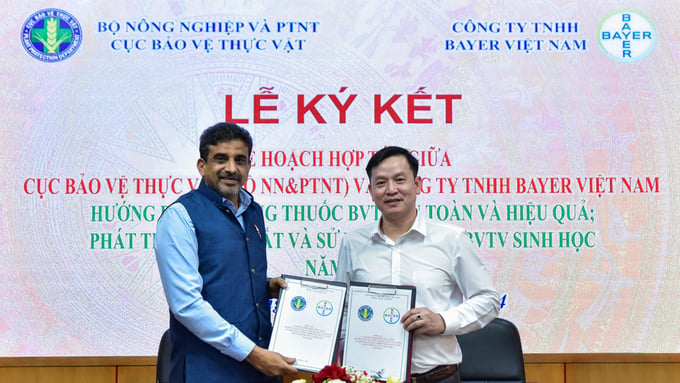
The Department of Plant Protection (Ministry of Agriculture and Rural Development) and Bayer Vietnam signed agreement to enhance biological pesticides use.
On the afternoon of April 9, the Department of Plant Protection (Ministry of Agriculture and Rural Development) and Bayer Vietnam Company Limited signed a commitment to implement the "Guidelines for Safe and Effective Pesticide Use; Development of Production and Utilization of Biological Pesticides" plan for 2024. This commitment outlines the objectives of the cooperation program for the period 2021-2025, as agreed upon by both parties earlier.
Bayer Vietnam's Crop Science Branch Director, Kg Krishnamurthy, highlighted the growth potential of Vietnamese agriculture. He noted the improving scientific and technical capabilities of Vietnamese farmers in clean and safe agricultural practices.
"This is evident as Vietnam's rice, coffee, and durian industries consistently achieve record export turnovers. We aim to partner with the Ministry of Agriculture and Rural Development, particularly the Department of Plant Protection, to serve the farmers' interests," stated the Director of Bayer Vietnam.
He proposed focusing on the durian industry in 2024, building upon successes in Dak Nong province, and subsequently extending the technology to durian growers in the Mekong Delta. Bayer aims to provide Vietnamese farmers with pest management solutions suitable for weather conditions influenced by climate change, ensuring product quality and pesticide residue control.
Huynh Tan Dat, Director of the Department of Plant Protection, emphasized the importance of maintaining scientific accuracy while ensuring accessibility for farmers to promote widespread adoption of farming models. He also urged Bayer to collaborate in promoting technical communication, raising awareness about the safe use of pesticides, and monitoring agricultural residues for export compliance.
Under the 2024 plan, Bayer Vietnam Co., Ltd. and the Department of Plant Protection will concentrate on training 3,000 farmers, agents, and pesticide distributors in Dak Nong and Mekong Delta provinces. They will establish models for the safe and effective use of pesticides to combat harmful organisms in key crops such as rice and durian in selected northern provinces and Dak Nong.
Both parties will collaborate to organize technical seminars and workshops on pesticide application to enhance professional capacity. They will also develop documentation and procedures for controlling harmful organisms in key crops.
The objective of these initiatives is to promote and establish multiple models for the safe and effective use of pesticides, as well as to improve the availability of biological and organic products. Additionally, it aims to garner interest and support from local professional agencies and relevant levels and sectors, thereby contributing to the development of clean, value-added, and sustainable agriculture.
Translated by Quynh Chi

(VAN) UNICEF and IOM receive this aid and provide essential services to assist families affected by recent storms and floods.

(VAN) Circular economy is regarded as a suitable pathway for Viet Nam’s fisheries sector, helping to improve production efficiency, optimize resources, and reduce environmental pressure.

(VAN) Vietnam and the UK are promoting cooperation in agriculture, environment, renewable energy, and green transition, with the goal of achieving Net Zero.

(VAN) Switzerland highly values carbon credit cooperation potential with Viet Nam and hopes to begin negotiations under Article 6 of the Paris Agreement.

(VAN) Northwestern women not only preserve traditional weaving but also leverage their cultural identity to create livelihoods, while spreading it to tourists through authentic experiences.

(VAN) Based on research results and production practices, the international scientific community evaluates UNI 126 as one of the world's best Panama disease-resistant banana varieties.

(VAN) More than 10,000 hectares of Cavendish bananas (Philippines), once abandoned due to the Panama Fusarium wilt Tropical Race 4 (TR4) disease, have now been brought back into production by switching to the Formosana variety.
