June 5, 2026 | 07:23 GMT +7
Hotline: 0913.378.918

June 5, 2026 | 07:23 GMT +7
Hotline: 0913.378.918
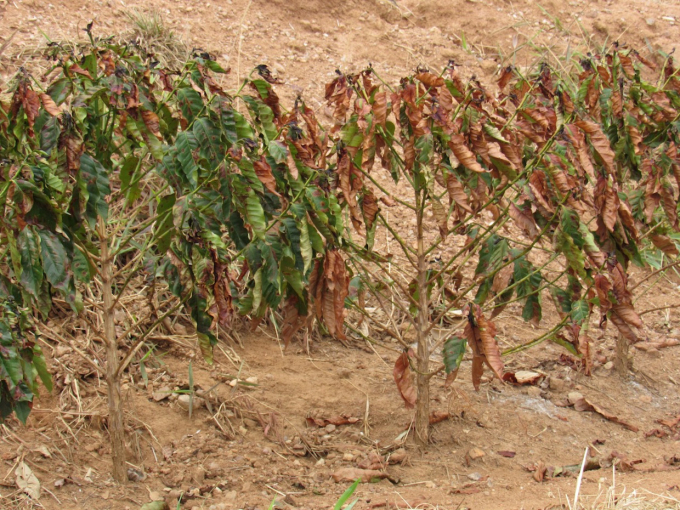
The drought at the beginning of the year and the current frost caused heavy damage to many major coffee-producing regions in Brazil.
Analysts predicted that the coffee price crisis would continue for a lengthy period of time. According to Jack Scoville of Price Futures Group, freezing temperatures have been recorded in two of Brazil's biggest coffee producing states, Minas Gerais and Parana, as well as in Sao Paulo. There has been no precise assessment on the amount of the damage, but it will undoubtedly be significant.
“This is flowering season for the next harvest crop, but coffee blossoms are frozen and will fall off the tree,” Scoville said, despite the warmer temperature.
The price of arabica coffee futures, one of South America's primary agricultural exports, soared to more than USD 2 per pound on Friday, the highest level since 2014. This implies that the global coffee market has increased by 60% since January.
While robusta coffee, which is mostly grown in Asian nations, also increased to its highest pricing since October 2017 and hit USD 1,993 per tonne, a nearly 40% rise this year.
According to Rabobank analyst Carlos Mera, "there are several reasons for the sudden increase in coffee prices, but the primary reason is due to the severe weather conditions in Brazil," adding that rising transportation costs and political unrest in Colombia - the world's third-largest coffee producer - are also major factors pushing up coffee prices.
According to AFP, Brazil had a record drought at the start of this year, followed by a frost wave that caused significant damage this week to many major farms in Minas Gerais, which accounts for 70% of the country's arabica coffee production.
“Sub-zero temperatures cause crop defoliation and even death of the youngest plants, which are critical for future harvests; furthermore, the arabica coffee type was significantly impacted owing to its biannual plant cycle, resulting in substantial production differences,” Mera said.
Coffee consumption worldwide is increasing this year as giant economies reopen their doors following the Covid-19 pandemic. This boosts demand for arabica coffee, which is commonly used in cafes and restaurants, in stark contrast to the lower grade robusta that is frequently used to make instant coffee.
Coffee prices have been low in recent years, according to commodities analyst Philippe Chalmin, after hitting more than USD 3 per pound arabica in May 2011.
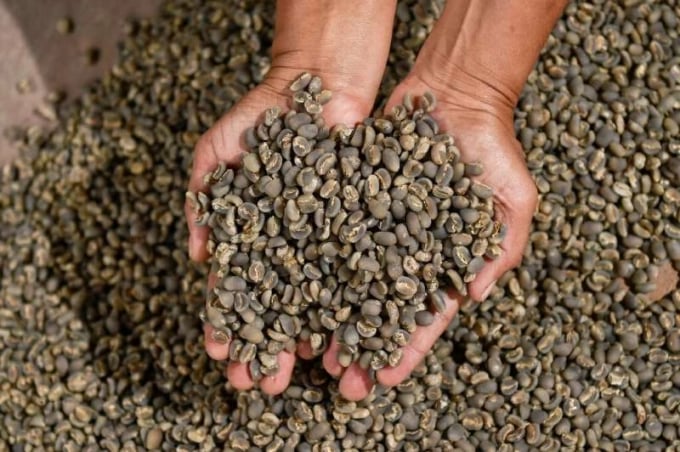
Arabica coffee prices skyrocketed to the highest level since 2014.
"The world's coffee farmers have endured a protracted pricing crisis that has left the majority in the red," Valeria Rodriguez, executive director of the Max Havelaar Fair Trade Association, told AFP.
“If this crop fails, it implies that a large number of farmers in Brazil will have no coffee to sell and therefore no income,” Max Havelaar said.
Meanwhile, Mera said that increased costs would eventually trickle down to customers. “Because roasters utilize the futures market to hedge against short-term price spikes, it typically takes three to nine months to observe impacts at the retail level,” he explained.
"Roasted coffee is presently priced at an average of 15 euros per kilogram, whereas Pods coffee is priced at 45 euros per kilogram, or even more," Rodriguez said. This is a long cry from the price of Arabica coffee at the moment, which is less than four euros a kilogram.”
According to data provided by the national statistics office, the price of coffee sold in supermarkets in France has been relatively stable in recent months and stays similar to the 2015 reference price.
Coffee prices are now rising against a background of raw material price inflation, whether agricultural or industrial - with copper and tin both setting records in recent weeks, analysts say.

(VAN) Rubber prices on June 3, recorded an upward trend in the global market across major exchanges, while domestic latex purchasing prices remained stable.

(VAN) Pepper prices on June 2, 2026, dropped by VND 1,000-3,000/kg, falling below VND 140,000/kg. Domestic prices are fluctuating around VND 136,000–139,000/kg.

(VAN) Rubber prices on June 1 recorded an upward trend across major global exchanges. Meanwhile, domestic latex purchasing prices in Vietnam remained stable.

(VAN) Rubber prices on May 29, recorded mixed movements across major exchanges. Meanwhile, domestic latex purchasing prices in Vietnam remained stable.

(VAN) Rubber prices on May 28, recorded mixed movements across major Asian exchanges. Meanwhile, domestic latex purchasing prices in Vietnam remained stable.

(VAN) After export difficulties, durian prices in the Mekong Delta are recovering well thanks to improved customs clearance and increasing demand.

(VAN) Rubber prices on May 27, recorded mixed movements across major Asian exchanges. Meanwhile, domestic latex purchasing prices in Vietnam remained stable.
