December 17, 2025 | 15:38 GMT +7
Hotline: 0913.378.918

December 17, 2025 | 15:38 GMT +7
Hotline: 0913.378.918
On January 24, the Department of Plant Protection (Ministry of Agriculture and Rural Development - DPP/MARD), in collaboration with the Australian Embassy in Vietnam, held the “Announcement Ceremony of new Glyphosate alternative phytosanitary treatment for export cut flowers to Australia.”
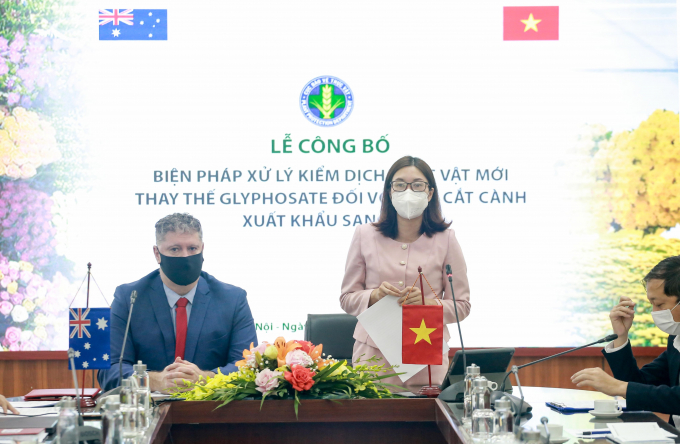
Ms. Nguyen Thi Thu Huong, Deputy Director of the Department of Plant Protection, announcing a new alternative phytosanitary treatment to Glyphosate for export cut flowers to Australia. Photo: Trung Quan.
According to Ms. Nguyen Thi Thu Huong, Deputy Director of the Plant Protection Department (PPD/MARD), species of cut flowers in general and chrysanthemums and carnations in particular must comply with the regulation Australia applies to all exporting countries: “Flowers must be treated with low concentration Glyphosate within 20 minutes to eliminate sprouts.”
In March 2015, International Agency for Research on Cancer (IARC) classified glyphosate as “probably carcinogenic to humans” (Group 2A).
Faced with that situation, the Vietnam MARD issued Decision No. 1186/QD-BNN-BVTV dated April 10, 2019, to remove this active ingredient from the list of pesticides permitted for use in Vietnam. MARD Circular No. 10/2020/TT-BNNPTNT took effect after June 30, 2021, stipulating that herbicides containing Glyphosate cannot be produced, traded, imported, or used in Vietnam.
This resulted in the halt of flower export to Australia because the Australian side does not accept flower stem sterilization using active ingredients other than Glyphosate.
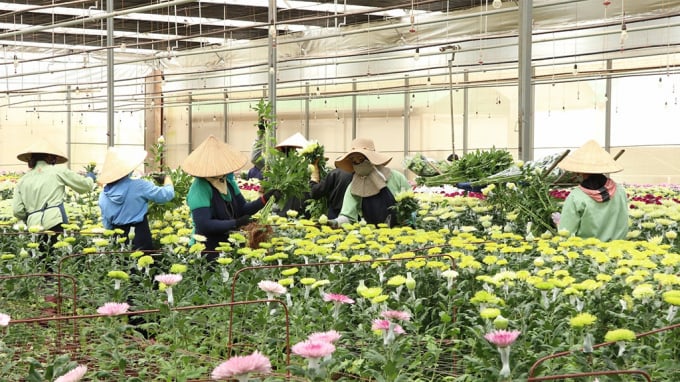
From March 1, 2022, cut chrysanthemum flowers for export to the Australian market do not need an import license from Australia, provided that they are treated with Metsulfuron methyl 200 g/kg at a dose of 0.67 g/l. Photo: TL.
In order to create conditions for Vietnam's cut flowers to be exported to Australia, DPP has actively worked with Australian authorities over the past time to discuss and propose Glyphosate substitutes. DPP also collaborated with Dalat Hasfarm Co., Ltd. to carry out a series of researches and tests on alternative active ingredients in accordance with Vietnam's regulations and to meet Australia’s import requirements.
As stated by Ms. Huong, through the testing process, two active ingredients Diuron and Metsulfuron methyl have been confirmed to be effective in treating chrysanthemum and carnation sprouts, capable of replacing Glyphosate. All test results and technical documents have been sent to the Australian side for evaluation.
Australia has completed the evaluation of technical test records of Metsulfuron methyl for cut chrysanthemums. Vietnam may now use Metsulfuron methyl as a substitute for Glyphosate to treat the sprouts of cut chrysanthemums exported to Australia from March 1, 2022. Cut chrysanthemum flowers for export to the Australian market do not need an import license from Australia, provided that they are treated with Metsulfuron methyl 200 g/kg at a dose of 0.67 g/l.
After re-exporting cut chrysanthemum flowers to Australia, both sides will continue to monitor the safety and effectiveness of Metsulfuron methyl on export shipments in the next six months to evaluate the authentic effectiveness of this active ingredient.
The Department of Plant Protection will work with Dalat Flower Association (DFA) and local authorities to support and guide businesses to complete the procedures in accordance with regulations, quickly export cut flowers to the Australian market.
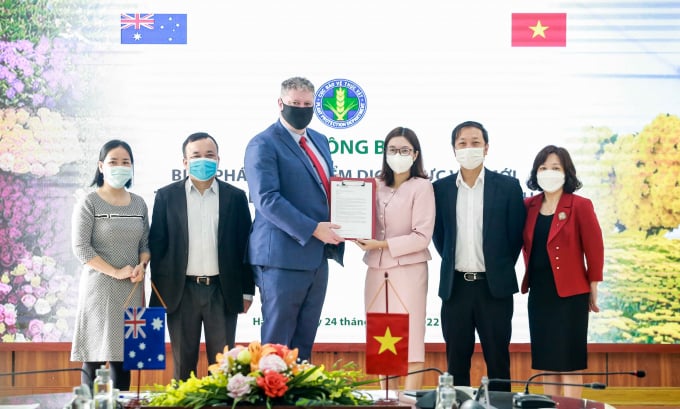
Mr. Tony Harman, Australian Agricultural Counselor in Vietnam, handed the DPP representative “Approval Decision to use the Metsulfuron methyl as an alternative to Glyphosate to treat cut chrysanthemum sprouts for export to Australia”. Photo: Trung Quan.
According to Australia’s regulations, it usually takes 12 months plus necessary administrative procedures to approve alternative active ingredients to Glyphosate in the treatment of imported cut flowers.
However, thanks to proactive and positive efforts of Vietnam in search of an active ingredient to replace Glyphosate, along with the close coordination and goodwill of the Department of Plant Protection, the approval of technical documents was faster than expected.
Mr. Tony Harman also hoped that flower producing enterprises and households of Vietnam in general and Dalat in particular would strictly implement the agreed regulations in order to create export quality products exported into Australia, thereby helping to increase export output, value, and sustainable development for Vietnam's flower industry.
Translated by Samuel Pham

(VAN) Trading forest carbon credits is to reduce greenhouse gas emissions while creating sustainable livelihoods for local communities.

(VAN) Expanding the area of forests with FSC certification creates a foundation for elevating the economic value of forests, promoting sustainable management, and offering opportunities to participate in the carbon credit market.

(VAN) MAE and GIZ organized the conference to strengthening capacity and readiness for EUDR implementation in Vietnam.

(VAN) When women, men, children, and people with disabilities all have the opportunity to maximize their potential, the economy will grow, and the country will prosper.

(VAN) Effective disaster prevention and the creation of sustainable livelihoods through practical forestry policies are the distinct and crucial values of special-use and protection forests.

(VAN) The policy movement regarding carbon emission reduction is opening up a new approach, linking national goals with practical agricultural production.

(VAN) Deputy Prime Minister Tran Hong Ha made this request at the 24th meeting of the National Steering Committee for Combating IUU Fishing with 21 coastal provinces and cities joining virtually.
