December 6, 2025 | 00:16 GMT +7
Hotline: 0913.378.918

December 6, 2025 | 00:16 GMT +7
Hotline: 0913.378.918
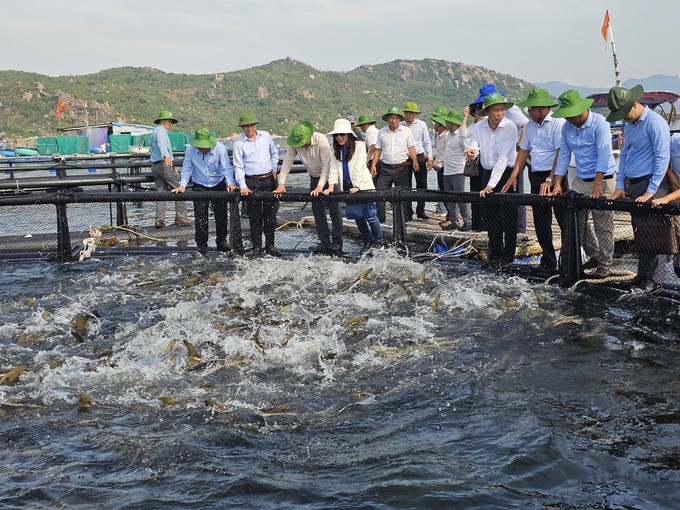
Khanh Hoa is replicating the pilot model of high-tech marine farming. Photo: KS.
Accordingly, in phase 1 (from now until the end of 2025), Khanh Hoa will expand the pilot model of high-tech marine farming with a scale of 30 hectares, expanding the pilot model of high-tech marine farming with the support funding of the Kind Heart Foundation (Vingroup).
From the results of the pilot model of high-tech marine farming in open seas that was deployed by the Khanh Hoa Provincial Agricultural Extension Center in collaboration with the Kind Heart Foundation in Cam Ranh City with 10 participating fishermen households, Khanh Hoa will continue to implement a pilot model of high-tech marine farming with 150 households participating in converting from traditional cages to HDPE plastic cages.
Accordingly, Van Ninh district will deploy 2 hectares with 10 fishermen households participating; Ninh Hoa town of 1 hectare with 5 participating households; Nha Trang city of 1 hectare with 5 participating households; the Hon Noi area of 10 hectares with 50 participating households in Cam Lam district and Cam Ranh city.
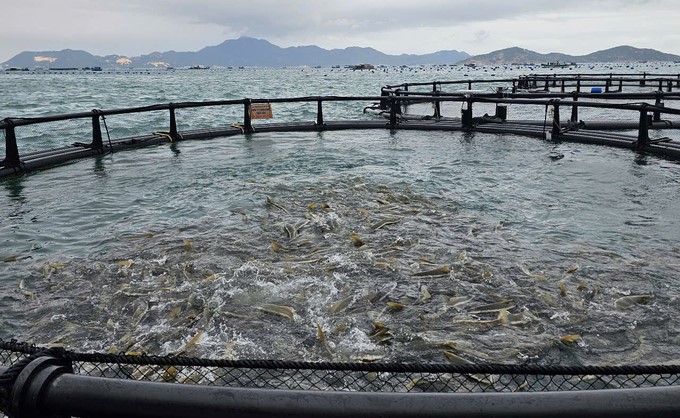
Fish raised in open seas grow quickly and develop well. Photo: KS.
In phase 2 (from 2026 to 2027), Khanh Hoa will expand the pilot model of high-tech marine farming with a scale of 100 hectares, including 500 households participating in converting from traditional cages to HDPE plastic cages. In phase 3 (from 2028 to 2029), Khanh Hoa will continue to expand the pilot model of high-tech marine farming with a scale of 110 hectares, including 550 households converting from traditional cages to HDPE plastic cages.
When he was Secretary of the Khanh Hoa Provincial Party Committee, Mr. Nguyen Hai Ninh (now as Minister of Justice) said, "The farther we go to offshore waters, the greater the risks and challenges in aquaculture. Pilot implementation can be successful or unsuccessful. But if we do not do it, we will not know when we succeed."
As expected by Mr. Nguyen Hai Ninh, the pilot models have shown outstanding effectiveness. For example, the households of Mr. Phan Van Thanh and Mr. Nguyen Van Cu in Cam Lap commune (Cam Ranh city) were each supported with two HDPE round cages with a diameter of 13 m, a volume of 800 m³, and a value of VND 530 million for cobia farming.
After only 8 months, the farmed fish grow and develop well, reaching a weight of 6–7 kg/head with a survival rate of 97%. In particular, fish have a light brown color and are very healthy. Therefore, many people who visit the model praise the households' successful farming.
"We stocked 2,000 cobia in each round cage, achieving an output of over 10 tons. With cobia prices ranging from VND 160,000 to VND 170,000/kg depending on the type, farming households earn about VND 600 million/cage after sale," Mr. Phan Van Thanh shared.
Mr. Nguyen Minh Tho's household in Cam Thuan ward (Cam Ranh City) was supported with an HDPE raft consisting of a cluster of 6 cages for scalloped spiny lobster farming in open seas. The HDPE raft has a volume of 24 m³/cage hung on 2 cage floors (meaning a total of 12 cages) and a total value of VND 530 million. Mr. Tho's model also gives good results.
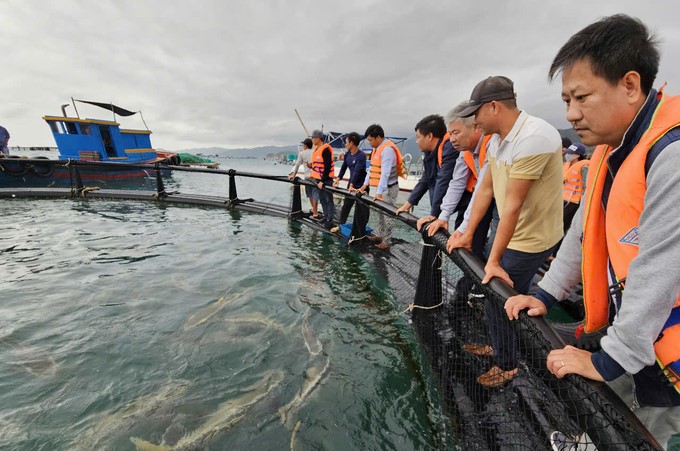
Farmers are excited that aquaculture in open seas brings remarkable results. Photo: KS.
According to Mr. Nguyen Minh Tho, farmed lobsters are stocked at a density of 600 head/cage. The time it takes for lobsters to reach commercial size is shortened by 1–2 months compared to near-shore farming. "After 8 months of farming, the lobster reached a weight of about 3 heads/kg, and the survival rate reached 76%. After sale, I earned a profit of about VND 30 million/cage," said Mr. Tho.
"After 1 year of implementation, HDPE cages of pilot farming models all yield higher profits than the traditional wooden cage farming model. Of which, the cobia farming model reaches an average profit margin of 172%, the lobster farming model reaches 112%, and the grouper farming model reaches more than 131%," said Mr. Phuong Minh Nam, Deputy Director of the Khanh Hoa Provincial Agricultural Extension Center.
According to Dr. Vo Van Nha, Director of the Research Institute for Aquaculture No. 3, the pilot model of developing marine farming with advanced technology is a new step in the journey to reach out to the sea to develop the country's ocean economy. Despite knowing that there will be many difficulties ahead, from planning the marine space to converting the farming model from a long-standing traditional farming method, high-quality human resources, and boldly handing over the seawater surface according to authority, "the difficult task is impossible not to be done."
“The advanced marine farming model based on the Law on High Technologies 2008 can also be understood as a high-tech marine farming model, flexibly and effectively applying multiple fields of technology (information technology, biotechnology, new material technology, and automation technology) into the model," shared Dr. Vo Van Nha.
Translated by Thu Huyen

(VAN) After three years, Project FST/2020/123 collected approximately 3,000 insect specimens, classified them into about 50 morphological groups, and identified around 40 species, including several new species.
/2025/12/01/0509-2-175427_206.jpg)
(VAN) Emission-reducing coffee areas in Lam Dong have entered the new crop with stable yields, improved quality, and a remarkably enhanced cultivation environment.

(VAN) The Institute of Agricultural Sciences for Southern Vietnam (IAS) marked its 100th anniversary in Ho Chi Minh City, celebrating a century of growth as a leading institute contributing significantly to Viet Nam’s agricultural development.

(VAN) An increasing number of livestock farms are using biogas generators to create a source of renewable electricity, helping to save costs and mitigate environmental pollution.

(VAN) Small changes in rice cultivation, from irrigation methods and straw collection to input management, are paving a new way for Vietnam's agriculture in the journey toward emission reduction.

(VAN) With the project of converting biogas into renewable electricity, Australia is both helping pig farms reduce their energy costs by up to 25% and contributing to environmental protection.
![Hue aims for Net Zero: [1] Initial steps from green transportation](https://t.ex-cdn.com/nongnghiepmoitruong.vn/608w/files/huytd/2025/11/28/0853-anh-6-giao-thong-xanh-hue-094717_940-153724.jpg)
(VAN) For sustainable development, Hue City is implementing many solutions to promote green transportation, which is an important initial step on the journey to building a Net Zero Hue.

/2024/12/11/3125-1-201824_514.jpg)
/2024/12/12/2738-2-090806_532.jpg)