December 7, 2025 | 21:22 GMT +7
Hotline: 0913.378.918

December 7, 2025 | 21:22 GMT +7
Hotline: 0913.378.918
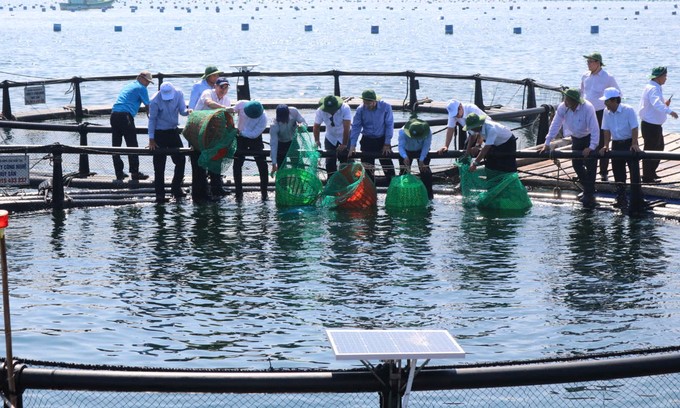
HDPE cages are adaptable to natural disasters and environmentally friendly. Photo: KS.
To develop sustainable marine farming, the Khanh Hoa Department of Agriculture and Rural Development has coordinated with the Research Institute for Aquaculture No. 3 (Ministry of Agriculture and Rural Development) to develop a pilot project on developing marine farming applying advanced technology in Khanh Hoa. Accordingly, through agricultural extension models, Khanh Hoa province's functional sector disseminates and guides farmers to convert from traditional wooden cages to modern HDPE cages to minimize risks and adapt to natural disasters.
Khanh Hoa has also developed a pilot project on developing marine farming using advanced technology. Of which, the location, subjects, and technologies applied are determined to develop high-tech farming in waters from the shore to 3 nautical miles and waters from 3 to 6 nautical miles.
According to Mr. Nguyen Duy Quang, Director of the Khanh Hoa Department of Agriculture and Rural Development, regarding marine farming technology in the area from the shore to 3 nautical miles, the functional sector recommends that fishermen apply a technology combination of movable high-density polyethylene (HDPE) synthetic plastic cages and flexible, multi-layered, floating semi-submersible cages. Combining with auxiliary technologies such as automatic feeding technology, automatic environmental monitoring technology (measuring and observing basic environmental factors directly related to livestock), solar energy technology, and cameras to monitor livestock's life activities (within cages and adjacent waters less than 10 m).
According to Dr. Vo Van Nha, Director of the Research Institute for Aquaculture No. 3, the advanced marine farming model can be understood as a model that integrates aquaculture technology using new materials (such as HDPE material that can withstand big waves and strong winds) with one or more auxiliary technologies such as automatic feeding technology, cage and aquatic animal monitoring technology by installing cameras to monitor activities on cages and living activities of livestock, solar energy technology, management technology, and use of industrial feed (supplemented with biological preparations, probiotics, minerals, etc.) to optimize feed utilization coefficient.
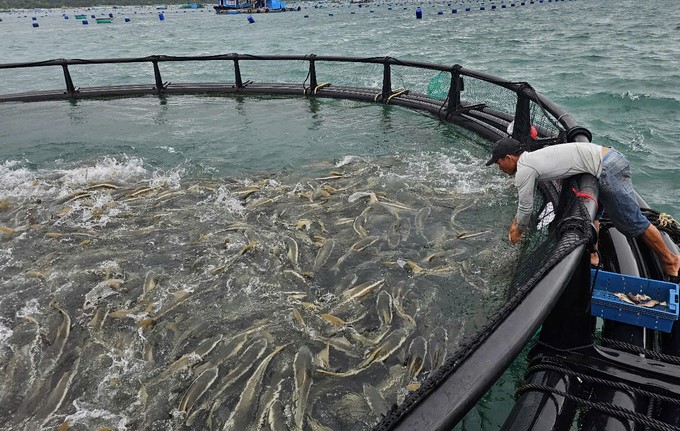
Cobia farming in HDPE cages in open sea in Cam Ranh city, Khanh Hoa province. Photo: KS.
Besides, automatic environmental monitoring and observing technology (measuring and observing basic environmental factors directly related to livestock) can also be integrated to transfer the entire database obtained to marine farmers via the internet system or smartphones.
According to Mr. Quang, for marine farming in areas from 3 to 6 nautical miles, the functional sector recommends that fishermen apply cages made of high-density polyethylene (HDPE) synthetic plastic material in the form of round, floating cages. Combining with other modern technologies such as automatic feeding technology; "Clean Harvest" technology that integrates the technology of harvesting, processing fish directly at sea, preserving it at a temperature of 4 oC, and bringing it to the processing factory; automatic environmental monitoring technology for marine farm management; clean energy and renewable energy technology such as proactive energy for marine farming from 3 to 6 nautical miles by using wind power, solar power, or other renewable energy.
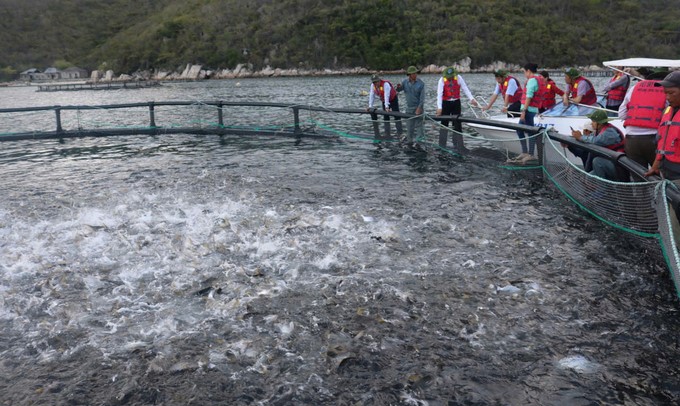
In Khanh Hoa province, there are currently many businesses investing in marine farming. Photo: KS.
Up to now, some marine aquaculture areas in Khanh Hoa have soon approached industrial-scale marine farming technology using HDPE cages. In 2000, Pearl Co., Ltd. invested in marine fish farming with HDPE round cages in Van Thanh commune, Van Ninh district. Next, Marine Fams ASA Vietnam Co., Ltd. (Norway) in 2006 and Australis Aquaculture Vietnam Co., Ltd. in 2007 began investing in equipment and technology for industrial-scale marine fish farming with HDPE cages in Van Phong Bay. In 2020, Mr. Nguyen Xuan Hoa (Van Gia town, Van Ninh district) started approaching and investing in marine fish farming using HDPE round cages in Van Phong Bay.
"These are the units, businesses, and individuals pioneering in industrial-scale marine farming using HDPE cages at sea in Khanh Hoa. The advantage of the high-tech farming system using HDPE cages is to ensure efficiency, sustainability, and safety in unusual weather conditions.
In addition to economic efficiency, the application of technology to marine farming also brings environmental efficiency as well as social efficiency, contributing to changing farmers' awareness and exploiting the potential and advantages of each locality," emphasized Mr. Nguyen Duy Quang, Director of the Khanh Hoa Department of Agriculture and Rural Development.
"New HDPE material technology plays a key role. Other technologies such as information technology (cameras monitoring livestock's life activities), automation technology (automatic feeding and environmental monitoring), and biotechnology (using biological preparations and probiotics in the farming process) are applied complementarily and flexibly in each specific condition in each sub-region of marine farming and each specific marine farming species," said Dr. Vo Van Nha, Director of the Research Institute for Aquaculture No. 3.
Translated by Thu Huyen

(VAN) After three years, Project FST/2020/123 collected approximately 3,000 insect specimens, classified them into about 50 morphological groups, and identified around 40 species, including several new species.
/2025/12/01/0509-2-175427_206.jpg)
(VAN) Emission-reducing coffee areas in Lam Dong have entered the new crop with stable yields, improved quality, and a remarkably enhanced cultivation environment.

(VAN) The Institute of Agricultural Sciences for Southern Vietnam (IAS) marked its 100th anniversary in Ho Chi Minh City, celebrating a century of growth as a leading institute contributing significantly to Viet Nam’s agricultural development.

(VAN) An increasing number of livestock farms are using biogas generators to create a source of renewable electricity, helping to save costs and mitigate environmental pollution.

(VAN) Small changes in rice cultivation, from irrigation methods and straw collection to input management, are paving a new way for Vietnam's agriculture in the journey toward emission reduction.

(VAN) With the project of converting biogas into renewable electricity, Australia is both helping pig farms reduce their energy costs by up to 25% and contributing to environmental protection.
![Hue aims for Net Zero: [1] Initial steps from green transportation](https://t.ex-cdn.com/nongnghiepmoitruong.vn/608w/files/huytd/2025/11/28/0853-anh-6-giao-thong-xanh-hue-094717_940-153724.jpg)
(VAN) For sustainable development, Hue City is implementing many solutions to promote green transportation, which is an important initial step on the journey to building a Net Zero Hue.

/2024/12/11/3125-1-201824_514.jpg)