December 8, 2025 | 15:06 GMT +7
Hotline: 0913.378.918

December 8, 2025 | 15:06 GMT +7
Hotline: 0913.378.918
The technique of grafting secondary roots for fruit trees such as durian, lemon, grapefruit, orange, etc. has been recommended by scientists for many years. Recently, the movement to grow durian has developed strongly. Farmers pay great attention to choosing quality seedlings, including trees with many "legs."
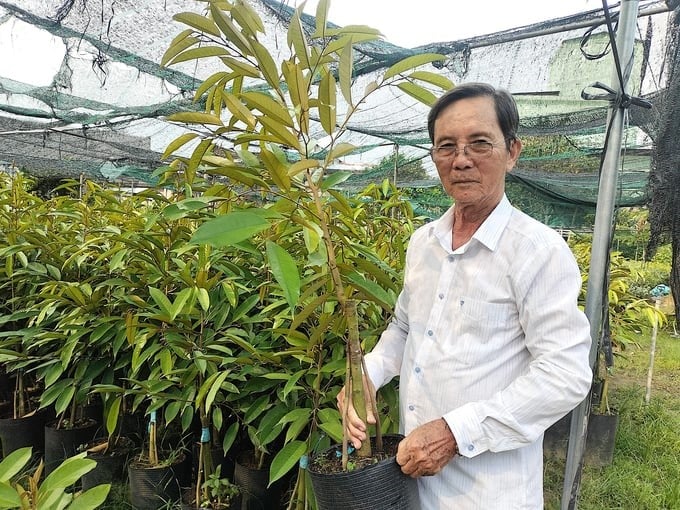
Mr. Nguyen Cong Thanh introduced durian seedlings grafted with two additional "legs." Photo: Minh Dam.
Mr. Nguyen Cong Thanh, owner of Tu Thanh seedling facility in Son Dinh commune, Cho Lach district, Ben Tre province, shared: "Currently, my customers in localities in the Central Highlands such as Dak Lak and Dak Nong have a tendency to order durian seedlings grafted with many secondary roots."
Mr. Thanh said that 30 years ago, when he bought durian seedlings in Thailand, they shared the technique of grafting secondary roots and gave him a "textbook" to practice grafting. Testing this method for decades in Mr. Thanh's garden and highland areas in the Southeast region has shown its effectiveness and many benefits.
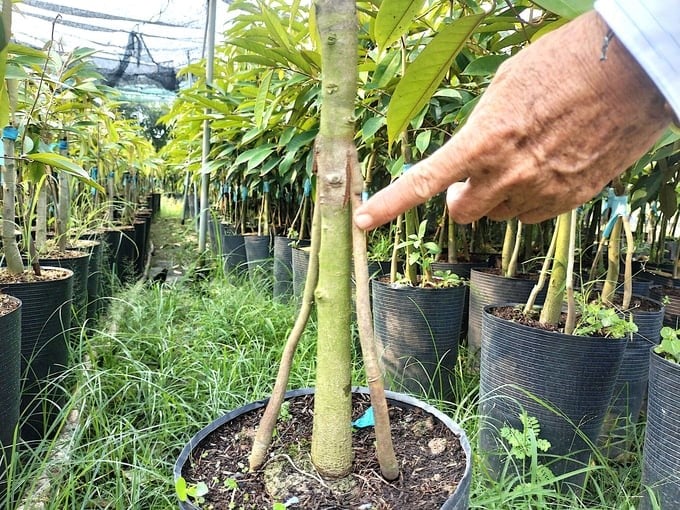
Graft two additional secondary roots for durian from vegetative plants when young. Photo: Minh Dam.
Many secondary roots will help trees stand firmly in mountainous, windy areas. Trees with many root systems will enhance water and nutrient absorption, meeting the tree's needs. When the main root system is diseased, such as when the Phytophthora fungus attacks and damages the tree, there are still healthy secondary roots to absorb nutrients and maintain the tree's life. Therefore, if the garden owner detects the disease early, there will be more time to treat and restore the tree.
In addition, an important point is that if there are many rootstocks, durian trees almost never suffer from bottlenecks at the foot. Trees that become bottlenecked at the foot, when exposed to strong winds, can easily break in this position.
"Grafting secondary roots has many benefits. I see that the tree grows relatively well, and in the future there will be no bottleneck at the foot. Because when the tree grows up, there will be 2-3 additional secondary roots along with the main root that merge into one block, so the bottleneck ratio is almost non-existent. This method has been around for a long time, but not recently.
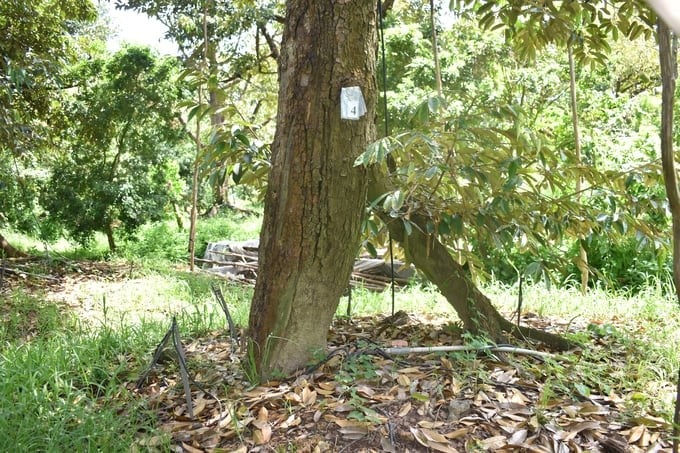
Mature durian is grafted with one secondary root, so the main root is not bottlenecked. Photo: Minh Dam.
When I imported seedlings from Thailand, they gave me an instruction book so I could graft up to 4–5 roots, depending on my wishes. Later, the root is very big but not sick, and it is able to withstand the wind on the hill. Previously, I sold seedlings with many rootstocks to the Central Highlands. Customers found it effective, so they came back to order it this way," Mr. Thanh said.
Talking about the selling price of seedlings with many rootstocks, Mr. Thanh said the price will depend on the number of secondary roots. The price of normal durian seedlings is VND 100,000/tree. As for seedlings with one secondary root, the price is VND 120,000/tree. The price of seedlings with four secondary roots is VND 180,000–200,000/tree.
Mr. Thanh added that this method can also be applied to plants propagated by grafting, such as grapefruit, lemon, orange, jackfruit, etc.
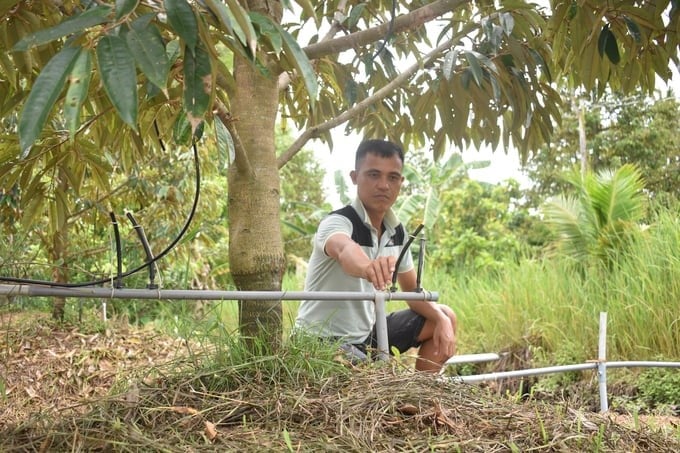
Durian trees that are not grafted with secondary roots often suffer from bottlenecks. Photo: Minh Dam.
According to Prof. Dr. Nguyen Minh Chau, former Director of the Southern Fruit Research Institute, trees grafted with secondary roots will grow very well. Each secondary root is grown from seed, so it has different genetics. When grafted, it will supplement the host tree very well. Especially the problem of being resistant to diseases and absorbing water very well. When one root system is diseased, another root system will raise the tree. Regarding quantity, he recommends grafting 2-3 secondary roots to be effective, not necessarily many.
Translated by Thu Huyen
/2025/12/01/2936-2-222331_70.jpg)
(VAN) Mortgaging his house and giving up a pharmaceutical management career, Mr. Nguyen Quang Duy succeeded in bringing Khanh Hoa's sea grapes to demanding markets such as Japan and the U.S.

(VAN) The large-scale agroforestry investment project aims to develop a leading sustainable agro-industrial center in Angola.
/2025/11/28/3433-1-212821_213.jpg)
(VAN) Many localities across the coconut land of Vinh Long are replicating emission-reducing models in production and daily life, contributing to the targets for emission reduction and green economic development.

(VAN) The green transition is an inevitable path for collective economy to achieve balanced growth and align with global trends.

(VAN) The TH Group is not only Vietnam’s leading clean-milk producer; it is also leaving a strong mark on sustainable development as it pursues the goal of carbon neutrality.
/2025/11/27/3830-1-152901_403.jpg)
(VAN) Dong Nai is developing its key crop areas, expanding planting area codes, and applying high technology to increase the value of agricultural products, aiming at a green and sustainable agriculture.

(VAN) Tay Ninh’s livestock sector is undergoing a major transformation, applying high-tech, closed-loop circular models to build sustainable value chains.
