November 25, 2025 | 03:18 GMT +7
Hotline: 0913.378.918

November 25, 2025 | 03:18 GMT +7
Hotline: 0913.378.918
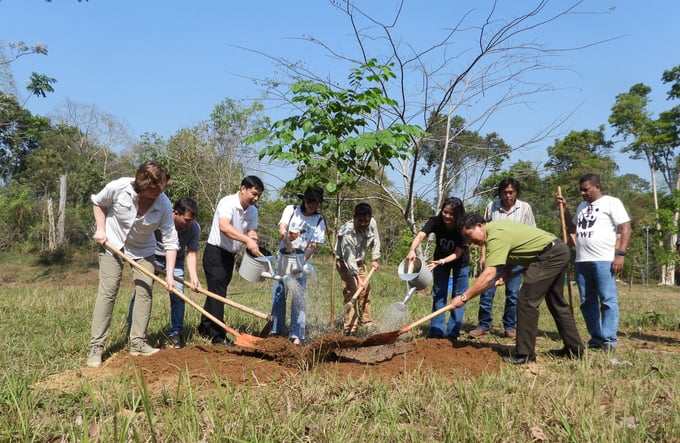
Ms. Kirsten Shuijt, Director of the World Wide Fund for Nature (WWF) and the delegation of the WWF-Vietnam organized a tree planting ceremony at Cat Tien National Park. Photo: Tran Trung.
On March 19, within the framework of the high-level workshop on sustainable financial orientation and solutions for national parks and nature reserves, Ms. Kirsten Shuijt, Director of the World Wide Fund for Nature (WWF) and the delegation of the WWF-Vietnam organized a tree planting ceremony at Cat Tien National Park.
WWF is one of the top conservation organizations. WWF provides consults on solutions, supports the government and partners to address the challenges of national development. In Vietnam, WWF prioritizes support for national parks and nature reserves, working with them on how to conserve biodiversity values, especially because most of Vietnam’s national parks and nature reserves showed signs of severe biodiversity loss in the past.
“In the past 10 years, the species populations in national parks and nature reserves have gradually recovered. Currently, we have been supporting national parks and nature reserves from the Central region to Ca Mau to rehabilitate endangered wildlife populations. This is the goal of WWF," said Ms. Kirsten Shuijt.
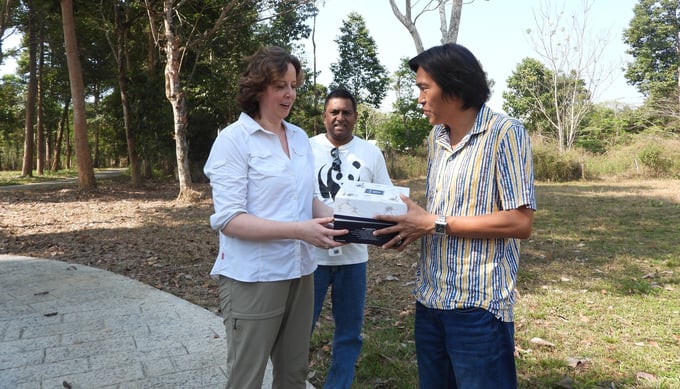
Ms. Kirsten Shuijt highly valued the biodiversity of Cat Tien National Park. Photo: Tran Trung.
According to Mr. Van Ngoc Thinh, Director of WWF-Vietnam, Cat Tien National Park is one of the national parks with high biodiversity. Tourists coming to Vietnam are tempted to visit Cat Tien National Park at least once to see wildlife populations with their own eyes. Since the early 2000s, WWF has cooperated with Cat Tien National Park to protect the rhino population and has supported ethnic minority communities around the buffer zone as well as in the core area to protect the forests and their biodiversity along with the functional sector.
“We are continuing to support Cat Tien National Park in many areas. Forest rangers and scientific research teams can receive capacity training in conservation works to monitor the impact on biodiversity within Cat Tien National Park. WWF-Vietnam also supports indigenous communities to develop eco-tourism, help people improve income while minimizing the impact on the forest,” said Mr. Van Ngoc Thinh, Director of WWF-Vietnam.

WWF supports indigenous communities to build longhouses and do eco-tourism, helping people increase their income and reduce impacts on the forest. Photo: Tran Trung.
WWF-Vietnam is working with the United States Agency for International Development (USAID) and the Ministry of Agriculture and Rural Development (MARD) on a huge biodiversity project, with Cat Tien National Park being one of the priority national parks. WWF-Vietnam will continue to improve the capacity of the forest protection team, the rangers by applying new advanced technology 5.0 to manage and monitor the forest’s biodiversity. In particular, the application includes image trap systems for monitoring by satellite and an infrared imaging system in the near future.
WWF-Vietnam provides assistance in other activities, such as calling for additional financial sources for forest rangers and the forest management team, advising on financial solutions for participating businesses on how to secure sustainable livelihoods for indigenous communities. “That is one of the long-term directions so that Cat Tien National Park can ensure the budget as well as the ability and capacity to well protect this biodiversity for Vietnam in the present and future,” said Mr. Van Ngoc Thinh.
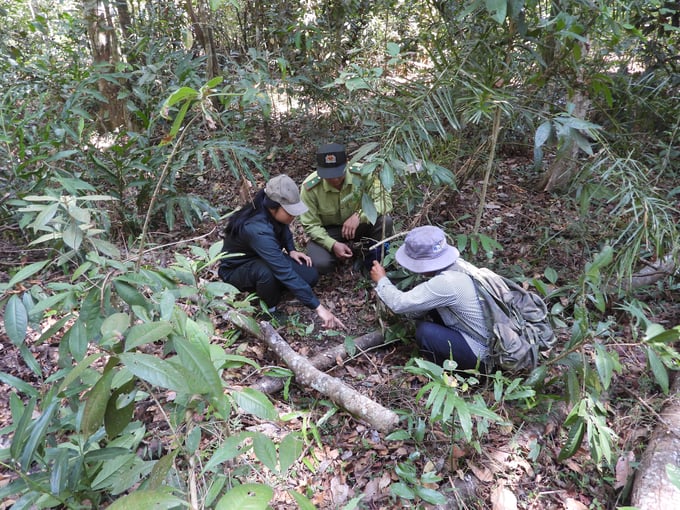
The forest protection force of Cat Tien National Park patrolled, detected and handled wild animal traps. Photo: Tran Trung.
According to Mr. Pham Xuan Thinh, Director of Cat Tien National Park, apart from the cooperation with WWF, Cat Tien is currently working with other conservation projects, including the biodiversity conservation component and the Sustainable Forest Management and Biodiversity Conservation in Vietnam (VFBC) funded by the United States Agency for International Development (USAID) to implement synchronous activities, from livelihood development, capacity building on biodiversity management and monitoring to increase community participation in field conservation work and raising awareness about biodiversity conservation and reducing wildlife consumption demand.
“To ensure the long-term effectiveness of conservation activities, it is important to create a sustainable livelihood for the communities living around the national park. In addition to ecotourism activities, Cat Tien National Park is currently studying and guiding people to replicate the mushroom growing model with the support of WWF-Vietnam and the Management Board for Forestry Projects, the Ministry of Agriculture and Rural Development through the Biodiversity Conservation Component”, said Mr. Pham Xuan Thinh, Director of Cat Tien National Park.
Translated by Samuel Pham

(VAN) Green transition is crucial for the Mekong Delta amid climate change and stricter standards, offering a path toward sustainability.

(VAN) Dong Thap promotes agricultural restructuring, forms large specialized farming zones, raises the value of agricultural products and develops toward ecological and high-tech directions.
/2025/11/22/4018-4-213342_747.jpg)
(VAN) The Mekong Delta Agricultural Experts Club has attracted 143 experts and researchers to participate in providing consultancy and contributing initiatives to the development of one million hectares of high-quality rice.

(VAN) Ca Mau’s development of OCOP products opens a path to increasing cooperatives value, helping boost income, expand markets, and affirm collective economy's role.

(VAN) Turning seemingly ordinary coconut shells into unique jewelry and artwork, Nguyen Bang Nhi spreads the value of local culture through her brand, Cocohand.

(VAN) Results from the Sustainable Durian Model Project in Dak Lak have confirmed the critical role of Yara Viet Nam in transferring advanced nutritional solutions to farmers.

(VAN) In Tuyen Quang province, livestock farmers have introduced effective models and innovative practices that significantly strengthen African Swine Fever prevention and control efforts.
