December 18, 2025 | 02:36 GMT +7
Hotline: 0913.378.918

December 18, 2025 | 02:36 GMT +7
Hotline: 0913.378.918
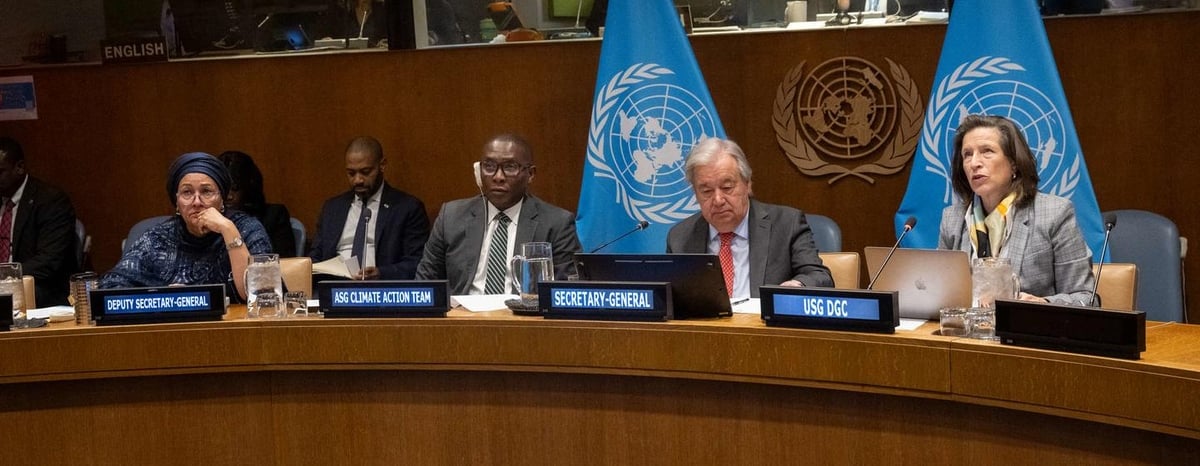
World leaders rally for ‘full-speed’ climate action ahead of COP30. Photo: UN.
The goal was to accelerate global climate ambition ahead of COP30, which will be hosted in Brazil.
The meeting was part of a joint mobilisation strategy by the two leaders to strengthen global action under the Paris Agreement and build momentum for stronger national climate plans to be announced in 2025.
The two-hour session, held behind closed doors, included representatives from China, the European Union, the African Union, the Association of Southeast Asian Nations, and the Small Island Developing States.
Mr. Guterres described it as one of the most diverse meetings of national leaders focused exclusively on climate for some time, carrying a powerful unifying message.
“As we heard today, the world is moving forward. Full-speed ahead. No group or government can stop the clean energy revolution”, he declared at a press briefing afterwards.
He said many leaders pledged to deliver ambitious new climate plans, formally known as National Determined Contributions (NDCs), as soon as possible in what he called a “strong message of hope”.
Guterres announced that President Xi Jinping confirmed during the meeting that China’s updated NDCs would cover all economic sectors and all greenhouse gases — a clarification he described as “extremely important” for climate action.
He added that these pledges provide a vital opportunity to chart a bold path for the next decade and most importantly, help speed up a just transition away from fossil fuels to renewables.
Renewable energy production is “the economic opportunity of the century,” he said, describing it as the “pathway out of climate hell.”
“The clean energy sector is booming – creating jobs and boosting competitiveness and growth worldwide…Science is on our side and economics have shifted.”
The UN chief noted that prices for renewables have fallen dramatically, offering “the surest route to energy sovereignty and security, ending dependence on volatile and expensive fossil fuel imports.”
Since the 2015 Paris Agreement, global projections for warming have declined, from over 4°C this century to 2.6°C if current plans are implemented.
But that still falls short of limiting temperature rise to 1.5°C above pre-industrial levels – the goal agreed in Paris by nations and endorsed by climate scientists.
The Secretary-General urged leaders to submit national plans that align with that target, cover all greenhouse gases and sectors, and signal a full commitment to achieving net zero emissions by 2050.
According to a senior UN official who spoke on condition of anonymity to discuss background prior to the meeting, Wednesday’s summit was “just another step” in the important effort to sustain political momentum during a pivotal year for combating climate change.
The group of invitees, the official said, was “small but representative,” including major economies, regional powers, former COP hosts, and climate-vulnerable nations.
“This is a really important year,” the official said, pointing to the 10th anniversary of the Paris Agreement and the upcoming deadline for countries to submit new climate plans.
“This meeting is about reminding leaders that climate remains a key priority – that collaboration and multilateralism still matter.”
A senior Brazilian official who also took part in the background briefing said the UN climate summit in Belém will move beyond negotiations to focus on implementation, transparency, and delivery. “We have already negotiated enough…now the world wants to see action – results, examples, solutions.”
The official also stressed that demonstrating tangible outcomes is essential for restoring trust in multilateralism.
“We want to prove that multilateralism is not only about negotiating documents,” they said, “but about making them real.”
Mr. Guterres underscored the need to direct far more support to developing countries, which face the most severe impacts of climate change despite contributing the least to global emissions.
“Africa and other parts of the developing world are experiencing faster warming – and the Pacific islands are seeing faster sea-level rise – even while the global average itself is accelerating,” he said.
He called on countries to deliver a credible roadmap to mobilise $1.3 trillion per year for developing nations by 2035, double adaptation finance to $40 billion this year, and increase contributions to the new Loss and Damage Fund created at COP28.
The Secretary-General also announced a high-level UN event in September – just weeks ahead of COP30 – to assess progress on climate plans and finance.
The message was clear, according to Mr. Guterres. “We cannot, must not, and will not let up on climate action.”
/2025/12/16/3554-1-192458_116.jpg)
(VAN) Minister Tran Duc Thang held a working session with the Viet Nam Seaculture Association to discuss solutions for developing marine farming in a methodical, industrial, sustainable, and well-organized manner.

(VAN) Trading forest carbon credits is to reduce greenhouse gas emissions while creating sustainable livelihoods for local communities.

(VAN) Expanding the area of forests with FSC certification creates a foundation for elevating the economic value of forests, promoting sustainable management, and offering opportunities to participate in the carbon credit market.

(VAN) MAE and GIZ organized the conference to strengthening capacity and readiness for EUDR implementation in Vietnam.

(VAN) When women, men, children, and people with disabilities all have the opportunity to maximize their potential, the economy will grow, and the country will prosper.

(VAN) Effective disaster prevention and the creation of sustainable livelihoods through practical forestry policies are the distinct and crucial values of special-use and protection forests.

(VAN) The policy movement regarding carbon emission reduction is opening up a new approach, linking national goals with practical agricultural production.
