January 3, 2026 | 03:53 GMT +7
Hotline: 0913.378.918

January 3, 2026 | 03:53 GMT +7
Hotline: 0913.378.918
Vu Quang National Park is identified as an ecological region of global priority, playing an extremely important role in preserving biodiversity for the entire central Truong Son region of Vietnam. In addition to performing the main function and task of preserving the forest ecosystem, this national park also effectively implements rescue and preservation for rare wild animals, which is highly appreciated by the ministries under Central as well as international organizations.
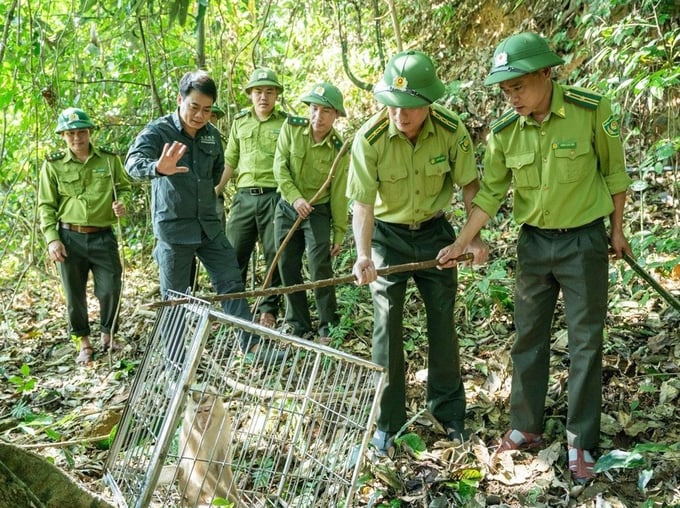
Vu Quang National Park has received many wild animals that people voluntarily submitted, then nurtured and took care of them before releasing them into their natural habitat. Photo: Vu Quang National Park.
According to statistics in the last four years (2020 - 2023), Vu Quang National Park has received and taken care of 657 wild animals, released 645 individuals of 20 different species into the forest. Among them, there are nearly 100 individuals that are endangered and rare animals listed in the Red Book of Vietnam and the world, such as pig-tailed macaque; stump-tailed macaque (red-faced macaque in Vietnamese); Assam macaque; northern white-cheeked gibbon; masked palm civets, Asian palm civets, Vietnamese box turtle, impressed tortoise and many more. All of them have been brought to the national park for monitoring before being released into the wild environment.
“Individuals that were once caged usually experience changes in habit and potentially cause damage to humans. Due to not being in their natural habitat, the animals are stressed, become aggressive or depressed. They are ready to attack anyone, including their owners. It is notable that wildlife is also a potential source of disease for humans due to contact with them. Many diseases from wild animals have become pandemics, typically Covid - 19. Therefore, we need to join hands to protect and bring wild animals back to where they are born and grow healthily. The common goal is to maintain the richness and diversity of biological species in the natural environment,” said the leader of Vu Quang National Park.
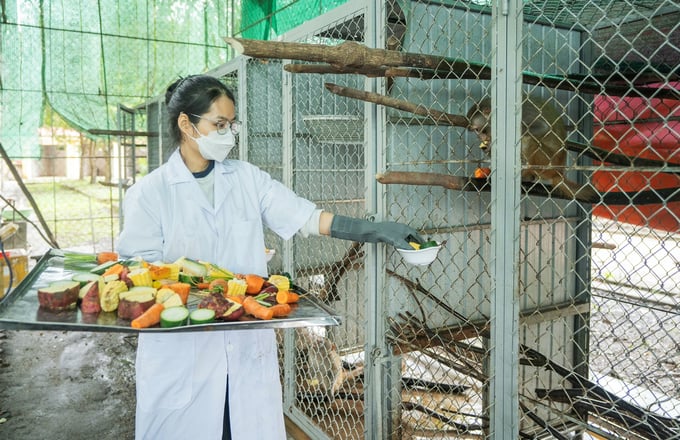
The professional staff of Vu Quang National Park takes care of wildlife individuals. Photo: Vu Quang National Park.
Doing a great job of rescue and conservation, Vu Quang National Park also coordinates closely with authorities in classifying and preserving wildlife exhibits, helping local forces promptly deal with Illegal wildlife traders and transporters. In recent years, Vu Quang National Park has become a reliable address for organizations and national parks to send wildlife individuals suitable for the ecological region, serving species conservation purposes.
Some mentionable examples include the collaboration with the Hoang Lien Center for Rescue and Conservative Organism (Hoang Lien National Park - Lao Cai) to survey and release 12 primates into the Vu Quang National Park area, transfer the rare black-faced spoonbill (Platalea minor) to Xuan Thuy National Park (Nam Dinh) for reintroduction into the distribution area; transfer the lesser adjutant (Leptoptilos javanicus) to Cat Tien National Park (Lam Dong), and transfer the northern white-cheeked gibbon (Nomascus leucogenys) to Cuc Phuong National Park (Ninh Binh).
Along with many rescue solutions from professional units and local authorities, in recent times, through disseminating information about forest protection laws, Vu Quang National Park has integrated activities to raise awareness of communities in the buffer zone, pupils, and students in terms of preserving endangered and rare wildlife.
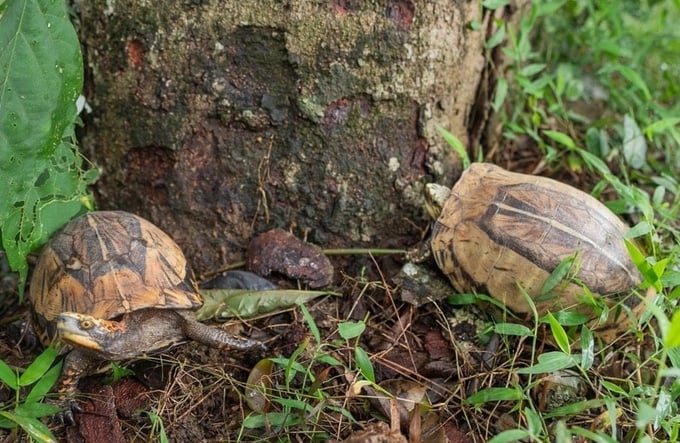
Endangered and rare wildlife individuals are strictly protected at Vu Quang National Park. Photo: Vu Quang National Park.
Most recently, Tran Duc Ha (Xuan Giang commune, Nghi Xuan district) discovered 3 rare rhesus monkeys in his garden, then captured them and took care of them and raised them at home. Realizing that rhesus monkeys are wildlife that need to be preserved, Ha proactively contacted the Nghi Xuan District Forest Ranger to hand them over to the authorities so that they can be released into the natural environment.
“In recent years, voluntary surrender of wild animals from organizations and people in Nghi Xuan district has become increasingly popular. After completing the procedures, we handed them over to Vu Quang National Park. After being brought to Vu Quang National Park, wildlife individuals are cared for and trained in wild behavior before being released back into the forest to help them survive and develop in top conditions," said the head of Nghi Xuan District Forest Ranger.
Translated by Samuel Pham

(VAN) Located in three former provinces, Nam Dinh, Thai Binh, and Ninh Binh, and now in two provinces, Ninh Binh and Hung Yen, "Red River Delta" is the name of Vietnam's first interprovincial coastal wetland World Biosphere Reserve.
/2025/12/29/1046-1-210728_624.jpg)
(VAN) In 2025, Viet Nam recorded severe and extreme disasters, breaking multiple historical records and causing heavy losses in lives, property, and infrastructure nationwide.

(VAN) Applied technologies, water-saving irrigation is a strategic solution to promote climate-resilient agriculture and strengthen water security in the uplands.
/2025/12/29/3936-3-163422_251.jpg)
(VAN) Can Gio mangrove forest in particular and the entire Can Gio Mangrove Biosphere Reserve in general hold great potential for carbon credits.

(VAN) Chu Pah Rubber has announced its products that comply with the EU Deforestation Regulation (EUDR), affirming its commitment to sustainable production and product origin transparency.

(VAN) Deputy Director Nguyen Hoai Nam stated that a digital data platform will be developed with agricultural sector databases, utilizing AI to help farmers make informed decisions on 'watering correctly, sufficiently, and efficiently.’
/2025/12/29/4841-2-134224_777.jpg)
(VAN) From only about 10 individuals in 2009, the wild elephant population in Dong Nai has recovered to nearly 30 animals after more than 10 years.
