December 7, 2025 | 23:49 GMT +7
Hotline: 0913.378.918

December 7, 2025 | 23:49 GMT +7
Hotline: 0913.378.918
On February 13, at Ba Vi National Park (Hanoi), the CITES Management Authority of Vietnam, Ba Vi National Park and the World Wild Fund for Nature in Vietnam (WWF-Vietnam) organized the launching ceremony of “the 2025 Tree Planting Festival in eternal gratitude to Uncle Ho” and the communication campaign to prevent illegal ivory trafficking in Vietnam.
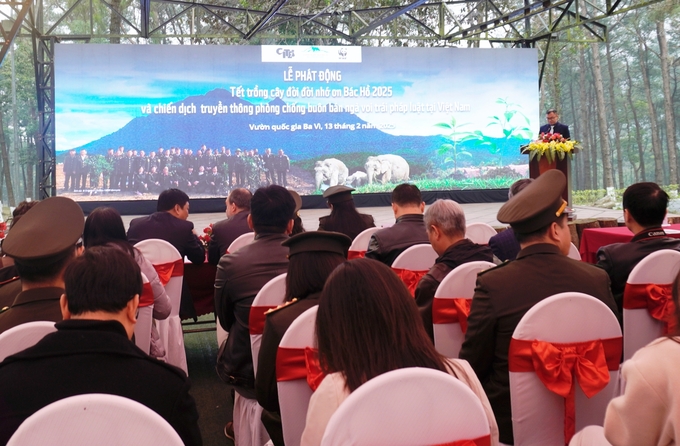
Overview of the launching ceremony of the “2025 Tree Planting Festival in eternal gratitude to Uncle Ho” and the communication campaign to prevent illegal ivory trafficking in Vietnam. Photo: Hong Tham.
“Vietnam is one of the countries active in investigating, prosecuting and trying criminals who violate the law on wildlife protection specifically those related to rare and precious species such as elephants, tigers, rhinos, pangolins, and many more,” said Chu Ngoc Quan, Deputy Director of the CITES Management Authority of Vietnam.
Authorities have seized dozens of tons of ivory illegally imported into Vietnam in 2023 and 2024. These shipments were transited through many countries before being exposed. Since the amendment of the Penal Code in 2017, many illegal ivory traders have been prosecuted and tried, some of whom have been sentenced to up to 12 years in prison, thus demonstrating strict enforcement of CITES and the law.
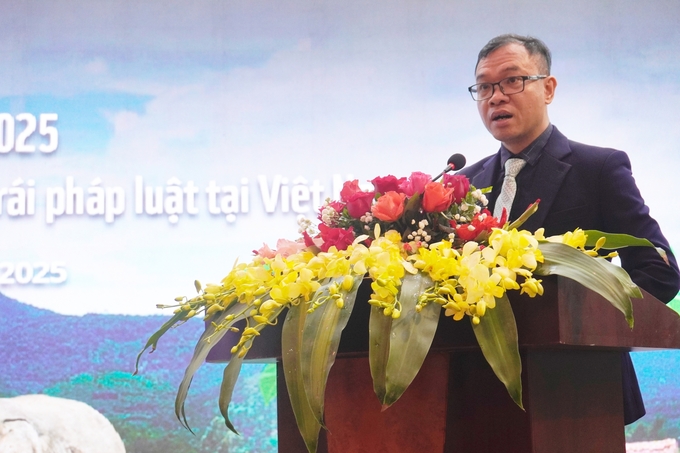
According to Chu Ngoc Quan, Deputy Director of the CITES Management Authority of Vietnam, international wildlife trade has shown further complications after Covid-19. Photo: Hong Tham.
Despite many achievements, Vietnam continues to face many challenges due to its geographical location and the large Asian wildlife market, hence the vibrant ivory trading activities. After Covid-19, the situation of international wildlife trade has become more complicated. The increasing number of tourists to Vietnam also requires the authorities to make multi-sectoral efforts in terms of implementing demand reduction activities, raising people's awareness, and strengthening the capacity of functional forces.

In early 2023 and 2024, authorities detected four consecutive cases of violation with a total of more than 8 tons of ivory confiscated. Photo: Hong Tham.
Thibault Ledecq, Conservation Director of WWF-Vietnam, mentioned that there has been no sign of a decrease in the number of cases of illegal ivory transportation into Vietnam. According to the Elephant Trade Information System (ETIS), the total volume of ivory discovered and confiscated since 2008 is over 70 tons and Vietnam has the largest amount of ivory seized among countries in Southeast Asia.
“The campaign to combat illegal ivory trade in Vietnam not only aims to raise awareness of the harmful effects of such activities but also to call on people for joint efforts to protect wildlife. We will organize communication activities, workshops and community events to provide knowledge, warn about the consequences of using ivory, as well as encourage the community’s action toward elephant protection,” said the Conservation Director of WWF-Vietnam.
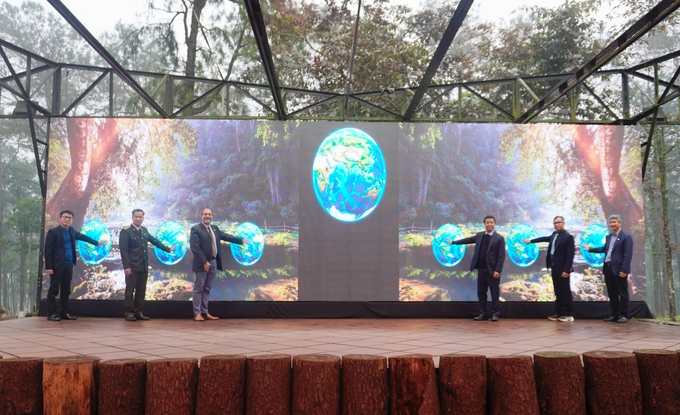
Representatives signaled the start of the media campaign to prevent the illegal ivory trade in Vietnam. Photo: Hong Tham.
Vietnam is considered a vital focal point in the illegal ivory supply chain in the world. Nguyen Le Phuc, Deputy Director of Vietnam National Administration of Tourism, said, “We need more decisive solutions to reduce the cases of illegal ivory trade. Raising awareness of tourists and the tourism community is a practical and effective measure.
“Considering the close coordination between the CITES Management Authority of Vietnam, Ba Vi National Park and WWF, this project will focus on communication, education and awareness-raising activities through media, workshops and community events. We believe that by understanding the serious consequences of ivory consumption, tourists will be more conscious in choosing legal products, contributing to the protection of wildlife and natural ecosystems”.
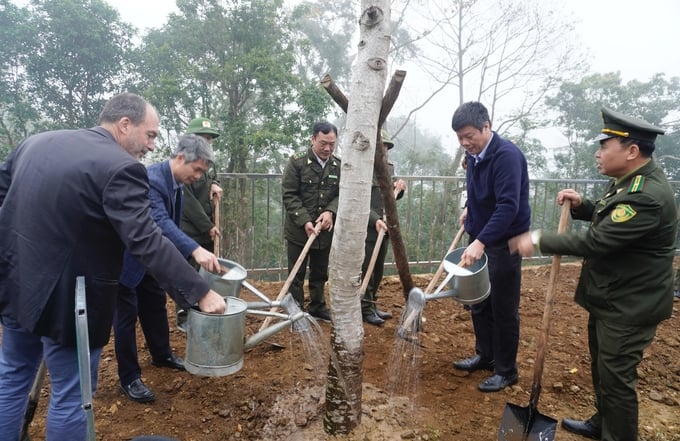
Leaders and guests at the event planted trees together in answer to the “Tet Tree Planting Program to Forever Remember Uncle Ho” in the spring of 2025. Photo: Hong Tham.
According to Do Huu The, Director of Ba Vi National Park, the park has prepared nearly 500 trees of various types, including precious species and native trees with landscape value such as incense-cedar (Calocedrus macrolepis), spiny-leaf podocarp (Podocarpaceae), Sterculia Lanceolata, and Bauhinia variegata.
The trees are planted along both sides of the road corridor from the Coste 400 Garden Gate which has just received construction investment and upgraded. The goal is to supplement and enrich the 2,181 existing plant species while also contributing to adding more green to the more than 9,700 ha of special-use forests managed by Ba Vi National Park.
Translated by Samuel Pham

(VAN) At the TARASA25 Conference, participating countries shared experiences on implementing agroecology and regenerative agriculture, contributing to a sustainable transformation of food and agriculture systems.

(VAN) Green industry is becoming a driving force for the development of Hue City, not only promoting economic growth but also protecting the environment, creating the foundation for the Net Zero goal.

(VAN) As of 2025, the ASEAN region has a total of 69 ASEAN Heritage Parks recognized across its 10 member states. Among them, Viet Nam contributes 15 ASEAN Heritage Parks.

(VAN) Yok Don National Park has high biodiversity with numerous endemic plant and animal species, and it is also the only dipterocarp forest ecosystem conservation area in Viet Nam.

(VAN) Viet Nam and Brunei signed two important MOUs on fisheries and IUU, expanding cooperation in agriculture, the environment, and Halal exports, aiming to substantively implement joint projects.

(VAN) The Viet Nam Coconut Association worked with the International Finance Corporation (IFC) and businesses to promote the supply chain, enhance competitiveness, and develop the coconut industry sustainably.
![Hue aims for Net Zero: [2] Pioneering low-emission tourism](https://t.ex-cdn.com/nongnghiepmoitruong.vn/608w/files/huytd/2025/12/04/0633-dulichzero-4-095634_236-161125.jpg)
(VAN) The ancient capital of Hue has developed Net Zero tourism products and models, aiming to reduce carbon emissions and pioneer the establishment of Viet Nam's green tourism destination.
