December 10, 2025 | 21:17 GMT +7
Hotline: 0913.378.918

December 10, 2025 | 21:17 GMT +7
Hotline: 0913.378.918
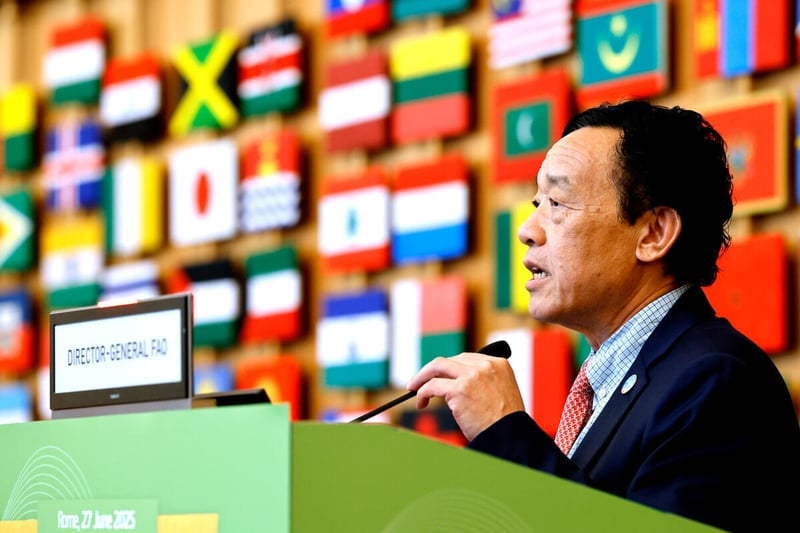
QU Dongyu, Director-General of FAO, speaks to participants during the ministerial conference between the African Union and European Union.
The Director-General of the Food and Agriculture Organization of the United Nations, QU Dongyu, today emphasized the urgent need for collaboration in addressing the interconnected and pressing challenges facing African nations, in his opening remarks at the 6th African Union (AU)-European Union (EU) Agriculture Ministerial Conference held at FAO headquarters in Rome. The event took place on the eve of the 44th Session of the FAO Conference (28 June – 4 July).
Qu underscored that the AU–EU partnership is essential for creating solutions that effectively respond to today’s critical issues. “No single country, region or continent can tackle the current challenges of food security, natural disasters and rural development alone,” he stated, reinforcing the importance of collective action and shared responsibility.
The Director-General highlighted how FAO's Strategic Framework 2022–31, structured around the Four Betters – better production, better nutrition, a better environment, and a better life – complements the AU Agenda 2063 and the EU Green Deal, calling for a unified approach to transform agrifood systems across the African continent.
He also noticed that FAO’s strategy for Africa prioritizes five accelerators: (1) strengthening institutions and governance; (2) boosting productivity and value addition; (3) enhancing resilience to climate and shocks; (4) empowering youth and women; (5) enabling investment and digital innovation.
FAO as an implementing partner
The Director-General expressed FAO’s commitment to acting as a bridge and partner in this collective effort, emphasizing that “the transformation of agrifood systems in Africa is a strategic imperative and the pathway to food security, economic opportunity, social stability, and climate resilience.”
FAO is actively fostering new partnerships with financial institutions to enhance support for African countries. Collaborations with the European Investment Bank, for instance, have led to significant initiatives, such as unlocking a USD 20 million credit line for smallholder lending in Ethiopia, enabling farmers to access critical financing for their agricultural activities.
FAO is also supporting the TERRA Programme, co-designed with Italy’s CDP Development Bank, to channel USD 110 million to agrifood small and medium-sized enterprises (SMEs) in Africa.
On the public investment side, FAO’s Investment Centre supported the design of 18 new projects in Africa in 2024, totaling USD 3 billion in collaboration with the World Bank, the International Fund for Agricultural Development (IFAD), the African Development Bank (AfDB) and the Green Climate Fund.
Concrete results in Africa
The Director-General shared some examples of impactful initiatives by FAO and partners in Africa, including:
The Director-General concluded by emphasizing the need for all stakeholders to act swiftly and collaboratively: “The future of Africa’s agrifood systems is not only Africa’s business – it is central to global resilience, equity, and sustainability.”
He called for a unified approach to accelerate progress and urged all parties to work together towards a prosperous and sustainable future for the African continent and beyond.
(FAO)

(VAN) Initiative launched in Cairo honors villages that are helping drive agrifood systems transformation.

(VAN) The European Union agreed Wednesday to phase out Russian natural gas imports by late 2027 as part of an effort to end the bloc’s decade-long dependency on Russian energy.

(VAN) Indonesia plans a US$1.2 billion investment in feed mills to boost poultry feed production.

(VAN) Japan's average retail rice price hit a new record high for the first time in three weeks, according to agriculture ministry data.

(VAN) The use of antibiotics in treating livestock in the UK has fallen, according to a new report released by the government’s Veterinary Medicines Directorate.

(VAN) Newly designated initiatives in Australia, Canada and South Africa represent science-based and inclusive examples of ecosystem restoration.

(VAN) Rice-based food has been selected as Japan's 'Dish of the Year' for 2025, reflecting public interest in the stable supply of the country's staple food amid a recent rice shortage.
