December 1, 2025 | 13:37 GMT +7
Hotline: 0913.378.918

December 1, 2025 | 13:37 GMT +7
Hotline: 0913.378.918
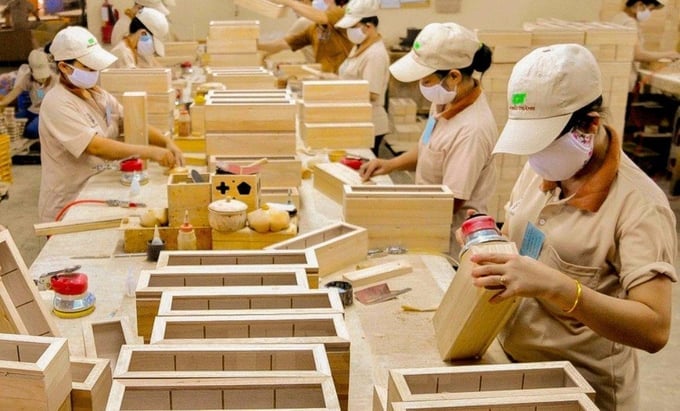
Vietnamese wooden cabinet products will be investigated by the DOC starting in 2022.
The US Department of Commerce (DOC) has just issued the final conclusion of the investigation into product scope and anti-circumvention of wooden cabinets imported from Vietnam.
Regarding product scope investigation, the US has maintained that the preliminary conclusion had been adjusted in September 2023. Accordingly, the three cases of wooden cabinets imported from Vietnam, which have suspected components made in China, fell within the scope of the original tax order with China.
First, the product has door components, drawer tops and wooden frames made in China, then assembled in Vietnam and combined with cabinet boards and drawer boxes made in Vietnam.
Second, the product with doors, drawers and wooden frames is a semi-finished product manufactured in China, then further processed in Vietnam and combined with cabinet boards and drawer boxes produced in Vietnam.
Third, the product has semi-finished details of doors, drawers and wooden frames (including straps, pillars, boards) made in China, then continued to be processed in Vietnam and combined with Cabinet boxes and drawer boxes are made in Vietnam.
The DOC will send a notice to the US Customs and Border Protection (CBP) to instruct the application of the Certificate Regime to Vietnamese wooden cabinets. The mechanism will therefore allow local firms that do not fall into the above three cases to be exempted from anti-dumping or countervailing duties when exporting items to the US market.
Before exporting, Vietnamese businesses need to complete a self-certification declaration form for exporters and provide supporting documents (invoices, orders, production records, etc.) for US importers.
The importer must complete the importer self-certification form before the shipment date. In addition, businesses need to retain records and documents as a basis to prove that confirmation within 5 years from the time the shipment is exported. From there, competent US agencies carry out verification and verification if necessary.
In the latest announcement, DOC has also canceled the entire investigation into anti-dumping and anti-subsidy tax evasion on wooden cabinets imported from Vietnam.
To best protect the rights and interests of Vietnamese export enterprises, the Trade Remedies Department (Ministry of Industry and Trade) recommends that relevant associations and businesses learn and fully comply with regulations on self-defense mechanisms. confirmed by the United States.
Along with that, continue to monitor the Department's early warning information to develop appropriate business and export plans. If a problem arises, businesses need to notify it early to receive timely support.
DOC has initiated product scope review and anti-circumvention investigations respectively since May and June 2022. Previously, from April 2020 until now, the United States has imposed anti-dumping and anti-subsidy taxes on wooden cabinets originating from China, with the highest tax rate up to nearly 300%.
At a meeting with Senator Tammy Duckworth, Deputy Minister of Industry and Trade Nguyen Hoang Long expressed concerns regarding restrictions on access to the US market and the increasing frequency of trade defense cases against Vietnam's exported agricultural products.
The Deputy Minister also asked the US side to make assessments that are objective, fair and consistent with production practices in the process of recognition of market economy status for Vietnam.
Translated by Phuong Linh

(VAN) The inevitable path forward is to reorganize production along the value chain, utilizing cooperatives as the core, enterprises as the driving force, and farmers as the central subjects.

(VAN) On November 28, Minister Tran Duc Thang, together with China's Minister of Agriculture and Rural Affairs Han Jun, chaired the 2nd meeting of the Viet Nam - China Agricultural Cooperation Committee.

(VAN) Forest carbon credits are only accepted when they ensure absolute environmental integrity, additionality, permanence, and transparency.

(VAN) Viet Nam partners with Beijing on controlling air pollution, cross-regional management, high-tech monitoring and relocating polluting facilities.

(VAN) With a USD 50 million investment, Australia is partnering with Viet Nam to operate its first public electric bus fleet and develop a nationwide EV charging network.

(VAN) On November 28, in Beijing, Minister Tran Duc Thang met Minister of Ecology and Environment of China Huang Runqiu, to share experience on environmental protection.
/2025/11/28/0950-2-120557_751.jpg)
(VAN) The recent flood spell in the South Central region clearly reflects the characteristics of natural disasters in 2025, which are compound, prolonged, and amplified.
