June 5, 2026 | 07:21 GMT +7
Hotline: 0913.378.918

June 5, 2026 | 07:21 GMT +7
Hotline: 0913.378.918
Starting off as a veterinarian, Mr. Nguyen Sy Dieu, a native of Minh Tan commune, Kien Thuy district, has had “some tricks up his sleeve” after working for livestock companies and traveling through many places. He has currently achieved initial success with the raising model of 5,000 pairs of pigeons, swimmingly earning hundreds of millions of Vietnamese dong each month.
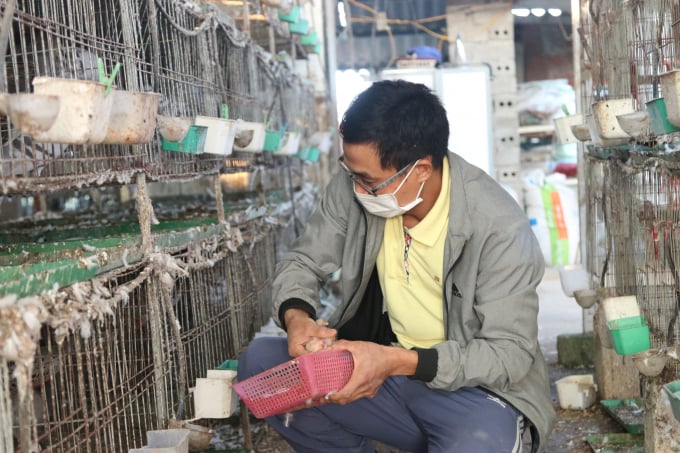
Mr. Nguyen Sy Dieu put the baby pigeons in cages so that each pair of parents can raise 3 to 5 hatchlings. Photo: Dinh Muoi.
Of course, raising pigeons is not new and basically anyone can do it, but Mr. Dieu’s model is different. Each pair of parent pigeons can raise 3 to 5 hatchlings at a time. Breeding efficiency thus increases to 60% instead of 40% as usual while the parents still have their health assured.
In this regard, Mr. Dieu shared, “While working for a livestock company in Bac Giang I gained some insight into the pigeon breeding market. Bac Giang, Bac Ninh, Thai Nguyen, despite being pigeon-breeding powerhouses, mainly serve the Hanoi market, while the market in Hai Phong is still left open. With the acquired veterinary knowledge, I was confident that I can build a pigeon farm of my own and make a fortune.”
Having gone through many “costly lessons”, Mr. Dieu now owns 5,000 pairs of parents pigeons, stably giving birth and regular products every month.
Mr. Dieu believes that the secret to success in raising pigeons besides the market factor is technology. It is a matter of survival, in which animal health must be of top priority. Consideration of hatchling stability and extraction techniques is key.
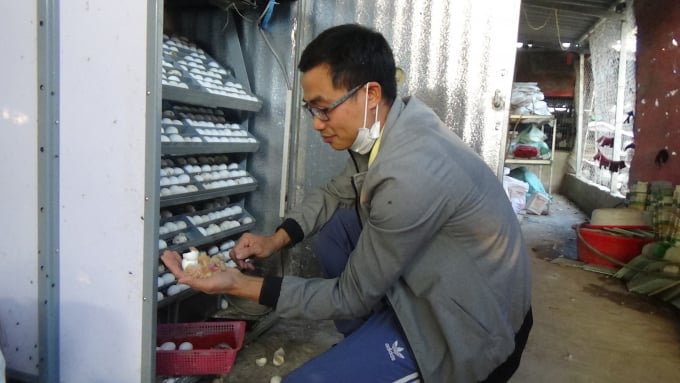
In addition to eggs that hatch naturally, Mr. Dieu uses incubators with the goal to reduce the workload on the parent pigeons. Photo: Dinh Muoi.
“I will separate 1,000 pairs just to collect eggs and use the incubator for support. As for the other 4,000 pairs I will let them incubate naturally. All information is carefully recorded. Later, when the eggs in the incubator hatch, I will put the hatchlings in slots already having two baby pigeons to initiate the procedure of raising three, four, or even five hatchlings. Under normal circumstances, pigeons raising two hatchlings only means 40-50% efficiency, but if this process is well executed the rate will go up to 50-70%," said Mr. Dieu.
Regarding healthcare for the flock, Mr. Dieu said that antibiotics should be kept to a minimum. Periodic vaccination and some traditional caring methods can serve as good alternatives. Farmers can use garlic-soaked wine to let the pigeons drink once a week to keep them healthy and prevent immature eggs. Another option is to use adjuvant drugs to help regenerate their ovaries and genital organs after laying.
Talking about income, Mr. Article revealed that his family's main source of income is the 10-15 days old hatchlings. Those that exceed 20-27 days old will be captured and delivered to restaurant systems, local markets, clean food stores and customers in need.
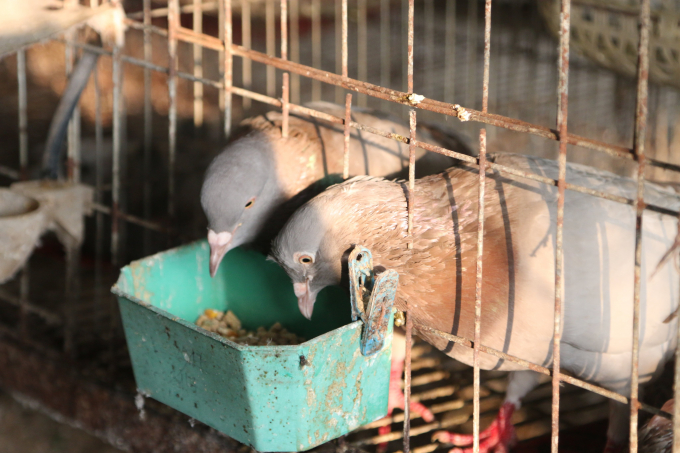
Every year the farm gains VND 1.6 million for each pair of parent pigeons. Photo: Dinh Muoi.
The second source of income comes from pigeon seedlings sold to commercial farming establishments in the form of a closed association - a seed supply-purchase relationship.
Pigeon seedlings of 60 days old can be sold for VND 200,000/pair, all vaccinated. The pairs are carefully filtered for the balance in percentage between males and females. The commercial price of unprocessed pigeons is VND 120,000/pair. Preliminarily processed, prices will vary depending on the market. Pre-processed ones will have their price varied depending on the market.
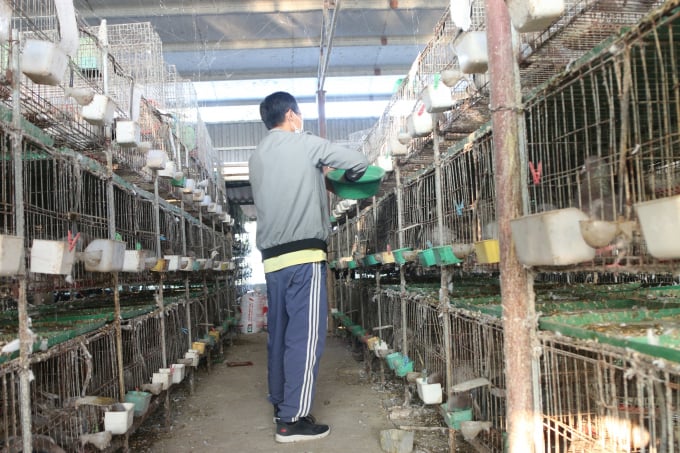
With only a few hundred square meters and an initial investment of nearly VND 3 billion, Mr. Dieu now earns an unimaginably large amount of money every year. Photo: Dinh Muoi.
“I hope to increase the scale to 10,000 - 20,000 pairs. I also want to cooperate with other households and satellite camps to further increase the number to 100,000 pairs, thus meeting the market’s output demand. I develop the model following the form of a cooperative link chain. I will readily supply seeds and materials, buy the local’s products, and share experiences with those who need them," said Mr. Dieu, harboring big ambitions for the future.
Translated by Samuel Pham

(VAN) Due to heatwaves and water shortages, weed outbreaks are surging in the Mekong Delta’s summer-autumn rice crop. Dong Thap is ramping up early-season weed management to cut costs and safeguard yields.

(VAN) At the Vegetable and Fruit Seed Research and Production Farm in Bac Ha, pear, peach, and plum orchards are carefully maintained to conserve valuable genetic resources and support the development of temperate fruit crops.
/2026/06/02/4947-3-223411_779.jpg)
(VAN) Protecting forests not only preserves natural resources but also helps safeguard water sources, living environments, and the foundation for long-term sustainable development.

(VAN) Jackfruit prices remain low despite the recent increase as exports to China struggle. Dong Nai is tightening quality control to restore the market.

(VAN) Mekong Delta farmland is degrading due to chemical abuse. Restoring soil with organic and microbial fertilizers while reducing chemicals is now urgent.
/2026/06/01/1824-2-211343_500.jpg)
(VAN) Quang Ngai province is implementing many measures to protect sargassum resources, contributing to restoring aquatic resources, preserving biodiversity, and creating sustainable livelihoods.

(VAN) Farmers in Phu Thuan Commune, Da Nang preserve healthy soil and maintain chemical-free farming seasons, producing clean sesame and bean export products.
