December 18, 2025 | 22:23 GMT +7
Hotline: 0913.378.918

December 18, 2025 | 22:23 GMT +7
Hotline: 0913.378.918
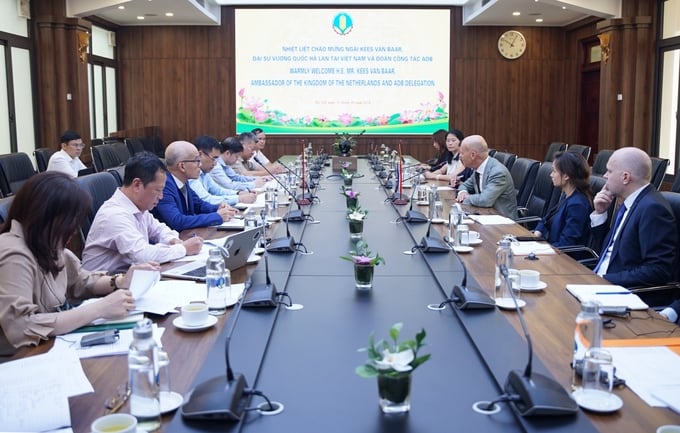
Deputy Minister of Agriculture and Rural Development Nguyen Quoc Tri received and worked with Ambassador of the Kingdom of the Netherlands to Vietnam Kees van Baar on forestry cooperation projects. Photo: Linh Linh.
On October 15, Deputy Minister Nguyen Quoc Tri had discussions with the Ambassador of the Kingdom of the Netherlands to Vietnam Kees van Baar, accompanied by a working group from the Asian Development Bank (ADB).
The Dutch Embassy and ADB have joined forces with MARD to foster bilateral cooperation in forestry between the two nations. This collaboration is particularly noticeable in their initiative to develop a project focused on forest restoration and protection management, aimed at bolstering climate change adaptation in the Mekong Delta region.
The project "Mangrove Restoration for Climate Change Adaptation in the Mekong Delta of Vietnam," is set to take place across five provinces: Tien Giang, Ben Tre, Tra Vinh, Soc Trang, and Bac Lieu, spanning the years 2024 to 2027. Ambassador Kees van Baar stated the Netherlands' dedication to supporting Vietnam in addressing climate change, while also emphasizing the importance of enhancing carbon storage and encouraging private sector involvement in the initiative.
The Ambassador highlighted the Mekong Delta as a crucial component of Vietnam’s economy, being the largest rice production region in the country, while also pointing out its significant risk to climate change. The Dutch Embassy, alongside MARD agencies, is implementing a range of projects that prioritize best practices and climate-focused strategies to bolster the region's resilience.
The project aimed at restoring mangroves to adapt to climate change in Vietnam's Mekong Delta has been developed and has secured initial funding commitments from ADB. The Netherlands anticipates that the collaborative efforts of the tripartite project group, which includes MARD, the Dutch Embassy, and ADB, will work in together to accelerate the approval of the project proposal and commence the initial phases. The Netherlands is dedicated to ensuring the effective completion of the project on its approval.
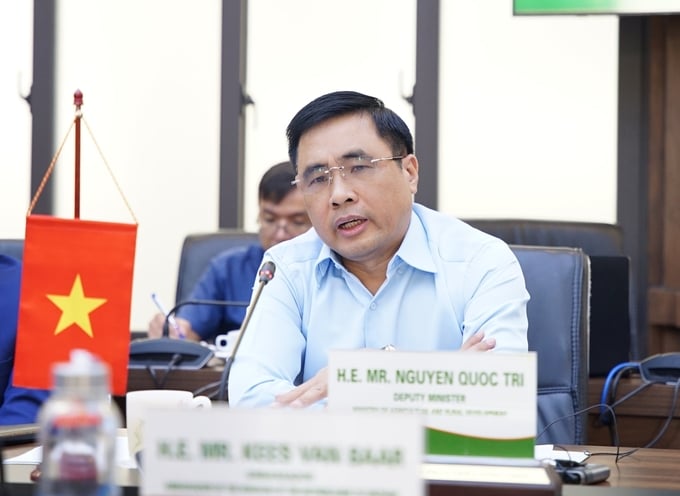
Deputy Minister Nguyen Quoc Tri shared at the working session with the Embassy of the Netherlands and ADB. Photo: Linh Linh.
The Forestry Management Board reports that the forest coverage rates in the five provinces involved in the project are notably low, ranging between approximately 1% and over 4%, which is below the average for the Mekong Delta region as a whole. Furthermore, it is observed that a significant portion of these areas comprises planted forests, making up nearly 60% to over 80% of the total forested land.
Each of the five provinces has established objectives aimed at enhancing forest coverage, aligning with the socio-economic development strategy for 2021-2030 and the forestry development framework for the same period. Additionally, the allocation of land resources for the cultivation and rehabilitation of mangroves is ensured through strategic planning and protective measures for forests, which also seek to enhance the livelihoods of communities in mangrove regions.
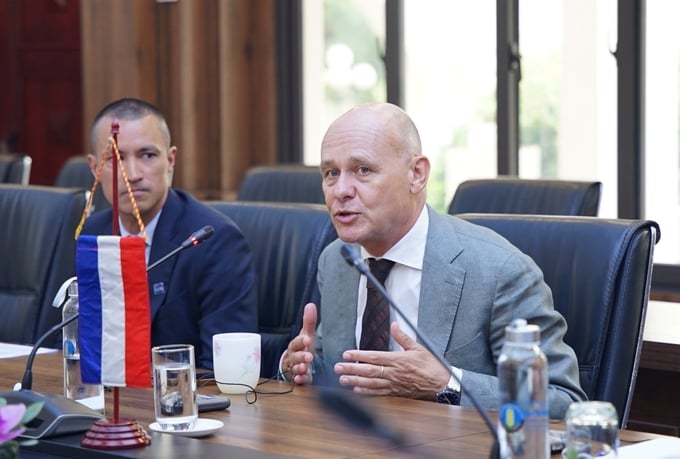
Dutch Ambassador to Vietnam Kees van Baar hopes that the two sides can promote the project proposal “Restoring mangrove forests to adapt to climate change in the Mekong Delta of Vietnam” to be approved soon. Photo: Linh Linh.
Ambassador Kees van Baar expresses optimism that both parties can move forward with the approval of the “Mangrove Restoration for Climate Change Adaptation in the Mekong Delta of Vietnam” initiative.
In response to the MARD’s position, Deputy Minister Nguyen Quoc Tri recognized this as a significant initiative with extensive impacts on coastal forest development. In alignment with the government's principles, mechanisms, and policies, the MARD is backing the project's preparation.
The initiative defines clear aims, including the safeguarding of forests, the improvement of monitoring frameworks in forest management, and the expansion and enhancement of forest areas and quality, in accordance with Vietnam’s objectives.
Deputy Minister Nguyen Quoc Tri provided that MARD will continue in collaborating with local authorities and other ministries to accelerate the project's approval process. In addition to the Mekong Delta, he urged the Dutch Government and ADB to explore the possibility of backing forestry initiatives in other areas, including the Central Highlands and Northwest.
Translated by Dieu Linh
/2025/12/17/0042-2-075234_14.jpg)
(VAN) In Vinh Long, high-quality, low-emission rice models are being scaled up from cooperatives, helping reduce production costs, increase farmers' incomes, and protect the environment.

Professor Nguyen Duc Ngu, the third generation of leaders since the establishment of Vietnam’s Hydrometeorology sector has witnessed and lived through the long arc of its development.

(VAN) Climate change, saline intrusion, and unsustainable farming practices are depleting agricultural land in the Mekong Delta. Restoring soil health is a key solution for the future of agriculture.

(VAN) Agroforestry coffee not only enhances coffee quality but also helps farmers in Quang Tri enter carbon credit market with high expectations.

(VAN) Towards Net Zero 2050, fertilizer manufacturers are proactively developing bio-based products, reducing emissions, and demonstrating responsibility to the environment.

(VAN) The smart rice cultivation model, which reduces methane emissions and aims at developing agricultural carbon credits, has been deployed in Thai Nguyen province and delivered positive results.

(VAN) The purpose of this visit is to unify the proposal for a technical assistance project supporting sustainable agricultural and forestry development in Angola.
