November 23, 2025 | 18:02 GMT +7
Hotline: 0913.378.918

November 23, 2025 | 18:02 GMT +7
Hotline: 0913.378.918
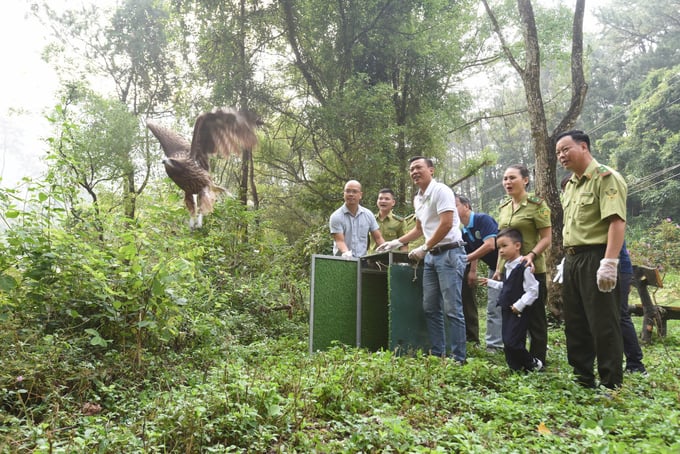
Wildlife release activities are part of the Forestry and Biodiversity regulations, demonstrating the efforts of authorities in protecting wildlife. Photo: Tam Dao National Park.
On November 7, Tam Dao National Park partnered with the Hanoi Wildlife Rescue Center to facilitate the release of several wild bird species within the park's borders. The Hanoi Wildlife Rescue Center received these birds from various groups and people, provided them with treatment, and then released them back into their natural habitat in compliance with legal regulations.
This release included 74 birds from 12 species natural to the region, comprising seven species classified under Group IIB of the Government's list of endangered, precious, and rare forest plants and animals. The species comprise the Chinese Hwamei (Pterorhinus chinensis), Silver-eared Mesia (Leiothrix argentauris), Red-tailed Laughingthrush (Trochalopteron milnei), Scarlet-faced Liocichla (Liocichla ripponi), Black-faced Laughingthrush (Trochalopteron melanostigma), and the Black Kite (Milvus migrans).
This animal release project is part of the laws concerning Forestry and Biodiversity, highlighting the government's commitment to wildlife protection. This also provides Tam Dao National Park with the chance to monitor biodiversity and include environmental education initiatives, especially for primary school kids.
Tam Dao National Park will persist in its collaboration with stakeholders to advance animal protection and conservation initiatives within natural ecosystems, to safeguard Vietnam’s rich forest resources for future generations.
Tam Dao National Park encompasses over 33,000 hectares throughout the provinces of Vinh Phuc, Thai Nguyen, and Tuyen Quang. The region has more than 26,000 hectares of natural evergreen rainforest, constituting 70% of the park's overall size. It furthermore includes many forest types, such as subtropical evergreen forest, dwarf forest on mountain summits, mixed forest, regenerating forest, planted forest, shrublands, and grasslands.
The park hosts around 1,300 plant species in 660 genera and 169 families of vascular plants, in addition to roughly 1,300 animal species. This comprises 93 mammal species, 332 bird species, 136 reptile species, 62 amphibian species, 651 insect species, and 25 fish species.
Translated by Linh Linh

(VAN) Applying green technology in rural water supply and sanitation helps improve resource efficiency, protect the environment, and enhance community living standards.

(VAN) Developing biosecure livestock production is the key that helps Tuyen Quang form linked chains in livestock production and build its brand in the market.

(VAN) During his bilateral activities in South Africa, Prime Minister Pham Minh Chinh welcomed Vice President of the South African Chamber of Commerce and Industry Neil Pollock.

(VAN) Prof. Dr. Hoang Van Cuong, National Assembly Deputy of the 14th and 15th terms, shares recent pioneering policy decisions.

(VAN) Deputy Minister Tran Thanh Nam directed a comprehensive reform of the agricultural extension system, emphasizing professionalism and connecting farmers with the market.
/2025/11/22/3633-1-072521_760.jpg)
(VAN) The signing ceremony took place under the witness of Prime Minister Pham Minh Chinh and President of the Republic of South Africa Cyril Ramaphosa.

(VAN) Severe flooding in Khanh Hoa Province has caused catastrophic damage estimated at around USD 30 million, with the agriculture and irrigation sectors alone accounting for roughly USD 15.7 million in losses.
