July 31, 2025 | 21:22 GMT +7
Hotline: 0913.378.918

July 31, 2025 | 21:22 GMT +7
Hotline: 0913.378.918
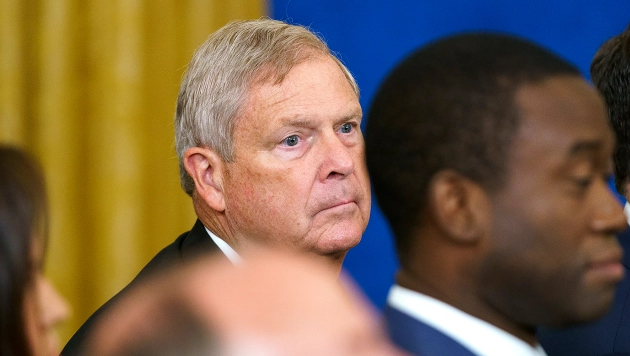
Secretary of Agriculture Tom Vilsack is seen before a ceremony to unveil portraits of former President Obama and first lady Michelle Obama in the East Room of the White House on, Wednesday, September 7, 2022.
That was a question that repeatedly came up during a Senate Agriculture committee hearing Thursday featuring Secretary of Agriculture Tom Vilsack, who was also grilled about topics ranging from rural broadband to bird-flu vaccine mandates.
To the question of ‘big or small’, both Vilsack and Senate agricultural leadership offered an emphatic answer: both.
Noting the rising supply costs and risk of extreme weather faced by farmers, ranking member Sen. John Boozman (R-Ark.) pointed to the size question as a potential pitfall.
“As we address this risk, it’s critical that we not get concerned by small farm versus big farm conflict,” Boozman said.
Pointing to Department of Agriculture (USDA) statistics, he noted that less than 10 percent of farms classified as small contributed 18 percent of crop production — while the 3 percent of “large” farms produce nearly half.
“All farms are valuable,” Boozman added. “This farm bill will not neglect and neglect the small or punish the large.”
Vilsack laid out a grim picture of the state of American farming. While the sector as a whole has had a succession of record years, those profits have been unevenly distributed.
“In record years, 89 percent of our producers either didn’t make any money or did not make the majority of money that they need to represent their families,” Vilsack said.
“This is not a small versus large situation. This is a situation where 90 percent of our farmers need help,” he added.
In his introductory remarks, Boozman noted that 71 percent of counties in his home state of Arkansas had lost population in the last census — as had 53 percent of counties in the U.S.
“All my colleagues on this committee are concerned about the hollowing out of our states in our country, and the impact that this will have on the future of America,” Boozman said.
If the U.S. wants to address that “hollowing out,” it needs to not only support “large commercial-sized operations,” Vilsack said. “We have got to figure out how we can create more revenue streams for farmers, particularly those small and midsize producers.”
That is a goal that conservative Republicans — even as they criticized the Biden administration’s focus on climate and more stringent water production measures — largely backed.
“It is important that we have support to some smaller, farmer owned and operated facilities,” Sen. Joni Ernst (R-Iowa) told the committee.
Ernst criticized the fact that half of the USDA funds intended to set up small meatpacking plants had gone to just three projects owned by very wealthy people.
“One of the projects in Nebraska is owned by a man on the Forbes billionaires list. Another in Idaho is the wealthiest man in the state of Idaho. And a project in South Carolina is being awarded to a privately held family business with production in five states,” Ernst said.
“What I find problematic is that taxpayer dollars are being doled out as free grants to billionaires while applications from farmer owned startups are deemed unworthy,” she added.
Vilsack countered that more money to set up new plants would be going out the door soon.
Sen. Tina Smith (D-Minn.) opened fire from the opposite direction, questioning whether support for small producers would decrease U.S. food security.
“This administration has repeatedly emphasized his desire to help small, inorganic and hobby farmers … and that is a good thing,” she said. “But we simply cannot feed the masses without these large conventional farms. I truly do support the smaller hobby urban things, but we can’t lose focus on we’re here to feed this country.”
It wasn’t an either-or choice, Vilsack said, “and I don’t think anybody should phrase it or or discuss it in the context of either-or. We need both.”
The U.S., Vilsack said, “really needs production. There’s no question about that. And we’re going to continue to have incredibly large, efficient, effective operations.”
“But if you’re also genuinely concerned as I am about the erosion of rural America, you’re going to want to keep people on the farm. Whether it’s 100 acres or 1000 acres appointed, we want to keep people on the farm.”
“So when you ask what is our intent, what is the philosophy? The philosophy is very simple. The safety nets are designed to keep people on the farm and to keep them farming, so they can do what every farmer that I know wants to do — which is to pass it on to the next generation.”
(The Hill)
(VAN) FAO-led publication outlines structure and highlights agenda including new harmonized indicators and capacity building accessible to all.
(VAN) Energy group experts left after draft guidance on global warming plans ‘did not reflect the industry view’.
(VAN) Special Event in New York explores the causes, consequences and solutions to the 2021-2023 food price inflation.

(VAN) Ahead of Cop30, the Guardian will profile each of the top 10 emitters and their plans – good or bad – to tackle emissions.

(VAN) Scientists have detected pesticides in rivers, lakes and oceans worldwide. So what are these pesticides doing to the fish?
(VAN) Farmers’ organisations from across the European Union feel that the EU is undermining farmers throughout the Union and call for reason.
(VAN) Director-General urges bigger and deeper thinking to address youth employment challenge.
