November 23, 2025 | 03:07 GMT +7
Hotline: 0913.378.918

November 23, 2025 | 03:07 GMT +7
Hotline: 0913.378.918
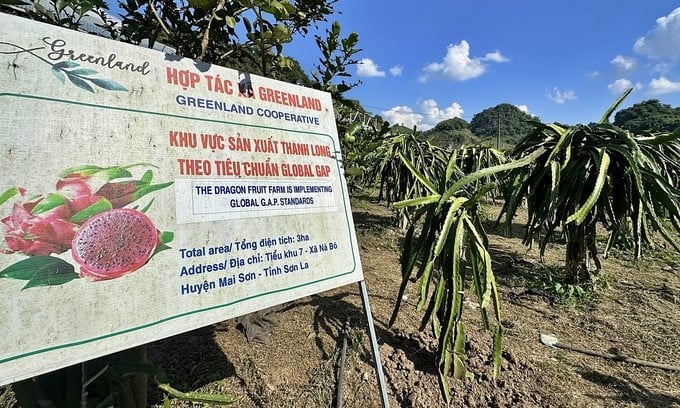
A dragon fruit garden in Mai Son district, Son La province. Photo: Duc Binh.
Mai Son district is now busy preparing for the off-season dragon fruit crop. Ms. Nguyen Thi Dung, Deputy Director of Ngoc Hoang Cooperative in Na Bo commune, said that dragon fruit is influenced by photoperiod, flowering under long-day conditions. The tree grows and develops well in places with adequate light but will become weak when there is a lack of light.
This problem does not occur in the Southern region without a cold winter, such as Binh Thuan, Tien Giang, and Long An. However, in the Northern region, people need to calculate to place pillars in the direction of the rising and setting sun. This will be the deciding factor, affecting productivity and product quality.
"To produce off-season dragon fruit, the most important thing is to observe which direction the sun rises when planting, and from there, adjust dragon fruit planting pillars in the direction of gathering the most light," Ms. Dung shared. She added that with this method, when the dragon fruit tree flowers, especially during the period of cold winter air, the flower buds must fully absorb light to set fruit.
To increase the photosynthesis ability of off-season dragon fruit, Ms. Dung and cooperative members also absolutely avoid trees with wide, high canopies to avoid shading the dragon fruit. Additionally, depending on field conditions, it is impossible to plant additional grass around the root of the dragon fruit, helping to retain humidity and fix protein for the tree.
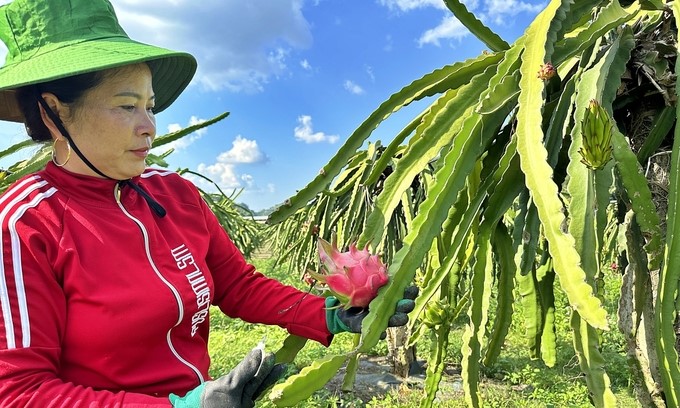
According to Ms. Dung, off-season dragon fruit gives much better income. Photo: Duc Binh.
Dragon fruit trees have taken root in Mai Son soil for decades. Since its inception on sloping land, the tree has shown its suitability for the soil conditions here, such as the ability to withstand unfavorable conditions, especially drought, with rainfall evenly distributed throughout the year. However, because of this, the tree produces a lot of fruit, but most of them are stunted, not ensuring the design and weight.
Thus, the members of Ngoc Hoang Cooperative passed on the experience that each branch should only have 1–2 fruits. Instead of keeping hundreds of dragon fruits per pillar, each pillar only focuses on raising 15–20 fruits so that the tree has enough nutrition, helping the fruit reach the size, color, and weight of type 1 goods and gradually achieve export standards to demanding markets such as the EU, Japan, and South Korea.
Dragon fruit trees need to cling to pillars, so choosing and preparing pillars is extremely necessary. According to the instructions of the Son La Sub-Department of Crop Production and Plant Protection, people should build concrete pillars, about 15x15 cm in size and 2.1–2.3 m long. The current trend is to lower the pillars, meaning that after burying the pillars, the average height is 1.6-1.8 m. Lowering the pillars aims to reduce costs. In addition, high pillars make care more difficult and more labor-intensive. Above the pillar are 4 pieces of iron, 20–30 cm long and bent in 4 directions to serve as the holder for the dragon fruit.
Place 3-4 cuttings around the pillar before using a knife to cut the polybag, and place the cuttings 0–5 cm apart to avoid root rot due to wet soil. When placing cuttings, it is necessary to place the flat part of the cutting against the edge of the pillar so that the cutting can later root and attach quickly to the pillar. After placing the cuttings, farmers should pay attention to tying the cuttings to the pillar so that the wind does not shake them at first because the aerial roots have not yet developed.
For areas lacking water, dragon fruit should be grown at the beginning of the rainy season (around May-June). In lowland areas, the crop can be shifted to October-November. This is the end of the rainy season with quite high humidity, helping plants grow quickly while helping plants avoid the risk of waterlogging.
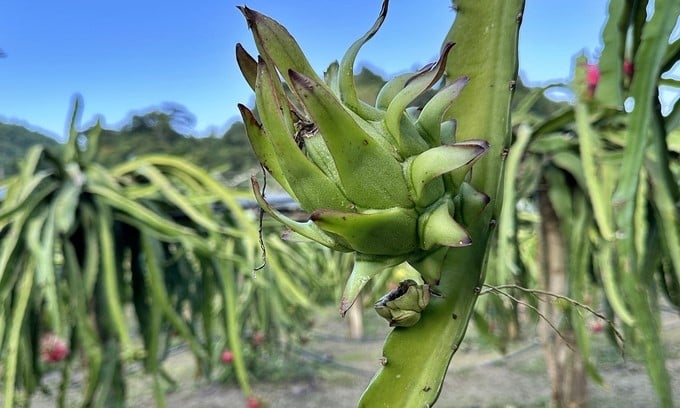
For the best quality, each branch should only have 1-2 dragon fruits. Photo: Duc Binh.
"Our dragon fruit not only stands out for its outstanding sweetness but is also favored by international customers. After tasting the product, most of them chose to order on-site because they were so impressed," Ms. Nguyen Thi Dung expressed. With a selling price at the garden of about VND 16,000/kg, after deducting all expenses, Ms. Dung's 2-hectare garden brings a profit of VND 400-700/year.
Dragon fruit can be grown on many different types of soil, from sandy soil, alluvial soil, and degraded gray soil to alum soil, basalt red soil, and loam soil, but it is best to grow it on loose, ventilated, well-drained soil with a pH of 5–7.
The planting distance is mainly 3x3 m or 3x3.3 m, so the density will be 1,000–1,200 pillars/ha. The tree needs a lot of water in the beginning, so in the upland areas, it is necessary to place the dragon fruit garden in a place with a source of spring or underground water for irrigation in the dry season. Before placing the cuttings, it is compulsory to dig down a distance of about 20–30 cm around the pillar and then fertilize.
It is best to plant 4 cuttings on each pillar, with 1 cutting on each side of the pillar. People can use a variety of fertilizers to help plants grow quickly, but manure only needs to be applied once after pruning (around November). Particularly, manure is the most important fertilizer, especially for soil types lacking organic matter and having poor humidity retention.
Dragon fruit is a good drought-resistant plant, but prolonged drought can easily cause the plant to lose strength and reduce productivity. Symptoms of a tree lacking water are that new branches form few and grow very slowly, or the branches shrivel and turn yellow. The flower drop rate in the first flowering sessions is consistently higher than 80%, and the fruit is small. Therefore, depending on soil humidity, people can water every 3–7 days.
In the second year after planting, start pruning lightly to create an umbrella-shaped canopy. If taken care of well, by the end of the third year, each pillar will have about 100 branches. With such a dense amount of branches, farmers focus on pruning branches, especially old branches or those that have fruited in some crops, to help open the canopy to receive sunlight and concentrate nutrients for new branches.
Harvesting dragon fruit should focus on sunny days. Especially, harvesting tools must be sharp and clean. After being cut, the fruit is stored in a plastic basket in a cool place, preliminarily classified, and transported immediately to the packaging warehouse, avoiding long-term storage in the garden. The best time to harvest is early morning or late afternoon to limit the impact of harsh sunlight, keeping the fruit fresh longer and ensuring preservation quality.
In the storage stage, each dragon fruit must be carefully inspected and wrapped in PE bags with ventilation holes or polystyrene mesh to avoid scratches during transportation. Each packaging box must be completely isolated from chemicals and contaminating materials. The satisfactory net weight of each box is about 5–5.2 kg.
Translated by Thu Huyen

(VAN) Results from the Sustainable Durian Model Project in Dak Lak have confirmed the critical role of Yara Viet Nam in transferring advanced nutritional solutions to farmers.

(VAN) In Tuyen Quang province, livestock farmers have introduced effective models and innovative practices that significantly strengthen African Swine Fever prevention and control efforts.

(VAN) This is the study conducted by IRRI and Can Tho University on the rice straw value chain in Mekong Delta showing an economic potential of more than 6.6 trillion VND/year.

(VAN) By participating in cooperative economics, many farmers in Tay Ninh have overcome hardship, mastered clean dragon fruit cultivation techniques.

(VAN) The crossbreeding program in the former Binh Dinh province (now part of Gia Lai) has shown signs of decline, and urgent measures are needed to revive it and sustain past achievements.

(VAN) The agricultural sector agreed on a roadmap to pilot the MRV protocol and expand low-emission rice production from the 2025-2026 winter-spring crop.

(VAN) Agricultural extension officers in Quang Ninh do more than transmit knowledge; they have become a steadfast support system for farmers on the path to sustainable agricultural development.

/2024/12/10/4611-1-173549_138.jpg)
/2024/12/11/1212-3-065922_924.jpg)
/2024/12/11/3414-1-142502_794.jpg)
/2024/12/13/1948-3-001656_746.jpg)