June 5, 2026 | 07:25 GMT +7
Hotline: 0913.378.918

June 5, 2026 | 07:25 GMT +7
Hotline: 0913.378.918
From a forest cover rate of just over 27% in the late 1980s to a stable 42.02% today, Vietnam’s forestry sector has travelled a long path, one built not only on labor and land, but also on robust scientific and technological foundations. Advances in breeding, silviculture, preservation, and processing have helped the sector move out of a trade-deficit position. By 2024, wood and forest products generated a trade surplus of more than USD 14.4 billion, while the industry became fully self-reliant in technology and raw materials.

Associate Professor Dr. Phi Hong Hai, Deputy Director of the Vietnamese Academy of Forest Sciences. Photo: Bao Thang.
According to Associate Professor Dr. Phi Hong Hai, Deputy Director of the Vietnamese Academy of Forest Sciences, seed quality accounts for up to 60% of forest productivity and represents the field where science and technology have made the most dramatic leaps. Since the 1990s, Vietnam has steadily adopted and improved international genetic technologies, especially for acacia and eucalyptus. Its acacia breeding program is now considered one of the region’s most advanced thanks to the use of molecular markers, genomic selection, mutation breeding, and tissue culture.
Forest plantation yields have doubled from 10 m³/ha/year to an average of 20 m³/ha/year. Current selected and hybrid varieties consistently exceed 25 m³/ha/year, with yields reaching up to 40 m³/ha/year in favorable areas such as the Southeast and the Mekong Delta. Improved varieties have shortened rotation cycles from 10 years to as few as 4-6 years. In addition to productivity, breeding research focuses heavily on wood quality for export markets, especially sawn timber, supported by technologies such as acoustic testing, molecular markers, and spectroscopy.
Propagation techniques have also undergone a fundamental shift, from uneven seed-based propagation to cuttings and tissue culture, which are now transferred to households. As a result, plantation forests have straighter stems, higher clear boles, better wood quality, and greater uniformity.
More than 40 seed production facilities nationwide have been equipped with standardized propagation technologies derived from elite genetic sources. The Academy has transferred over 45 improved tree varieties directly to growers, supporting Vietnam’s annual goal of establishing 230,000 hectares of new forests.
For protection forests, research prioritizes promising native species such as black star, Dipterocarpus alatus, Cinnamomum balansae, Castanopsis spp., Michelia mediocris, Lithocarpus spp., Terminalia myriocarpa, and Ailanthus triphysa, species that enhance biodiversity, increase carbon absorption, and create livelihoods. Non-timber forest products (NTFPs) like Amomum spp., cardamom, Lai Chau ginseng, macadamia, Michelia tonkinensis, cinnamon, and star anise are also being studied to broaden forest value.
If improved varieties are the foundation, silviculture is the hand that shapes the forest. Intensive cultivation of acacia and eucalyptus is not only aimed at higher yields but also at soil conservation, carbon sequestration, and emission reduction. Instead of burning residues after harvest, new guidelines require retaining organic material on site to preserve nutrients and prevent soil degradation and erosion. Standardized fertilization, bio-products, thinning, and pruning protocols reduce pests and enhance timber quality.
Sustainability standards (FSC, VFCS/PEFC), plantation coding systems, and traceability have expanded and now significantly boost export value. Certified forest areas have reached 663,216 ha, including 232,246 ha under the national VFCS/PEFC scheme. A total of 159 enterprises are certified under the PEFC chain of custody.
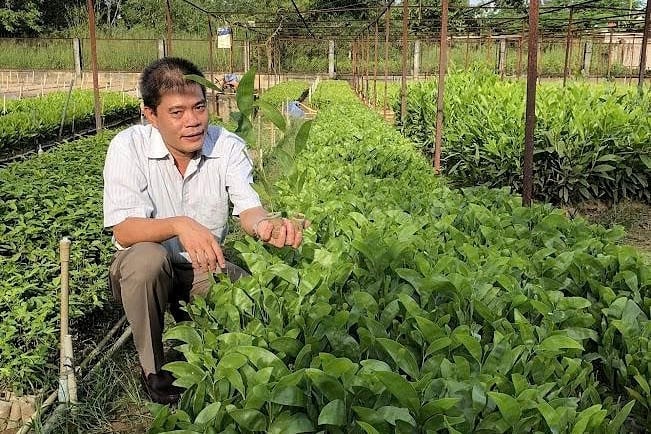
Associate Professor Dr. Phi Hong Hai at a forestry seed orchard. Photo: Archives.
Science and technology are equally crucial in processing, the decisive stage for final product value. Research on preservation and anti-fungal treatments using environmentally friendly technologies has supported the development of new materials such as laminated timber, compressed bamboo, compressed wood, and molded wood for construction and interior use. Many machines have been domestically designed, including soil sifters, seedling potting lines, nursery control systems, slope-terrain hole diggers, residue-management devices, and wood-chip processors, reducing labor costs and improving efficiency and consistency.
Another milestone is the national wood database covering 800 species, supporting timber identification for processing and trade. High-resolution spectrometry technology imported from the United States has cut identification time from several days to just hours, ensuring legality and meeting stringent market requirements.
Dr. Hai stresses that forestry science does not stay confined to laboratories; it is continually applied in the field. From tissue culture to intensive silviculture, every innovation aims to make forests not only greener, but more productive, higher in quality, and more valuable. Across the chain, from seedlings to export, science has become the red thread that transformed Vietnam’s forest-cover narrative into an export-surplus story, turning the country from a “learner” into a confident global player.
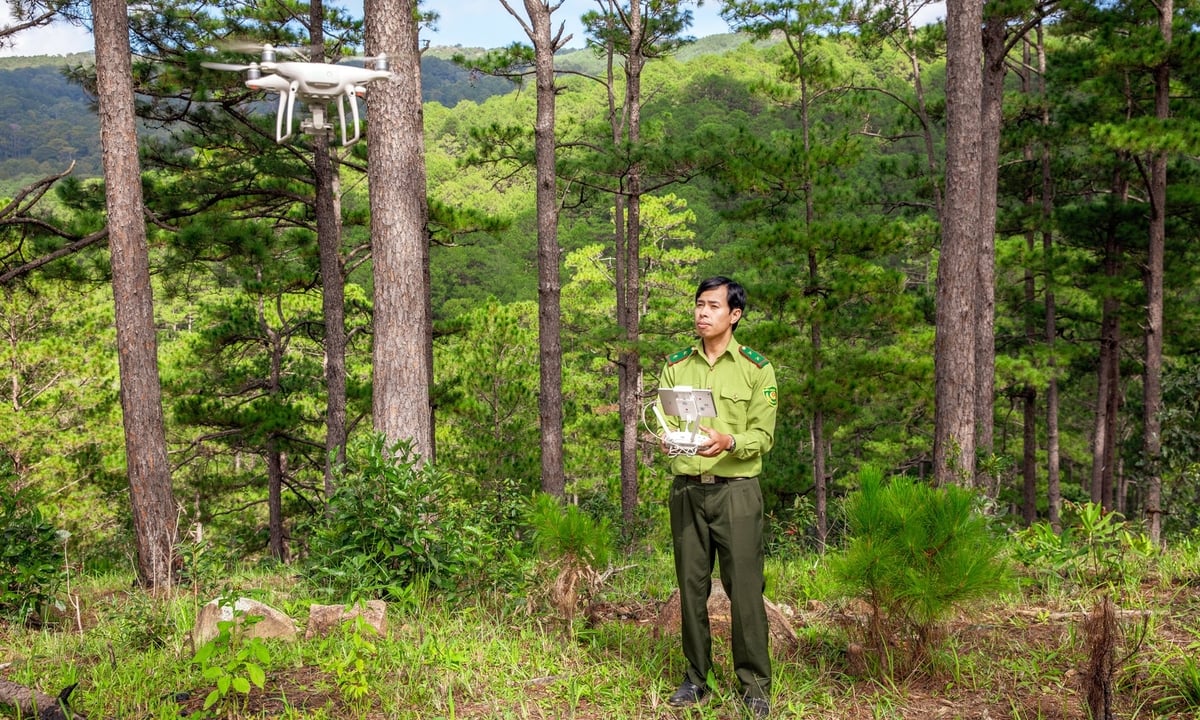
Forest rangers use drones to monitor changes in forest conditions. Photo: Forestry and Forest Protection Department.
If science is the hand behind seeds, silviculture, and processing, it also plays the role of “architect” in policy and management. Research on forest ecosystem functions underpins Vietnam’s Payments for Forest Environmental Services (PFES), where forests are valued not only for timber but also for water regulation, erosion control, and biodiversity protection.
Science enables precise quantification of forest carbon stocks, forming the basis for carbon credit markets and global carbon-trade integration. Permanent sample plots across forest types allow accurate measurement of carbon accumulation for domestic management and international mechanisms.
In protection and natural forests, science supports assisted regeneration, enrichment planting, and NTFP cultivation under the canopy. These models follow the “multi-value” principle, balancing extraction, conservation, and ecotourism. Forest-based tourism linked with OCOP products made from native species is emerging as a new economic driver for buffer zones.
Research also guides value-chain design, from planting to procurement, processing, and consumption, ensuring sustainability and transparency. Landscape-scale management is recommended over fragmented approaches, with agroforestry models expanded at village scale and circular-economy principles applied so that by-products from one stage feed the next.
Science provides solutions for soil-degradation control, reservoir sediment monitoring, and mangrove restoration. Newly recognized Bruguiera varieties, which grow fast and tolerate cold, are supporting coastal ecosystem recovery in the face of climate change.
Associate Professor Hai notes that without data and science-based solutions, forestry policies cannot translate into practice. PFES, carbon credits, and value-chain linkages have already been widely implemented. The Forest Protection and Development Fund, once nonexistent, now generates VND 3,000-4,000 billion annually, strengthening the long-term commitment of forest growers and protectors.
Vietnam has transitioned from state-run forestry enterprises to community- and enterprise-based management. Crucially, people can now earn a livelihood from forests, a key policy benchmark. Science not only supports production and processing but also shapes development thinking, turning “sustainability” from a slogan into an operational principle.
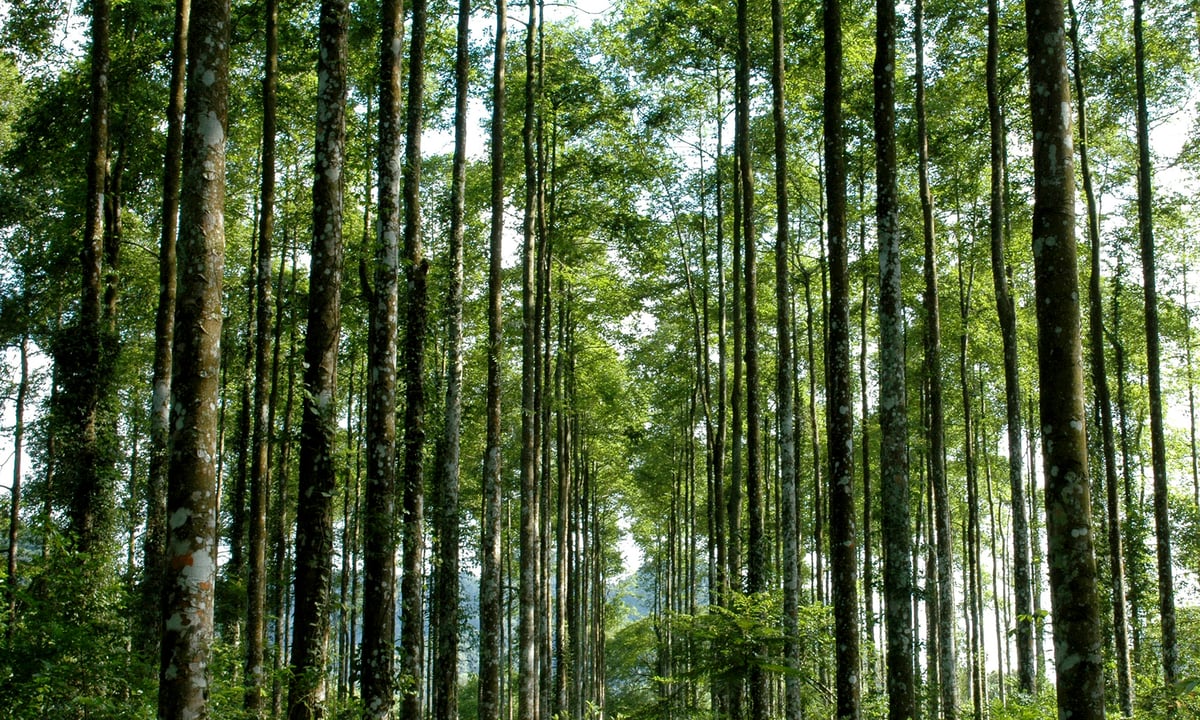
Thanks to advances in science and technology, plantation forests now produce straighter stems and higher clear boles. Photo: Bao Thang.
Forestry is a long-term endeavor, Dr. Hai emphasizes, one requiring sustained, strategic investment. Today’s achievements represent only the beginning of a broader vision in which science and technology evolve from supporting tools to the guiding force in sustainable forest development.
The top priority remains breakthroughs in breeding through biotechnology, genomic selection, gene editing, molecular markers, and polyploid induction, combined with traditional methods to improve precision, cut costs, and shorten breeding cycles.
Tissue culture, deployed for more than 30 years, must also evolve. The greatest challenge is high seedling costs; the solution lies in increasing multiplication rates through somatic embryo culture, automation, and artificial intelligence to reduce materials and labor expenses. DNA databases for forest species will provide scientific foundations for breeding, conservation, and genetic identification.
In silviculture, the direction is smart plantation management, increased use of organic fertilizers, reduced emissions, and enhanced carbon sequestration. Science will embed forestry deeper into the circular economy, where forests generate timber, NTFPs, ecological services, and carbon credits.
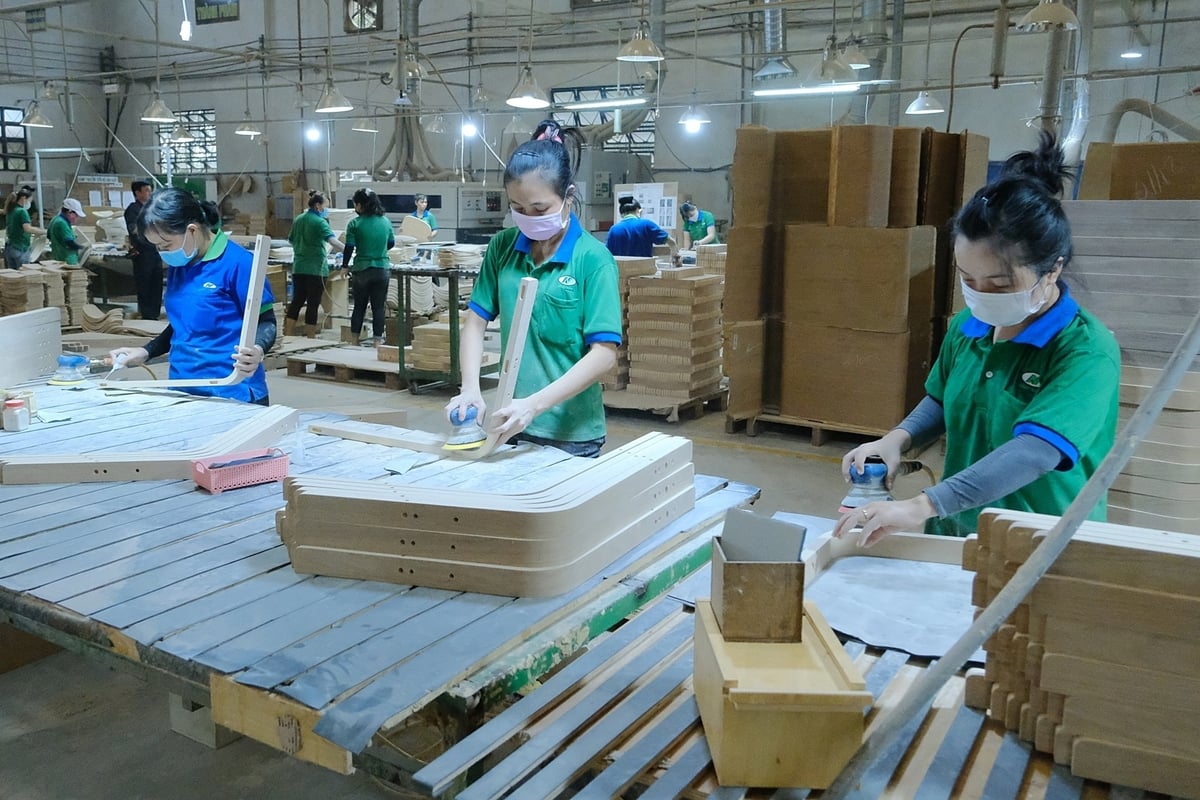
Vietnam’s wood-processing industry has become self-sufficient in raw materials thanks to the expansion of plantation forests. Photo: Bao Thang.
Agroforestry models will expand beyond household scale, forming integrated ecosystems with gene-bank zones, landscape forests, timber and NTFP production areas, and community ecotourism. Households will harvest timber, sell OCOP products, and host tourists, all within a sustainable circular system.
AI, remote sensing, and GIS will become essential for resource monitoring, pest and fire early warning, and restoration planning. In depleted natural forests, protection forests, and coastal forests, restoration solutions will be based on detailed site evaluations to rebuild productivity and resilience, recreate near-original forest structures, and strengthen climate-adaptation functions.
With Vietnam’s experience in carbon accounting, the carbon-credit market is expected to provide new income streams for growers and forest protectors. Science will underpin internationally compliant MRV (measurement, reporting, verification) systems, enabling Vietnam not only to participate in but also to initiate large-scale forest carbon projects.
Research will focus on biomass and carbon estimation via satellite imagery, detection sensors, LiDAR, degraded-land restoration, ecosystem rehabilitation, and biodiversity enhancement, factors that increase carbon-credit value and strengthen Vietnam’s position in environmental trade.
In processing and preservation, future research will advance new materials from plantation timber, bamboo, rattan, and NTFPs, as well as adhesives, coatings, and preservatives. AI, IoT, and Big Data will be integrated into equipment design and manufacturing to increase efficiency.
Forestry development requires decades-long research programs, covering the full chain from breeding to cultivation, harvesting, processing, and markets. The Politburo’s Resolution 57 is expected to shorten the path from laboratory to field, turning scientific results into green forests, internationally certified timber, and stable incomes for communities.
The future of forestry will not be measured solely by area or export value, but by sustainability, resilience, and community benefits. When science becomes the sector’s “brain” and “heart,” forestry will not only meet market demands but also protect ecosystems.
And when every forest-management decision is grounded in data, forests will grow healthier, standing as symbols of responsible production and global integration. In that future, science is not merely an assistant, but the guide that leads the way.
Translated by Linh Linh

(VAN) This is the view of Dr. Muthukumara S. Mani, Lead Environmental Economist for Southeast Asia at the World Bank, on Viet Nam’s ocean economy potential.

(VAN) Hue City launched the VIE/301 Project "Climate Adaptation and Resilience Finance," funded by the Green Climate Fund (GCF) and the Luxembourg Government.

(VAN) The Viet Nam Association of National Parks and Nature Reserves (VNPPA) has warned of the risk of ecological fragmentation if management is divided along administrative boundaries.

(VAN) The IUU inter-agency working group met to agree on regulations, build transparent coordination and boost database digitization.
/2026/06/02/2436-2-211902_630.jpg)
(VAN) The rural tourism development plan for the 2026–2030 period aims to create sustainable livelihoods, increase incomes, and promote the value of indigenous culture and resources.

(VAN) The delegation from MAE exchanged experiences on Extended Producer Responsibility (EPR), Deposit Return Systems (DRS), and the circular economy during a working visit to Germany and Norway.
/2026/05/30/1359-3-130327_621.jpg)
(VAN) Green transition requires a '4-party' linkage ecosystem to reduce capital pressure on enterprises, maximize social resources, and form a green value chain network.
