November 27, 2025 | 19:11 GMT +7
Hotline: 0913.378.918

November 27, 2025 | 19:11 GMT +7
Hotline: 0913.378.918
Restoration and fortification of cultivated land in the Central Highlands is a matter of great urgency as the soil health in this area has been greatly affected by prolonged chemical fertilizer and pesticide abuse. Vietnam Agriculture News has recently had an interview with Dr. Nguyen Dang Nghia of Soils and Fertilizers Research Institute (SFRI) regarding this issue.
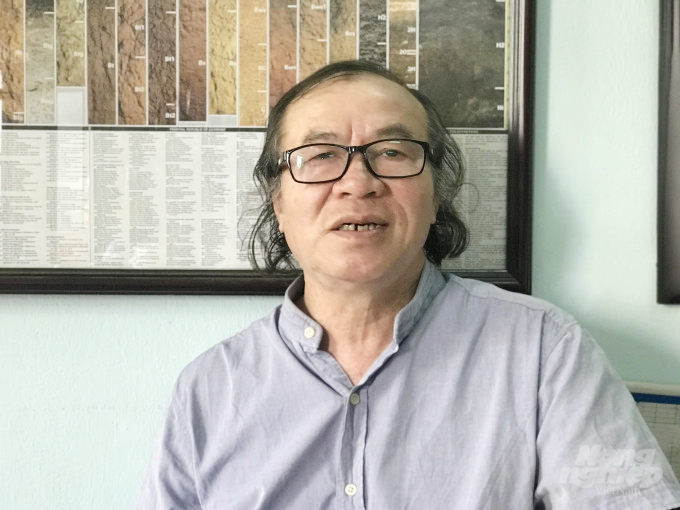
Dr. Nguyen Dang Nghia. Photo: Thanh Son.
Dear sir, what should we do to cure the cultivated land area in the Central Highlands?
Mentioning the story of curing the cultivated land area in the Central Highlands, I have this first thought that the agricultural sector and agroproduction extension system in localities must help farmers understand the benefits of balanced fertilization and its techniques so as not to upset the balance of nutrients, giving rise to limiting factors in the soil.
Farmers only need to reduce chemical fertilizers and increase the use of organic fertilizers. They can be organic fertilizers gained from traditional practices, enterprise purchases or importation. If farmers apply 1kg of inorganic fertilizer, at least 0.5kg of organic fertilizer should be added to the soil accordingly. In the short term, farmers only need to do so because the amount of organic fertilizer we need is more than the amount we can possess at the moment.
Even before talking about soil health, environmental protection or agro-product quality improvement, the current context of fertilizer prices skyrocketing which is having a great influence on agro-input costs already signals to farmers a good opportunity to reduce chemical fertilizers and increase the usage of organic fertilizers to well-manage the overall production costs. The establishment of production models that promote these actions needs to be further encouraged.
Scientists, press agencies and the media should jointly increase awareness and guide Central Highlands farmers so that they can be ready to switch to using organic fertilizers. The increased amount of organic fertilizer applied to the soil will contribute to the detoxification process and gradually balance nutrients in the soil.
Our people have these concepts of "Observation is the best teacher” and “Practice makes perfect”, therefore it is necessary to have specific and effective models and at the same time organize field workshops for farmers to witness and learn from.
You just mention that the available amount of organic fertilizer is far short of the demand. Will agricultural waste and by-products be the key to helping farmers in the Central Highlands solve this problem?
We are indeed promoting circular agriculture models, but in fact a lot of agricultural waste and by-products obtained during harvesting and agro-product processing are still left unattended.
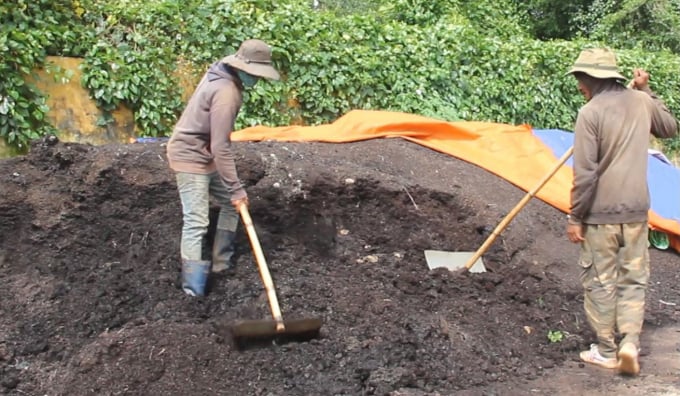
The Western Highlands Agriculture and Forestry Science Institute (WASI) composts manure from coffee husks to fertilize crops. Photo: Tran Minh Quy.
Coffee husks are abundant in the Central Highlands. Over the years, many Central Highlands farmers have learned to effectively apply techniques to make organic composting from coffee husks, but we still need to further promote the use of waste and by-products from coffee with the aim of returning a part of what the coffee plant has taken from the soil.
Not only in the case of coffee, all branches and leaves in pepper, rubber, fruit trees and other crops in the Central Highlands should also be utilized to the fullest. Farmers also need to take advantage of waste sources in the process of raising livestock and compost it as organic fertilizer.
However, in order to make good quality organic fertilizer from agricultural waste and by-products, farmers need to be equipped with the necessary knowledge specifically composting techniques. The techniques are not difficult, the source of probiotics that scientific research facilities and enterprises produce is plenty at present, so it’s completely possible to produce organic fertilizers in a large quantity.
Those are the immediate solutions. In the long run, what do we need to do to maintain the fertility of arable land in the Central Highlands, sir?
In my opinion, the most fundamental solution in the long run is that the Ministry of Agriculture and Rural Development has a program of soil health tests. Accordingly, it is required to organize soil sampling to assess the health of the soil used to plant coffee, pepper, and fruit trees in the Central Highlands.
Once we have assessed the current state of soil health, we can come up with the most appropriate solutions to restore soil and maintain soil fertility. Another solution is to accelerate the conversion of agroproduction from quantity to quality in the Central Highlands. When production focuses on quality instead of running after output, farmers will abandon the current habit of chemical fertilizers and pesticides abuse.
Thank you, sir!
Translated by Samuel Pham

(VAN) According to Mr. Vo Minh Thanh, Director of the Tay Ninh Department of Agriculture and Environment, Resolution 57 has created a new development pathway for the locality, shifting from traditional toward modern agriculture.
/2025/11/26/4909-2-154329_878.jpg)
(VAN) Pearl grouper farming in HDPE cages not only delivers economic efficiency but also contributes to protecting the environment, creating jobs, and promoting marine-based experiential tourism.

(VAN) The model of making a living under the forest canopy through the agroforestry system in Van Son commune, Bac Ninh province, is expected to generate an annual income of approximately VND 30 million/ha.

(VAN) Many enterprises in Can Tho are harnessing natural energy and reducing greenhouse gas emissions in their production processes, thereby contributing to the promotion of a sustainable green transition.
/2025/11/24/3536-2-112800_176.jpg)
(VAN) Dong Nai now has tens of thousands of hectares of forests certified for sustainable management, and this area will continue to be expanded in the coming period.

(VAN) Vinh Ha hamlet (Dai Xuyen commune, Hanoi) is shifting away from small-scale farming as households adopt bioscurity into their breeder chicken models.

(VAN) Heavy rains make aquatic species more vulnerable to disease. Proactive water management and high-tech systems help farmers prevent outbreaks and protect yields.
