December 17, 2025 | 18:47 GMT +7
Hotline: 0913.378.918

December 17, 2025 | 18:47 GMT +7
Hotline: 0913.378.918
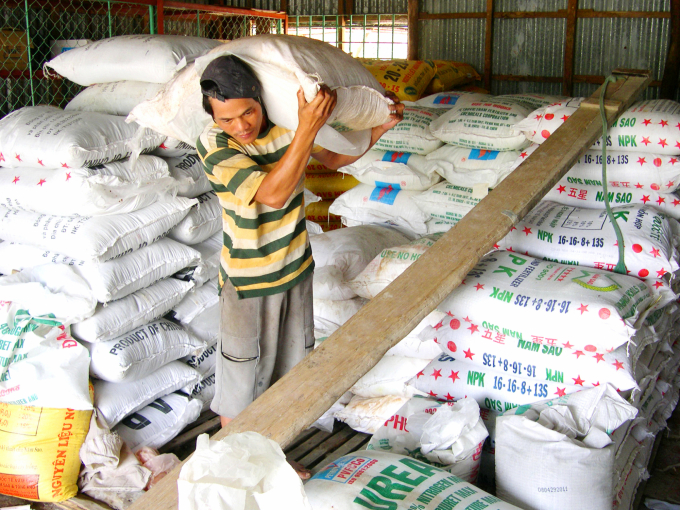
Fertilizer prices have skyrocketed in recent crop seasons. Photo: Le Hoang Vu.
Farmers in Bac Lieu province are currently harvesting the autumn-winter rice crop and the rice crop on the shrimp farming land in 2021. According to farmers’ calculations, in this year's autumn-winter rice crop, they will not earn many profits, even expecting losses because they are forced to use fertilizers at too high a price.
Facing the situation of high fertilizer prices, many households in the province have considered a perfunctory production plan, while many others are thinking of ways to cut down on fertilizer to reduce investment costs instead.
There has been a proposal to reduce fertilizer by 50% to reduce the cost for the next winter-spring crop in the past few days.
Mr. Tran Van Dang, Thoi Phuoc A hamlet, Tan Thanh commune, Thoi Lai district, Can Tho city, feel confused after hearing the news. "While listening to information on the radio recently I know of an opinion that farmers should reduce fertilizer by 50%, but us farmers are still worried about whether with this reduction will the yield be guaranteed. Farmers nowadays usually have the habit of using chemical fertilizers and consider winter-spring rice as the main crop of the year because it brings the highest profit compared to the other two rice crops,” he said.
"As a matter of fact, for many years farmers have used a large amount of chemical fertilizers in cultivation and there is a possibility that a certain amount remains in the soil, so the soil may therefore still be abundant with nutrients. I think the yield can still be guaranteed in the next winter-spring crop even if farmers reduce the amount of fertilizer used.
“If they have decided to implement the reduction of inorganic fertilizers, they may first reduce the amount of urea and at the same time increase the use of organic fertilizers at each appropriate stage to renovate the soil and increase soil fertility."
(Mr. Tran Thanh Tam, Director of Dong Thap Sub-Department of Crop Production and Plant Protection)
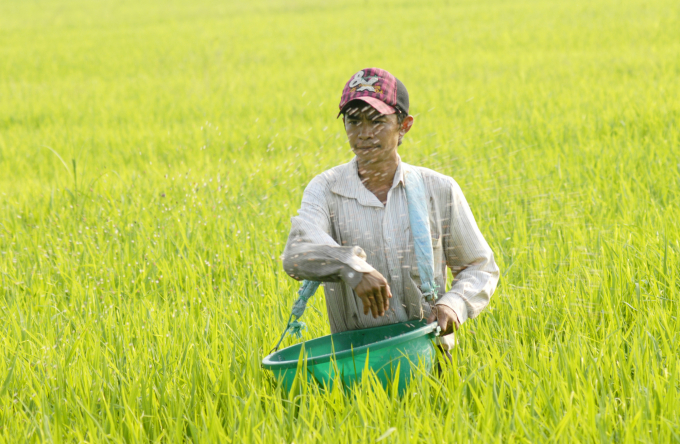
The 2021-2022 winter-spring crop in the Mekong Delta is under great pressure due to high fertilizer prices. Photo: Le Hoang Vu.
Regarding this matter, Mr. Vo Van Men, Director of Tien Giang Sub-Department of Crop Production and Plant Protection said, “the general recommended formula for fertilizer application by scientists for 1ha of rice is: 90kg of nitrogen, 45kg phosphate, and 30kg potash (90N - 45S - 30K). That is 4.5 bags of DAP (18%N - 46%P2O5), 1.5 bags of potash (61% K2O) and 2 bags of urea (46% N). The total amount of fertilizer is around 400 kg/ha.”
If the formula in use is 150 - 160 N, reducing the amount of fertilizer by 50%, down to 75 - 80 N is acceptable if combined with measures to reduce fertilizer loss and help rice plants absorb quickly.
At the tillering stage, farmers can divide the fertilizer into several fertilizing periods to help the rice plants gain the best absorption and prevent the fertilizer to be washed as well as reduce a significant amount of fertilizer used.
Mr. Nguyen Vinh Phuc, Director of Vinh Long Sub-Department of Crop Production and Plant Protection had another opinion: "Reducing fertilizer on rice and fruit trees is possible. But reducing chemical fertilizers requires increasing organic fertilizers or applying in accordance with the correct nutritional needs to save fertilizer and avoid waste.
“In the case of rice plants, farmers usually decide to fertilize when they think it is time to apply, but now they apply according to the rice leave color chart, that is, only fertilize upon seeing that the plant is lacking in nutrient considering its needs. This will also contribute to reducing the amount of fertilizer used."

Many local experts believe that if there is a scientific fertilizer solution, the 50% reduction of inorganic fertilizer in the 2021 - 2022 winter-spring crop will not have much effect on the yield. Photo: LHV.
As shared by Mr. Tran Thanh Tam, Mr. Tran Thanh Tam, Director of Dong Thap Sub-Department of Crop Production and Plant Protection, instead of using 100% inorganic fertilizers in the past, the agricultural sector recommends that farmers increase the use of organic fertilizers to reduce costs. That means even if the use of chemical fertilizers is reduced by 30-40%, the crop will not be affected in terms of yield in the first fertilizer-reduced crop.
The Dong Thap agriculture sector recommends manure NPK and potassium fertilizers before sowing. This is also a form of reducing the amount of fertilizer by 20-25% compared to the traditional method. This reduction of inorganic fertilizers can gradually raise farmers’ awareness have them switch to bio-organic fertilizers for a more sustainable direction.
Businesses agree
According to Mr. Nguyen Van Dem, Director of Phi Nhieu Co., Ltd. (Can Tho city), a supplier of fertilizer products to agents in the Mekong Delta, there have been opinions from leaders of the crop production industry proposing to reduce 50% of fertilizer for the 2021-2022 winter-spring rice crop to adapt to the situation of high fertilizer prices. Although he is a business enterprise in the fertilizer industry, he strongly supports this suggestion.
“In order to successfully apply measures to reduce the use of inorganic fertilizers by 50% in the 2021-2022 winter-spring crop, from now on experts and leaders of the agricultural industry need to promote recommendations and training courses so that farmers have a foundation of belief to follow and apply the measures,” said Mr. Dem.
Translated by Samuel Pham

Professor Nguyen Duc Ngu, the third generation of leaders since the establishment of Vietnam’s Hydrometeorology sector has witnessed and lived through the long arc of its development.

(VAN) Climate change, saline intrusion, and unsustainable farming practices are depleting agricultural land in the Mekong Delta. Restoring soil health is a key solution for the future of agriculture.

(VAN) Agroforestry coffee not only enhances coffee quality but also helps farmers in Quang Tri enter carbon credit market with high expectations.

(VAN) Towards Net Zero 2050, fertilizer manufacturers are proactively developing bio-based products, reducing emissions, and demonstrating responsibility to the environment.

(VAN) The smart rice cultivation model, which reduces methane emissions and aims at developing agricultural carbon credits, has been deployed in Thai Nguyen province and delivered positive results.

(VAN) The purpose of this visit is to unify the proposal for a technical assistance project supporting sustainable agricultural and forestry development in Angola.
![Unlocking carbon credit potential: [3] New direction for rice production](https://t.ex-cdn.com/nongnghiepmoitruong.vn/608w/files/huyenvt (e)/2025/12/10/3428-2-092319_209.jpg)
(VAN) Low-carbon rice models in Thanh Hoa are opening up opportunities for a green, circular agriculture, aiming at carbon credit generation.
