December 7, 2025 | 05:58 GMT +7
Hotline: 0913.378.918

December 7, 2025 | 05:58 GMT +7
Hotline: 0913.378.918
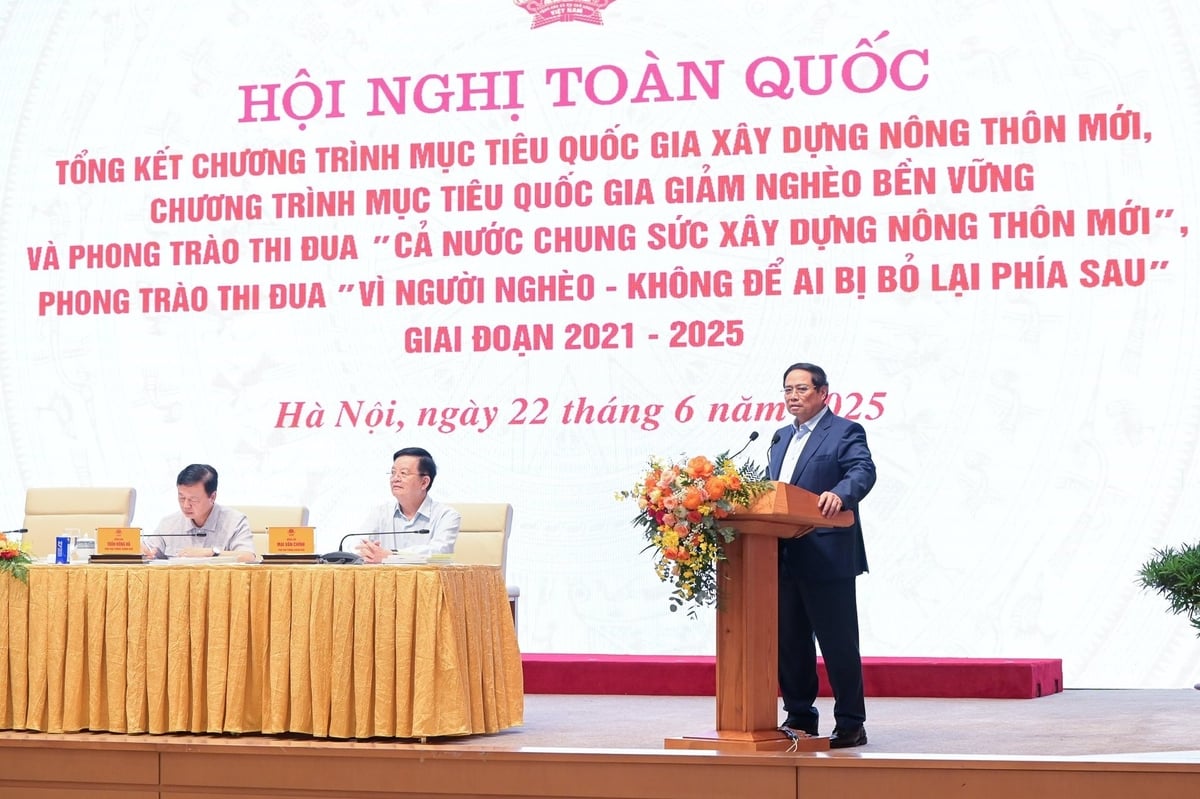
Prime Minister Pham Minh Chinh speaking at the National Conference. Photo: Tung Dinh.
On June 22, speaking at the conclusion of the National Conference reviewing the National Target Program on New Rural Development and the National Target Program on Sustainable Poverty Reduction, Prime Minister Pham Minh Chinh commended the thorough preparation, presentations, and discussions.
He underscored the importance and urgency of conducting this assessment in June 2025, six months ahead of schedule and just prior to Vietnam's transition to a two-tier local government model on July 1. He observed that this is a component of the nation's preparedness to enter a new period of national transformation and development.
The Vietnamese PM has stated that the implementation of Resolution No. 26-NQ/TW on agriculture, farmers, and rural areas has been well-substantiated, timely, and effective, substantially contributing to the country's economic restructuring and sustainable development. Investments in infrastructure, transportation, irrigation, healthcare, culture, and education, in addition to comprehensive enhancements to rural living standards and landscapes, have made a tangible impact.
Vietnam has become a global model for the achievement of the Sustainable Development Goals, particularly in the areas of poverty alleviation, rural development, and access to pure water, as a result of these efforts.
PM Chinh emphasized the consistent and direct leadership of the Party, particularly the Politburo and the Secretariat, the unity of the nation, the involvement of the entire political system, support from international partners, and the synergetic relationship between agriculture, farmers, and rural development when reflecting on the key drivers behind these achievements. He highlighted the necessity of utilizing natural resources, cultural heritage, the rice-based civilization, and, most importantly, human capital, particularly the active involvement of farmers.
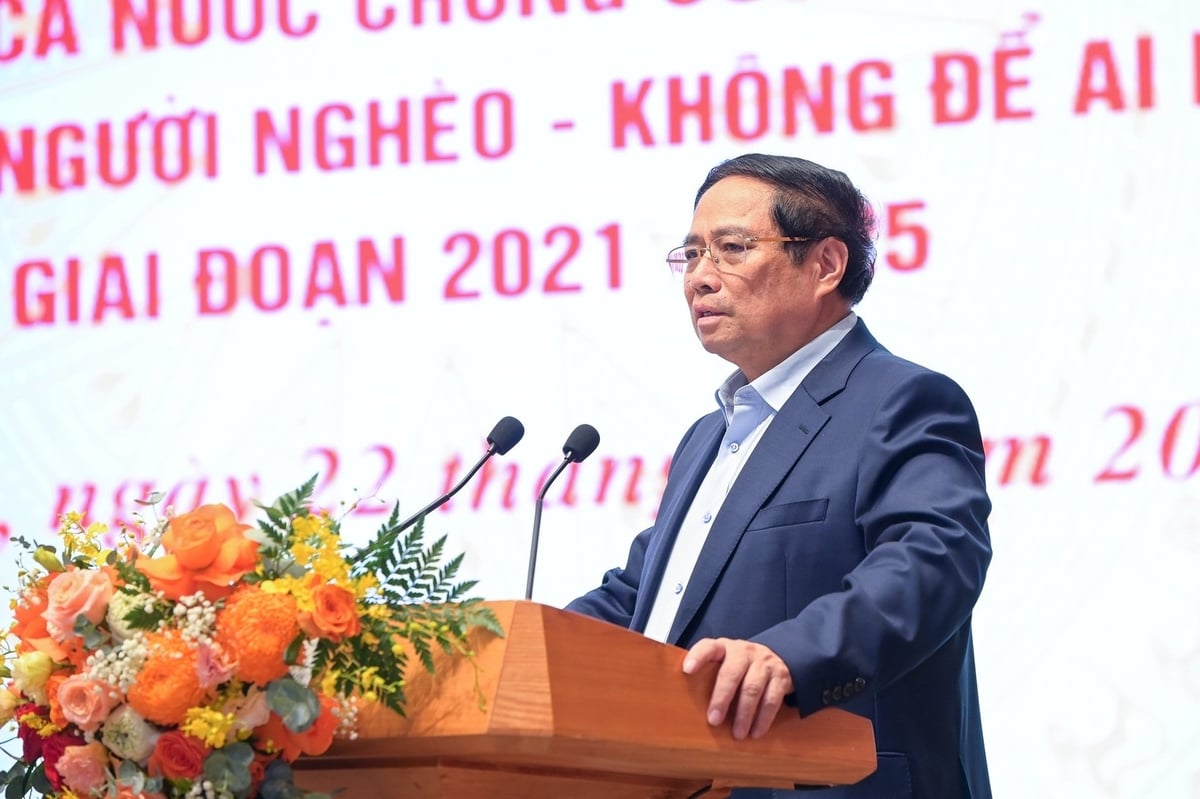
Prime Minister Pham Minh Chinh saying that Vietnam has become a model in poverty reduction and rural development. Photo: Tung Dinh.
The PM urged the entire political system, including Party commissions, authorities, the Vietnam Fatherland Front, and socio-political organizations, to concentrate on four critical priorities in order to further advance national objectives:
Institutional development: Facilitate the establishment of legal and policy frameworks that establish farmers as the primary actors, agriculture as the propelling force, and rural areas as the foundation of development.
Strategic infrastructure: Create strategic infrastructure that is specifically designed to meet the requirements of agriculture and rural communities. This infrastructure should encompass transport, energy, healthcare, education, culture, sports, and digital infrastructure, with an emphasis on sustainability and green growth.
Human development: Invest in the development of individuals, with a particular emphasis on preparing farmers to adapt to new stages of development, such as the forthcoming two-tier governance model. He advocated for the implementation of the Party's four fundamental resolutions: scientific and technological advancements, innovation, and digital transformation; international integration in a dynamic world; legal reform; and private sector development.
Agricultural diversification: Encourage the development of a variety of agricultural products that cater to the requirements of both domestic and international consumers; diversify agricultural supply chains and export markets. He cited the extensive Halal food market, which caters to two billion consumers worldwide, as an example.
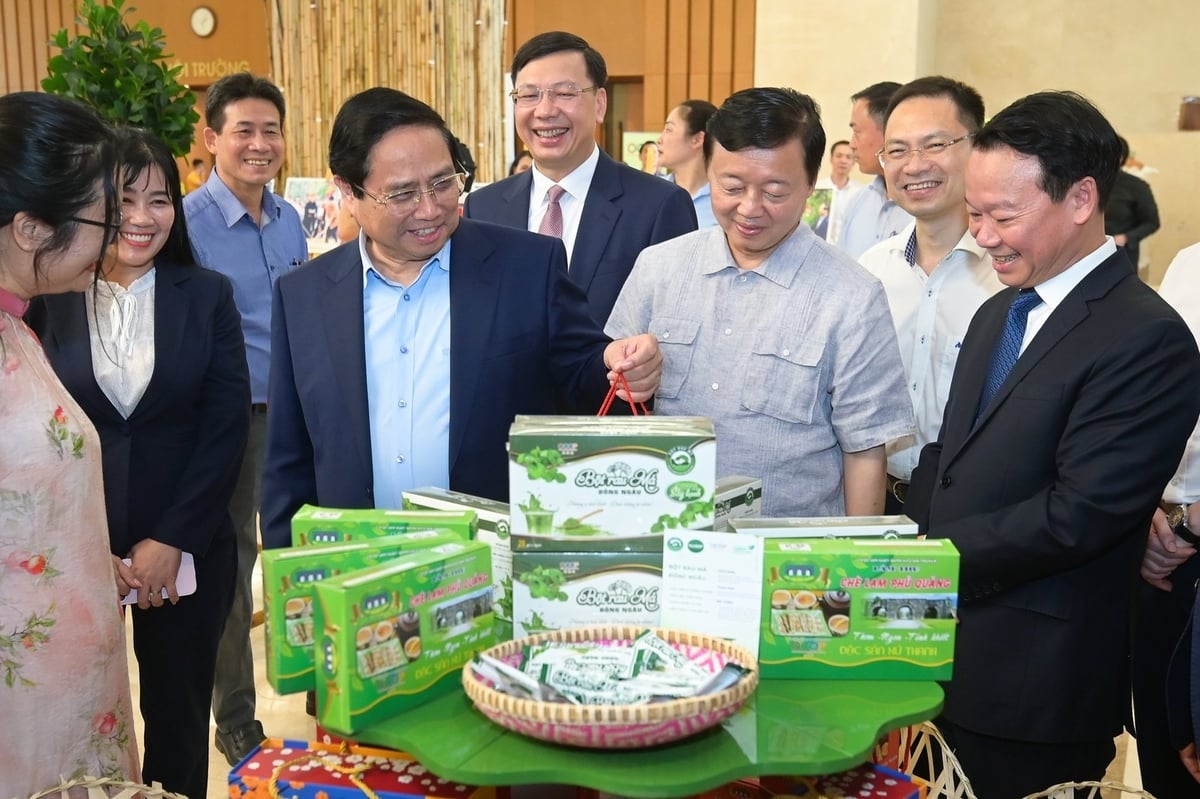
Prime Minister Pham Minh Chinh, Deputy Prime Minister Tran Hong Ha and Minister Do Duc Duy visiting the OCOP booth on the sidelines of the Conference. Photo: Tung Dinh.
Addressing farmers directly, the Prime Minister urged them to be pioneers in three key areas: escaping poverty and establishing prosperity through hard work and innovation; fostering a modern, civilized farmer identity; and leading the charge in green, sustainable production and digital transformation, particularly in the launch of a digital literacy campaign that aims to establish a digital economy, government, society, and citizenship.
In addition, he advised ministries, sectors, and local governments to rigorously adhere to and internalize the leadership of the Party Central Committee, Politburo, and General Secretary. He also assigned specific responsibilities to these entities. He urged for an urgent, integrated approach to the development of national target programs for the 2026–2035 period, with a particular emphasis on sustainable poverty reduction and new rural development. In order to achieve this, it is necessary to mobilize the entire political system with a high level of determination, significant effort, and decisive action, following the principle of "six clears": clear roles, clear tasks, clear timelines, clear responsibilities, clear deliverables, and clear authority.
PM Pham Minh Chinh underscored the significance of public resources as a "priming fund" in the current context, as it serves to stimulate and attract a broader societal investment. He called for the establishment of robust public-private partnerships and underscored the importance of completing institutional reforms, unlocking resources, investing in human capital and infrastructure, and ensuring that social policies and safety systems do not leave anyone behind. Growth alone must never be at the expense of progress and equity, social welfare, and the rural environment.
Lastly, the PM emphasized the necessity of implementing all programs and initiatives in a genuine and effective manner: "Promise it, deliver it; say it, do it." He advocated for measurable results, rigorous supervision to prevent corruption and waste, and an active media presence in the promotion of these initiatives.
“A sound policy must be matched with strong consensus and effective implementation. The benefits to the people must be real and felt, not empty rhetoric or broken promises,” PM Chinh concluded.
Translated by Linh Linh
/2025/12/02/2629-3-141849_60.jpg)
(VAN) Based on its large-scale planted forests, several rubber enterprises have proactively conducted greenhouse gas emission inventories in preparation for entering the forest carbon credit market.

(VAN) MAE is leading in developing a national rare earth strategy, which will be submitted to the competent authorities for promulgation in early 2026.
/2025/12/02/4006-4-092040_652.jpg)
(VAN) The model of converting low-efficiency rice land to aquaculture in many localities has helped increase incomes by 5 to 15 times, improve the environment, and form new fisheries economic zones.

(VAN) Funded by ACIAR, Project FST/2020/123 focuses on measures to prevent harmful alien species, thereby protecting forests from invasive threats.

(VAN) The National Assembly's Supervisory Delegation pointed out solutions for the blue economy, circular economy, environmental protection, and technology application for sustainable marine governance.

(VAN) Lao Cai’s forestry sector is stepping into the spotlight with a series of pioneering initiatives in forest management, monitoring, and sustainable development aimed at generating carbon credits.

(VAN) The Provincial Competitiveness and Governance Index (PCGI) is a tool designed to reflect the quality of local governance.
