December 1, 2025 | 16:21 GMT +7
Hotline: 0913.378.918

December 1, 2025 | 16:21 GMT +7
Hotline: 0913.378.918
According to statistics from the Protected Planet database (with Protected areas data of Vietnam updated in 2015), the total area of protected zones on land, inland waters, coastal, and marineareas in Vietnam accounts for just over 8% (including 7.58% for terrestrial and inland waterprotected areas, and 0.49% for marine and coastal protected areas). Meanwhile, the National Biodiversity Strategy to 2030, with a vision toward 2050, sets targets aiming for “at least 9% of the terrestrial territory to be protected as nature reserves; and 3-5% of the country’snatural marine and coastal areas to be conserved”.
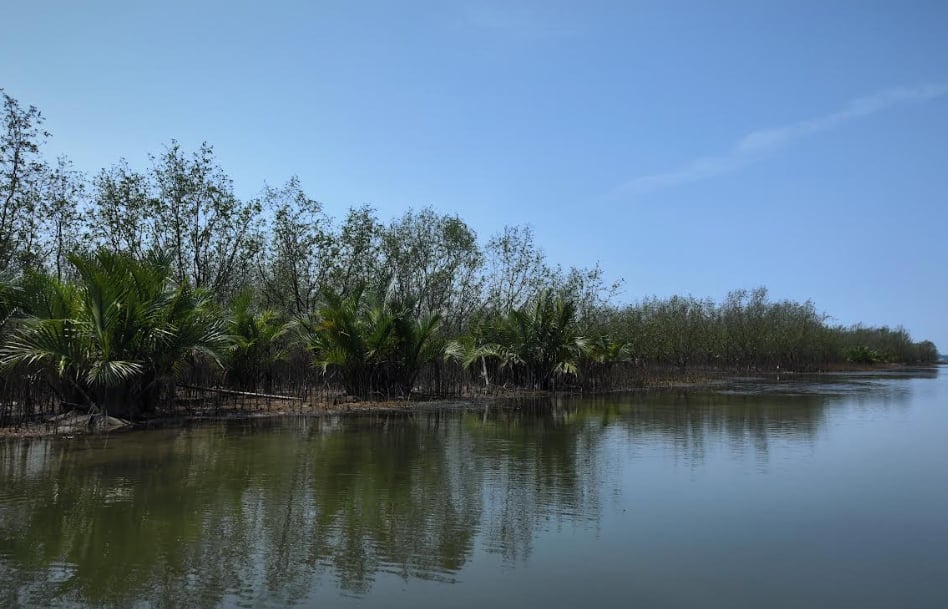
Doi Choi Fisheries Resource Protection Area in Phu Dien commune, Phu Vang district, Hue city. Photo: WWF-Vietnam.
In the Kunming-Montreal Global Biodiversity Framework (GBF), adopted by the Parties at the 2022 COP15 Conference of the Convention on Biological Diversity (CBD), OECMs are recognized as a viable solution alongside protected areas to help achieve the 30x30 target (to ensure that at least 30% of terrestrial, inland water, coastal and marine areas, especially those of particular importance for biodiversity and ecosystem functions and services, are conserved and effectively managed through ecologically representative, well-connected andequitably governed systems of protected areas and other OECMs.)
To contribute to achieving the more ambitious GBF goals agreed at COP15, Vietnam needs toproactively promote expanding conservation measures beyond formally designated protected areas and OECMs present an opportunityto develop and scale-up.
The recognition of OECMs is based on the consensus and voluntary participation of landowners or rights holders and does not require changes to the existingmanagement authority or practices.
It enables countries to officially report biodiversityconservation areas outside protected areas to the CBD, thereby complementing existing protectedarea networks and recognizing the ecological value of areas managed for other purposes. Moreover, OECMs serve as a way to acknowledge and safeguard the contributions ofcommunities, private entities, local authorities, and other stakeholders who are actively engagedin effective conservation efforts - even when the areas they manage are used for other purposes.
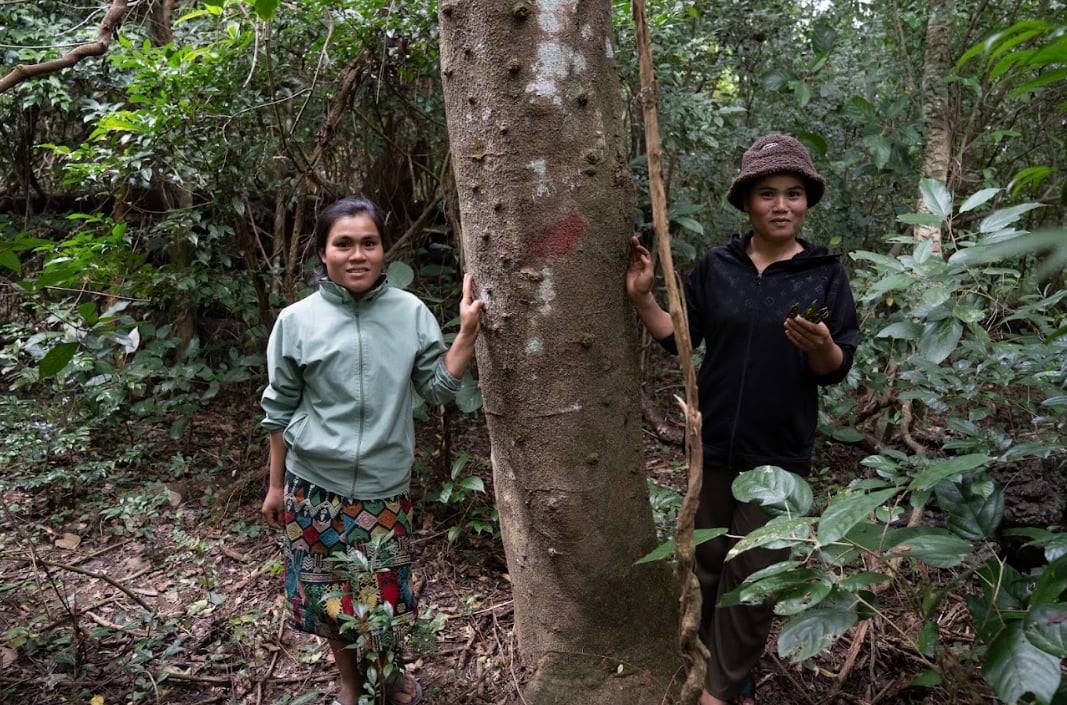
OECM areas can help diversify the livelihoods of local communities and managing landowners through environmentally friendly approaches. Photo: WWF-Vietnam.
The recognition and integration of OECMs into the national conservation system makes iteasier for local communities and organizations to follow up with training programs, receive technical support, and access opportunities for collaboration with existing national and international conservation organizations. As a result, conservation capacity, biodiversity monitoring, and the sustainable use of natural resources will be enhanced, contributing to improved conservation effectiveness beyond traditional protected areas.
Recognition of OECMs facilitates the conservation and promotion of indigenousknowledge - an inseparable part of the ecosystems that communities safeguard. Through community-led conservation activities, cultural values, traditional rituals, and the close relationship between people and nature are maintained and passed down to future generations.
Once officially recognized, OECM areas can help diversify the livelihoods of localcommunities and managing landowners through environmentally friendly approachessuch as developing ecotourism, increasing income from ecosystem services, andpromoting sustainable agriculture, forestry, and fisheries.
Based on a preliminary review by WWF-Vietnam, the following quick win OECM opportunity is the community forest areas and fisheries resource protection zones outside the protectedwetland area of Tam Giang - Cau Hai in Hue city show great potential to be recognized as OECMs. For example, the community forest area in Le Trieng II village, Hong Trung commune, A Luoi district, Hue city, covering 675.4 hectares within the buffer zone (outside) of Phong Dien Nature Reserve since 2013. This forest area has clearly defined geographical boundaries and ishome to many endangered and rare species of flora and fauna such as Vietnam ironwood, Chinese White Meranti, Hopea tree, Tonkin Magnolia, as well as deer, muntjac, and pheasants…Many plant and animal species are recovering thanks to the patrolling and protection efforts ofthe local community.
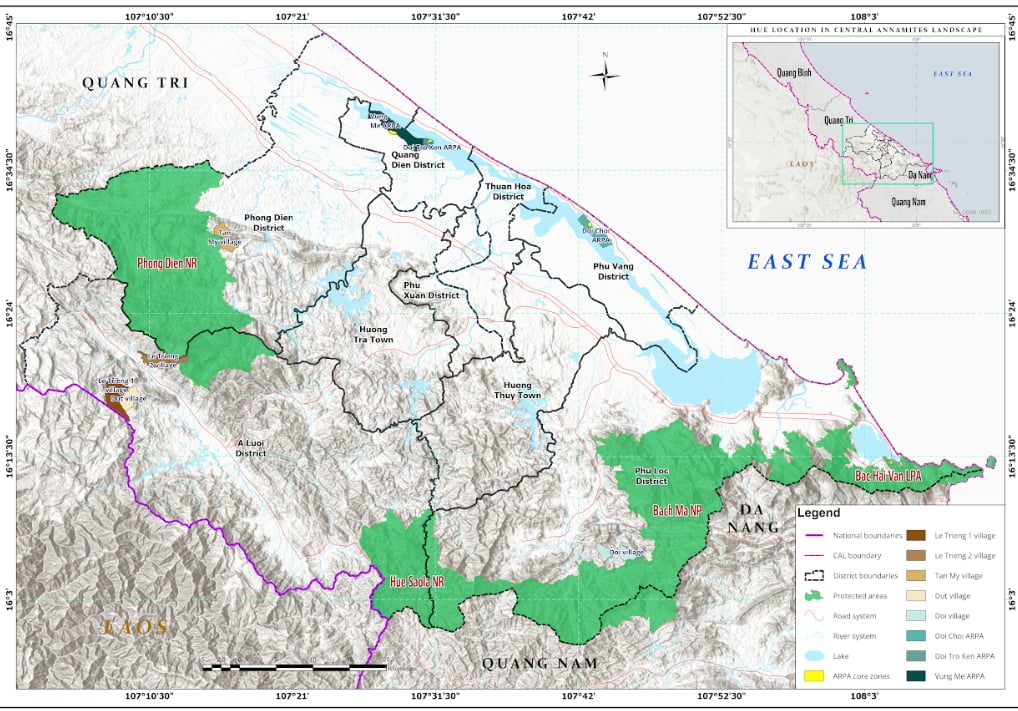
Mapping the potential of OECMs in Hue City. Photo: WWF-Vietnam.
Another opportunity is the Doi Choi Fisheries Resource Protection Area in Phu Dien commune, Phu Vang district, Hue city, with a shared exploitation area of 632.6 hectares, which has beendirectly managed by the Thanh My - Phu Dien Fisheries Association under the authorization ofthe Phu Vang District People’s Committee. This area is not only home to many fish species suchas Stingray, Grey mullets, Bronze Featherback, Suot Carp, but also provides food and habitat formany rare bird species, including: the Chinese Pond Heron, Great Egret, Little Egret, Osprey, …
Both the community forest in Le Trieng II village and the Doi Choi Fisheries Resource Protection Area meet the two criteria of potential OECM candidates: being located outside protected areas, having clearly defined geographical boundaries, and having the capacity to support long term sustainable biodiversity values. Such community forests and fisheries resource protection zones can be thoroughly assessed and registered for official recognition as OECMs. This will enable Vietnam to flexibly and effectively increase its in-situ biodiversityconservation areas, aligned with current management realities and development trends.
In the context of Vietnam’s efforts to strengthen conservation linked with sustainable development to meet international commitments, OECMs represent an important solution. Promoting multi-stakeholder cooperation among government agencies, non-governmental organizations, the private sector, and local communities will be key to implementing pilot OECM models, developing recognition guidelines, and establishing specific support mechanisms.
In Vietnam, no area has yet been officially recognized as an OECM , although many sites havestrong potential. The National Biodiversity Master Plan (2021-2030) has identified several keytargets, including: The transition of 3 existing biodiversity corridors; The establishment of 7 new biodiversity corridors; Identification of 10 important ecological landscapes; Recognition of 22 areas with high biodiversity value; Designation of 10 nationally important wetlands. These areas all have great potential to be recognized as OECMs.
Translated by Kieu Chi

(VAN) The inevitable path forward is to reorganize production along the value chain, utilizing cooperatives as the core, enterprises as the driving force, and farmers as the central subjects.

(VAN) On November 28, Minister Tran Duc Thang, together with China's Minister of Agriculture and Rural Affairs Han Jun, chaired the 2nd meeting of the Viet Nam - China Agricultural Cooperation Committee.

(VAN) Forest carbon credits are only accepted when they ensure absolute environmental integrity, additionality, permanence, and transparency.

(VAN) Viet Nam partners with Beijing on controlling air pollution, cross-regional management, high-tech monitoring and relocating polluting facilities.

(VAN) With a USD 50 million investment, Australia is partnering with Viet Nam to operate its first public electric bus fleet and develop a nationwide EV charging network.

(VAN) On November 28, in Beijing, Minister Tran Duc Thang met Minister of Ecology and Environment of China Huang Runqiu, to share experience on environmental protection.
/2025/11/28/0950-2-120557_751.jpg)
(VAN) The recent flood spell in the South Central region clearly reflects the characteristics of natural disasters in 2025, which are compound, prolonged, and amplified.
