November 27, 2025 | 22:06 GMT +7
Hotline: 0913.378.918

November 27, 2025 | 22:06 GMT +7
Hotline: 0913.378.918

Wood products and items from Nghe An province are leaving a distinct mark on consumers. Photo: Viet Khanh.
Nghe An province currently possesses a planted forest area of over 170,000 hectares. The annual average timber harvest reaches between 1.2 to 1.4 million cubic meters, which excludes a substantial volume of medicinal materials and non-timber forest products.
The Prime Minister issued Decision No. 509/QD-TTg on March 31, 2021 to establish a high-tech forest area in the North Central region, with Nghe An province at its core, in order to fully utilize the country's natural advantages. This decision was seen as a crucial legal framework to enable the local wood products to conquer challenging global markets.
At present, Nghe An province is home to 45 wood processing businesses and 98 non-timber producers. Additionally, there are 10,410 individual production and business establishments for various wood and non-timber forest products. Two notable projects include the Nghia Dan Wood Processing Plant Phase 1, featuring an European laminated timber production line with an annual capacity of 12,000 cubic meters, and an MDF board production line with an annual capacity of 130,000 cubic meters, which has been operational since 2016.
The Nghe An Provincial People's Committee expects to attract investors into the wood processing sector with the aim of transforming the province into a focal point. Three local biomass pellet factories, Biomass Fuel Vietnam Limited Company, the biomass pellet factory of Thien Minh Duc Group Joint Stock Company, and Thanh Chuong wood factory, are currently in operation with capacities ranging from 140,000 to 160,000 tons per year.
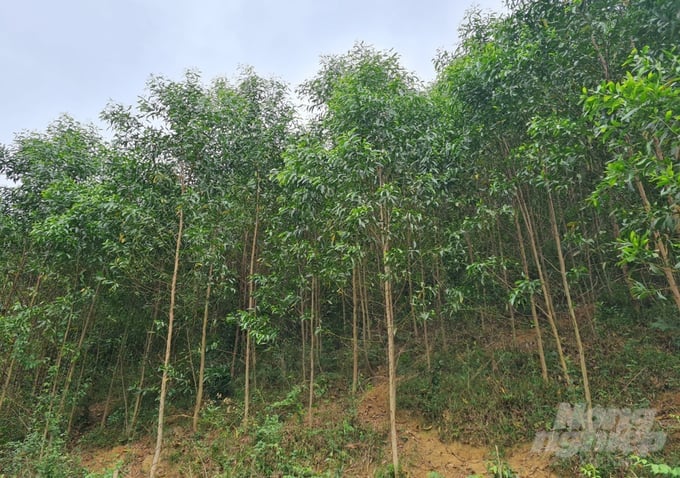
Proactively expanding the material forests is the optimal development direction for Nghe An province's wood industry. Photo: Viet Khanh.
Securing a substantial and reliable source of raw materials is necessary to maintain proactive resilience in all circumstances. Nghe An province transformed 11,486 hectares of small-scale timber forests into large-scale commercial timber forests from 2017 to 2022. This effort has been perceived as the pivotal stepping stone towards the realization of expansion goals. Moreover, the aforementioned figure has demonstrated the province's determination against prevailing challenges.
As a result of the Covid-19 pandemic and the escalating conflict between Russia and Ukraine, the global market has witnessed considerable volatility. Nghe An province and Vietnam as a whole have not been exempt from this global crisis. Delayed transactions and the withdrawal of partners have caused great difficulties to several prominent businesses within the region including Thanh Thanh Dat, Thanh Chuong Wood Production and Trading Joint Stock Company, Song Hieu Agriculture and Forestry Limited Company, Nghe An Joint Venture Paper Raw Material Company.
Reports from specialized agencies highlight a marked decline of over 50% in the number of purchasing orders for wood businesses in Nghe An province within the first six months of 2023. After a prolonged period of stagnation, a turning point emerged in July 2023. Subsequently, crucial orders for European countries, South Korea, Japan, among others, recommenced. As a result, previously amassed inventories of wood products were released, thereby facilitating capital circulation.
Sustainable development requires a collaborative approach whereby businesses must not operate independently. Conversely, the government bears the responsibility of proactively devising a comprehensive roadmap and timely enforcement of support policies and incentives to attract major businesses. With collective effort, Vietnam's wood industry can enjoy an optimistic and vibrant outlook.
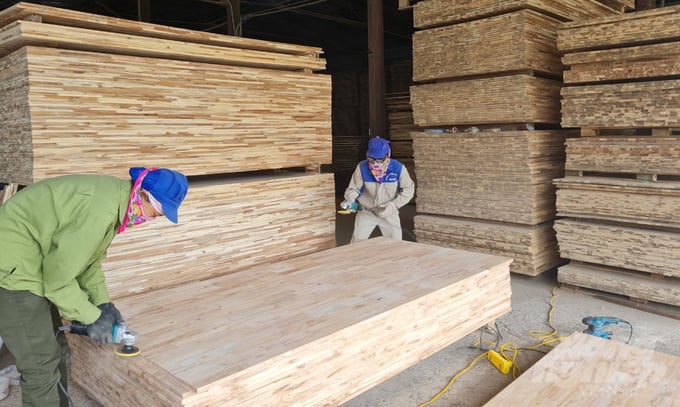
With a substantial expanse of raw forests and an abundant workforce, the wood industry in Nghe An province is sufficiently equipped to expand and conquer even the most demanding markets. Photo: Viet Khanh.
Between 2017 and 2022, Nghe An province successfully mobilized over 2,700 billion Vietnamese dong to undertake the task of managing, safeguarding, and developing forests. Accordingly, the central budget funds accounts for 413 billion Vietnamese dong, and the remainder amount is derived from ODA and other legal sources of capital.
Comprehensive forest development activities have brought substantial accumulated value to the wood industry, thereby contributing to the local economic development objectives. This is evidenced by the stable annual increase in forest area in Nghe An province, maintaining an average 18,000 hectares of various types of concentrated forest.
The rapid expansion of planted forests, which surpasses the rate of decline, not only enhances environmental protection but also improves the living standards of local people, forest owners, and the wood industry.
With the aim of rapid expansion, Nghe An province needs to target beyond the current 170,000 hectares of planted forests. According to the approved planning, the province sets the target to increase the scale of timber forest area to 257,490 hectares by 2025, and 283,562 hectares by 2030.
Translated by Nguyen Hai Long

(VAN) China’s cooking oil is suddenly flooding into India. It all comes down to a soybean surplus that Beijing doesn’t quite know what to do with.

(VAN) An Giang promotes supply-demand connections, standardizes quality and builds value chains, creating a foundation for sustainable bird’s nest development and aiming to expand exports.
/2025/11/24/5339-4-nongnghiep-075331.jpg)
(VAN) Recently, the conference on 'Sustainable Fisheries Linkage Chain - Tilapia for Export' took place in Tien Hai commune, Hung Yen province.
/2025/11/21/4309-2-153400_128.jpg)
(VAN) Green and low-emission rice is paving the way for Vietnamese rice to enter high-end markets, marking the beginning of a transformation journey toward greening and elevating the national rice brand.

(VAN) ‘Right to Win’ outlines a national action plan that shapes a new vision for Viet Nam’s agriculture in an era of renewal and global integration.

(VAN) Lam Dong’s farmed sturgeon output this year is expected to reach 2,300 tons, worth VND 450 billion, affirming the brand’s position on the market.

(VAN) A surge in Ukrainian egg exports, largely driven by soaring sales to the UK over the last few years, has notably pushed up egg prices on the domestic market.
