November 25, 2025 | 19:32 GMT +7
Hotline: 0913.378.918

November 25, 2025 | 19:32 GMT +7
Hotline: 0913.378.918
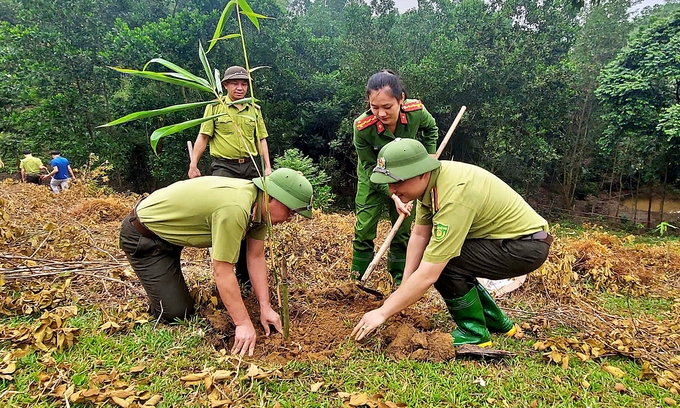
Yen Bai Provincial Forest Rangers, together with local people and relevant authorities, are planting forests. Photo: Bao Thang.
The Ministry of Agriculture and Rural Development (MARD) is urgently developing the Vietnam Forest Carbon Standard for application in the domestic carbon market. Based on international practices, a carbon standard typically includes six main components: measures to mitigate greenhouse gas emissions; spatial scope, reference period, and crediting period; methods for measuring, calculating, and reporting emissions and carbon absorption, including determining additionality; identification of risks such as leakage, emission displacement, and reversals; ensuring environmental and social safeguards; and processes for verification, validation, and credit issuance.
Creating internationally tradable carbon credits requires significant costs, including expenses for implementing mitigation measures, developing concepts and detailed documentation, conducting measurements and reporting, validation, credit issuance, and maintaining registry accounts. Due to the complexities and the need for a comprehensive legal framework, Deputy Director Pham Hong Luong suggested that farmers focus on simple measures like agroforestry at the household level to proactively balance emissions. He emphasized, “Agricultural production inherently involves emissions. Therefore, even at the household level, farmers should develop plans to plant more trees to enhance carbon absorption.”
To calculate emissions reductions from forest ecosystems, experts typically examine two primary carbon pools: the carbon stored in the biomass of living trees, both above and below ground. Estimates show that these two pools account for over 90% of the total carbon in forest ecosystems and are highly variable due to human impact.
Based on this, the Forestry Department has proposed various emissions reduction measures, including forest protection, restoration, and productivity enhancement. Additionally, scaling up agroforestry models increases carbon storage and conserves soil.
According to Mr. Pham Hong Luong, Deputy Director of the Forestry Department, prior to 2010, the forestry sector was a net emitter, with peak emissions reaching nearly 15 million tons of CO2e annually. This was partly due to increased deforestation and inefficient use of intercropped agricultural and industrial crops.
Using coffee cultivation as an example, Mr. Lượng highlighted that agroforestry coffee plantations create rich habitats for various species, maintaining ecological balance and minimizing pest intrusion. Furthermore, intercropped trees in agroforestry systems reduce soil erosion, preserve organic matter and nutrients, and enhance the recycling of trace elements.
Dense greenery in agroforestry systems also helps regulate temperature, humidity, and light levels for coffee plants, reducing water evaporation and greenhouse gas emissions. "Coffee grown under agroforestry absorbs more CO2 than traditional monoculture systems," Mr. Luong explained, attributing this to the combined CO2 absorption of coffee plants and shade trees.
Promoting agroforestry also motivates farmers to adopt eco-friendly practices such as using organic fertilizers and recycling waste like coffee husks into biofertilizers, improving soil quality and contributing to carbon neutrality or negative emissions.
Despite its many outstanding advantages, the agroforestry model still has some limitations, such as competition between coffee plants and intercropped species, or a decline in coffee yield due to shading from perennial tree canopies.
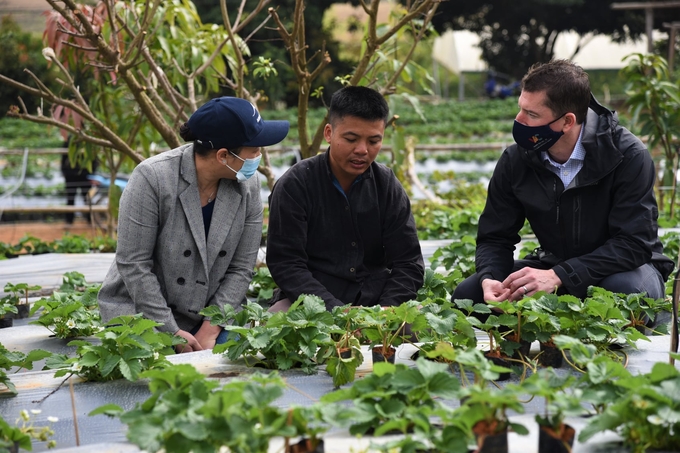
The CIFOR-ICRAF organization provides guidance, training, and workshops on the agroforestry model for the people of Sơn La. Photo: Bao Thang.
Dr. Ha Cong Tuan, former Permanent Deputy Minister of Agriculture and Rural Development and President of the Agricultural Economics and Rural Development Science Association, recalls that from 2010 to 2020, the forestry sector made a “breakthrough” in reducing emissions. From emitting 15 million tons of CO2e, the sector stabilized carbon absorption at 40 million tons of CO2e.
“Vietnam has done a relatively good job of protecting forests, with less forest encroachment than before. However, without improving forest quality, carbon absorption will remain unchanged, as there is no additional land for natural regeneration,” he explained. He also noted that about 80% of annual forest planting is dedicated to exploitation and replanting.
The Sustainable Forest Management Certification Office (VFCO) has measured carbon storage across various forest types in Vietnam, revealing significant disparities. Specifically: rich forests absorb 123–206 tons of carbon per hectare, medium forests store 100–155 tons of carbon per hectare, poor forests store only 84–123 tons of carbon per hectare, regenerating forests store 66–106 tons of carbon per hectare.
Natural regenerating forests have the lowest carbon storage, at only 19–35 tons of carbon per hectare. “This emphasizes our responsibility to preserve, protect, and enrich forests as much as possible. Once degraded, it takes a long time for carbon storage to return to its previous level,” stressed VFCO Director Vũ Tấn Phương.
Mr. Phuong further noted that upgrading forests from poor to medium quality takes decades, while restoring them to rich forest status takes even longer.

Many agroforestry models have been developed based on coffee plants. Photo: TL.
Based on the national forest status announced by the Forest Protection Department, areas of forest with low and medium-low carbon storage account for the largest proportion nationwide, but these areas have shown an increasing trend in recent years. In contrast, areas with high carbon storage (mainly concentrated in the Central Highlands and South Central regions) have been decreasing due to the pressures of deforestation and forest degradation.
Vietnam has made strong commitments to reducing greenhouse gas emissions, aiming for Net Zero by 2050. According to Mr. Lương Quang Huy from the Department of Climate Change (Ministry of Natural Resources and Environment), the ultimate goal of establishing a carbon market and participating in the global exchange is to reduce emissions, not to create surplus economic value.
Currently, the two major emitting sectors, energy and agriculture, have developed emission reduction plans and issued guidelines on greenhouse gas inventories, measurement, and reporting. These serve as the basis for reporting sectoral contributions to the nation's climate commitments.
In addition to its significance in carbon storage, the CIFOR-ICRAF organization also applies agroforestry models aimed at transitioning to sustainable food systems. These studies are particularly important in remote and isolated areas, helping ethnic minority communities stabilize their livelihoods.
Translated by Kieu Chi

(VAN) Deputy Minister Nguyen Quoc Tri emphasized the determination to prevent violations at CoP20, sharing enforcement results and commitments to strengthen cooperation with the international community in the coming period.

(VAN) In addition to strengthening the relationship between schools and enterprises, the Aus4Skills project expands opportunities for female students and people with disabilities to work in the transport and logistics sector.

(VAN) Nghe An is preparing policy, technical, and resource steps to participate in the forest carbon credit market.
/2025/11/25/1648-2-110733_532.jpg)
(VAN) From 2011 to 2023, Ca Mau province lost approximately 6,200 ha of coastal land and protection forests due to erosion, threatening many residential areas, infrastructure facilities, and production zones.

(VAN) Quang Ngai holds strong potential for carbon credits but needs a clear legal and policy framework to secure sustainable revenue from this resource.

(VAN) With its diverse ecosystem, Phu Quoc National Park plays a vital role in environmental protection and biodiversity conservation and serves as the core zone of the Kien Giang World Biosphere Reserve.

(VAN) Cooperation activities under the Aus4Skills program focus on: logistics professional development, competency-based training and assessment (CBTA), leadership innovation, and digitalization.