June 5, 2026 | 07:25 GMT +7
Hotline: 0913.378.918

June 5, 2026 | 07:25 GMT +7
Hotline: 0913.378.918
According to the Plant Protection Sub-Department of Lam Dong province, Lam Dong is currently the leading locality in the application of biotechnology, especially in tissue culture technology (invitro) in the production of plant varieties.
In addition to rapidly multiplying disease-free high-quality seeds for domestic production, invitro production facilities have gradually improved their capacity. They also focus on producing seeds for export to many countries around the world.
The whole province of Lam Dong currently has 56 organizations and individuals investing in the field of invitro seed production. Da Lat city accounts for the majority with about 47 establishments.
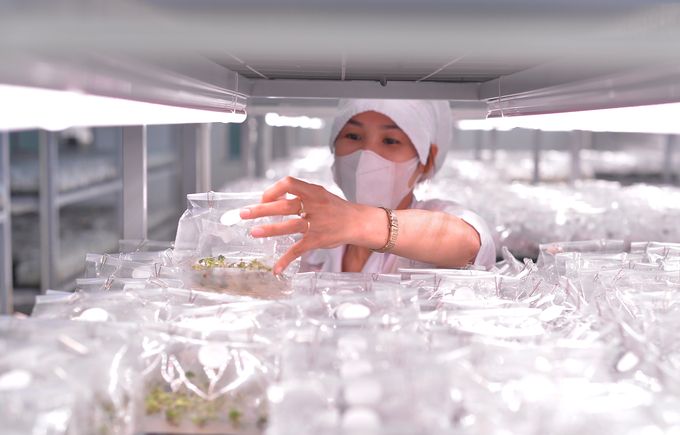
Lam Dong currently has 56 organizations and individuals investing in invitro seed production. Photo: Minh Hau.
In 2021, these local tissue culture facilities have produced 72.32 million plants including varieties such as chrysanthemums (27.86%), ornamental plants (52.4%), gerbera (1.74%), orchids (6.8%), carnations (2.09%), Salem (1.6%), strawberry (1.7%), purple star (0.76%), potato (3.2%), other plants (1.85%) and 27.8 tons of dried cordyceps mushrooms and button mushrooms.
The output of tissue culture seedlings for export reached 35 million plants (an increase of 1.6 million plants compared to 2020), and the export value in 2021 reached $9 million. Mr. Ha Ngoc Chien, Director of the Lam Dong Plant Protection Sub-Department, said that in the first 6 months of 2022, local tissue culture facilities produced 37.3 million flower seedlings for farming in the province. These varieties include chrysanthemum, gerbera, orchid, carnation, and salem. "In the first six months of the year, the locality also exported 20 million invitro seedlings with a total export value of over $6.2 million", Mr. Ha Ngoc Chien, Director of the Lam Dong Plant Protection Sub-Department said.
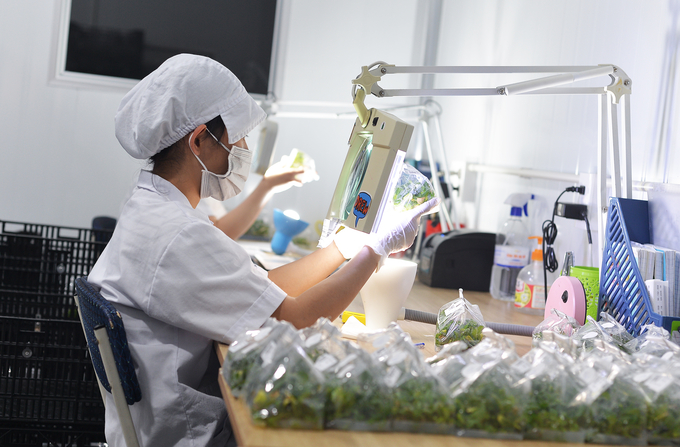
In 2021, invitro seed production facilities in Lam Dong supplied 72.32 million seedlings of all kinds to the market. Photo: Minh Hau.
Currently, out of 56 invitro seed production facilities in Lam Dong province, 22 have announced quality standards for plant varieties. Their production reaches over 60 million seedlings per year (accounting for 83.4% of the province). Companies with large seedling production are Da Lat Flower Forest Biotechnology Joint Stock Company; Quang Nguyen Co., Ltd; Highland Vitro Joint Stock Company (HIVICO); F1 Biotechnology Co., Ltd.…
Lam Dong is a leading locality in the field of invitro seed production, however, current seed production facilities are still facing many difficulties and need supportive solutions. Accordingly, the biggest problem is still that the facilities for invitro seed production do not have synchronous and modern investments. According to the Plant Protection Sub-Department of Lam Dong province, most of the facilities have not met the technical requirements of the isolation space between the transplant room and the tissue culture room. The facilities have not yet built and applied the process and mainly based on their experience… In particular, human resources and technicians with high professional qualifications are still lacking and unable to meet production requirements.
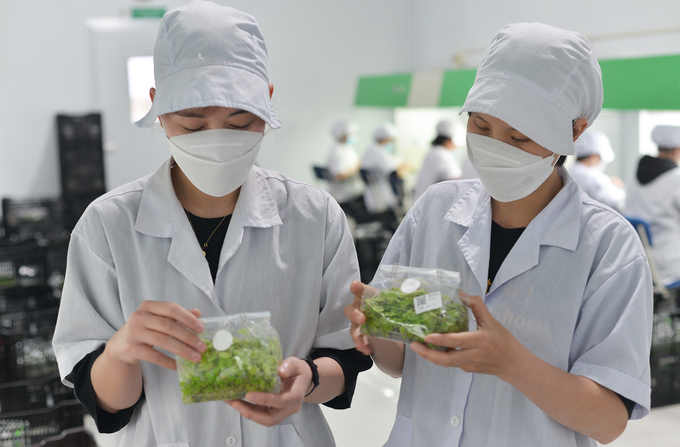
In 2021, Lam Dong province's invitro seedling output reached 35 million plants, with an export value of $9 million. Photo: Minh Hau.
In addition, the problem of the initial breeding source is a major obstacle. Facilities have no clear origin and the initial breeding sources are not disease-free before being put into tissue culture. Most facilities select elite plants from production gardens to propagate, so there is a potential risk of pests from the mother plant, spreading disease on a large scale in production and seed degradation.
For the invitro field to develop, the agricultural sector of Lam Dong province suggested that the People's Committee of Lam Dong province should have solutions. The People's Committee of Lam Dong province should direct relevant sectors to research and propose specific mechanisms for land and attract investment. Especially import and use equipment, chemicals... Simultaneously, there is an additional plan for public investment from the state budget or other capital sources to invest in the agricultural Products Quality Certification and Analysis Center. This is for standardization and quality control of invitro seedlings and other agro-products.
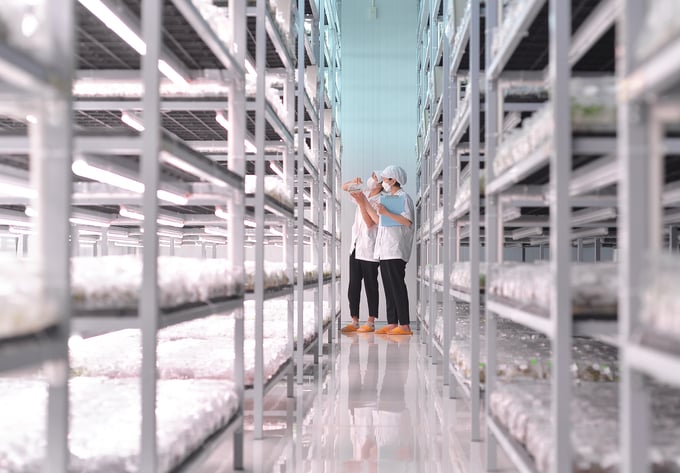
The agricultural sector of Lam Dong province is encouraging businesses and production facilities to import copyrighted seeds from countries around the world to serve invitro seed production. Photo: Minh Hau.
According to Mr. Ha Ngoc Chien, head of the Plant Protection Sub-Department of Lam Dong province, the agricultural sector also suggested that the Flower Association and tissue culture facilities focus on investing in facilities. They should also focus on investing in modern equipment and new technology for in vitro seed production and implementation of seed control measures to ensure disease free.
"We also recommend the Flower Association and invitro seed production facilities to import and purchase copyrights of new, high-value mother plant varieties to serve production in the province. At the same time, they should strengthen linkages and cooperation activities, exchange experiences, expand production scale and capacity to gradually form an invitro seed production industry," said Mr. Ha Ngoc Chien.
According to the Plant Protection Sub-Department of Lam Dong province, most local enterprises and invitro seed production facilities have not been able to purchase copyrights of original varieties. They have to select parent plant varieties through trial production in the field. Through the survey and investigation, seed production facilities choose the method of selecting mother plants. This means taking the original varieties (imported varieties, domestic varieties) that are produced in the field, and evaluating the uniformity of each variety in each garden. They then select gardens that meet the criteria for various characteristics from here and choose excellent plants and bring them back to the breeding garden. Finally, they continue monitoring these varieties for the next 02-03 crops for evaluation; if it ensures stable growth and good disease resistance, and ensures 100% color through 2 to 3 breeding seasons, it will be used as a mother plant.
The selection of mother plants is mainly done by Centers, Institutes, Universities, and some businesses with large investment capital. While the small production facilities only deploy the rapid multiplication of varieties from the production garden without selecting the mother plant. The risk of affecting seed quality is very high, especially the problem of pest management in the field.
Translated by Hoang Duy

(VAN) Due to heatwaves and water shortages, weed outbreaks are surging in the Mekong Delta’s summer-autumn rice crop. Dong Thap is ramping up early-season weed management to cut costs and safeguard yields.

(VAN) At the Vegetable and Fruit Seed Research and Production Farm in Bac Ha, pear, peach, and plum orchards are carefully maintained to conserve valuable genetic resources and support the development of temperate fruit crops.
/2026/06/02/4947-3-223411_779.jpg)
(VAN) Protecting forests not only preserves natural resources but also helps safeguard water sources, living environments, and the foundation for long-term sustainable development.

(VAN) Jackfruit prices remain low despite the recent increase as exports to China struggle. Dong Nai is tightening quality control to restore the market.

(VAN) Mekong Delta farmland is degrading due to chemical abuse. Restoring soil with organic and microbial fertilizers while reducing chemicals is now urgent.
/2026/06/01/1824-2-211343_500.jpg)
(VAN) Quang Ngai province is implementing many measures to protect sargassum resources, contributing to restoring aquatic resources, preserving biodiversity, and creating sustainable livelihoods.

(VAN) Farmers in Phu Thuan Commune, Da Nang preserve healthy soil and maintain chemical-free farming seasons, producing clean sesame and bean export products.
