December 3, 2025 | 03:12 GMT +7
Hotline: 0913.378.918

December 3, 2025 | 03:12 GMT +7
Hotline: 0913.378.918
The Khanh Hoa Provincial People's Committee has recently issued a Plan to implement Resolution No. 37/NQ-CP, dated May 27, 2025, by the Government regarding the Implementation Plan for the National Marine Spatial Planning for the period 2021–2030, with a vision to 2050
Accordingly, for key tasks to be carried out by 2030, Khanh Hoa province will focus on coordinating with ministries, sectors, and central agencies to implement the main task groups specified in Resolution No. 37/NQ-CP. At the same time, the province will proactively carry out specific groups of tasks within its jurisdiction. These include: finalizing spatial and land-use planning; developing coastal, marine, and island infrastructure; promoting sustainable marine economic development aligned with green growth, circular economy models, and low-carbon principles; ensuring environmental protection and the conservation of marine biodiversity; fostering scientific and technological research as well as training and developing high-quality human resources in the fields of marine and island management; and preparing detailed land-use plans for both coastal areas and islands.
Notably, in terms of promoting a green and low-carbon marine economy, the Provincial People’s Committee has assigned the Department of Agriculture and Environment to lead, in coordination with relevant departments and coastal localities, the effective implementation of the pilot project for high-tech marine aquaculture in Khanh Hoa - approved by the Prime Minister under Decision No. 231/QD-TTg dated January 24, 2025, and specified by the Provincial People’s Committee in Plan No. 1884/KH-UBND.
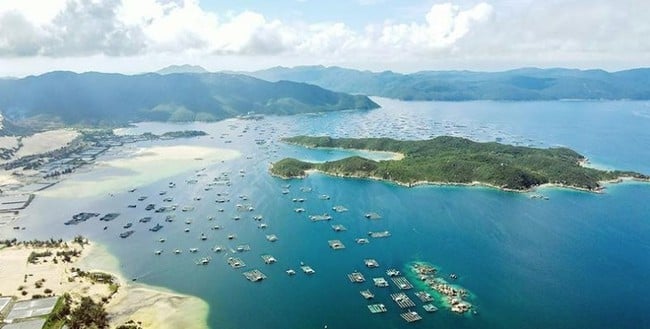
The People’s Committee of Khanh Hoa Province has requested coastal localities to accelerate the development of islands in alignment with a green, circular, and low-carbon economy, with high resilience to climate change, while also integrating efforts to ensure national defense and maritime security. Illustrative image.
In addition, the Khanh Hoa Provincial People's Committee has assigned the Department of Agriculture and Environment to implement the Plan for combating illegal, unreported, and unregulated (IUU) fishing within the province. This plan is expected to contribute significantly to the sustainable development of the fisheries sector while ensuring the province’s international integration.
The Department of Culture, Sports, and Tourism has been tasked with preparing the dossiers for the inventory, classification, and ranking of heritage sites at the provincial, national, and special national levels. At the same time, the department is responsible for cataloging and proposing the inclusion of intangible cultural heritage elements into the National List of Intangible Cultural Heritage, as well as for recognition as world heritage and documentary heritage. From this, the province will continue to preserve and promote the value of heritage, historical traditions, and marine cultural identity, while building a society that is closely connected to and friendly with the sea.
Particularly, the Khanh Hoa Provincial People's Committee has emphasized the need for coastal localities to accelerate the development of islands in alignment with a green, circular, and low-carbon economic model. This development approach must ensure high resilience to the impacts of climate change while also strengthening national defense and maritime security.
Translated by Phuong Linh

(VAN) MAE is leading in developing a national rare earth strategy, which will be submitted to the competent authorities for promulgation in early 2026.
/2025/12/02/4006-4-092040_652.jpg)
(VAN) The model of converting low-efficiency rice land to aquaculture in many localities has helped increase incomes by 5 to 15 times, improve the environment, and form new fisheries economic zones.

(VAN) Funded by ACIAR, Project FST/2020/123 focuses on measures to prevent harmful alien species, thereby protecting forests from invasive threats.

(VAN) The National Assembly's Supervisory Delegation pointed out solutions for the blue economy, circular economy, environmental protection, and technology application for sustainable marine governance.

(VAN) Lao Cai’s forestry sector is stepping into the spotlight with a series of pioneering initiatives in forest management, monitoring, and sustainable development aimed at generating carbon credits.

(VAN) The Provincial Competitiveness and Governance Index (PCGI) is a tool designed to reflect the quality of local governance.

(VAN) An environmental expert has outlined eight strategic actions for Vietnam to successfully meet its commitment to achieve Net Zero emissions by 2050.
