December 9, 2025 | 12:51 GMT +7
Hotline: 0913.378.918

December 9, 2025 | 12:51 GMT +7
Hotline: 0913.378.918
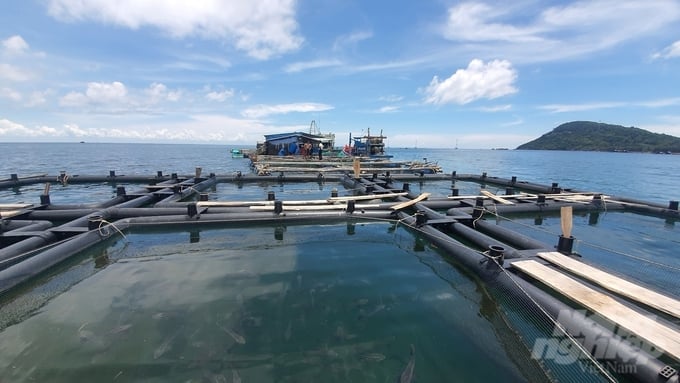
Aquaculture cages made from HDPE plastic in Dam Bay, Phu Quoc city. Photo: Kien Trung.
Aquaculture farmer in the An Thoi sea region in Phu Quoc City, Kien Giang province have been gradually transitioning from using traditional wooden cages to HDPE plastic cages to enhance economic efficiency and environmental protection.
Prior to the implementation of HDPE plastic cages, fish farmers in the Phu Quoc sea region primarily utilized manually crafted wooden cages reinfocred with nails, screws, and plastic loops. In addition to being vulnerable to strong waves and winds, these traditionally crafted cages can typically last up to three years. Additionally, the wooden cages were physically rigid and prone to breakage due to frequent impacts with ocean waves and saltwater corrosion. The small surface area of these manually crafted cages was limited by the length of the wooden poles, rendering them cumbersome and difficult to relocate during natural disasters or storms.
Furthermore, the scarcity of wood materials has increased the cost of creating these traditional fish cages, thereby raising the cost of this aquaculture practice.
As a result, numerous aquaculture households in Phu Quoc have trended towards using industrially assembled HDPE plastic cages since May 2022.
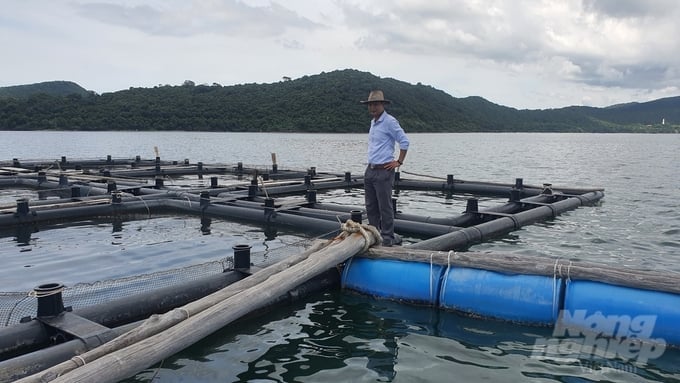
Mr. Tran Nam Chung next to the HDPE plastic aquaculture cages. Photo: Kien Trung.
Mr. Tran Nam Chung from the Directorate of Fisheries under Ministry of Agriculture and Rural Development, commented: "The material used for industrial aquaculture cages are primarily 100% HDPE plastic connected by heat welding technology. They boast a lifespan of over twenty years. They can also withstand harsh weather conditions, possesses high elasticity, and endures extreme bending forces. Most importantly, industrial aquaculture cages, constructed in a Lego-like assembly, allow for flexible adjustments in size according to the farmers' needs.
The initial cost of building industrial aquaculture cages is higher compared to manually crafted wooden cages. However, plastic cages can last seven times longer, thereby extending the duration for cage fish farming. Additionally, industrial aquaculture cages allow farmers to relocate them to avoid storms. Finally, the industrial plastic cages also contribute to local landscape in addition to protecting the marine environment."
Mr. Nguyen Van Truong's aquaculture household has experimented with nine industrial aquaculture cages to replace the manually crafted wooden cages in the Dam Bay area, An Thoi sea region since May 2022. Each cage, with each side measuring 5 meters, covers an area of 25 square meters. These cages are designed to be connected with one another and form a cohesive unit. The plastic tubes used for the cage framework, which consist of elongated pipes with a diameter of 250 centimeters, are positioned close together to form pathways, allowing traversal for farming activities.
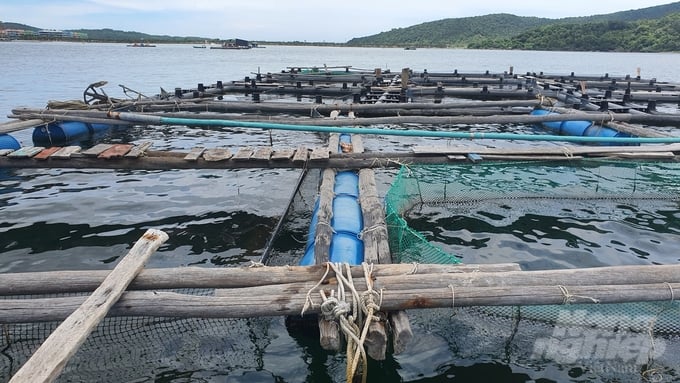
Wooden aquaculture cages are less efficient and durable compared to industrial aquaculture cages, and cannot be relocated to avoid storms. Photo: Kien Trung.
"The HDPE plastic cages feature higher appeal as well as safety. According to the design, we have left space at the tube ends to raise the net surface, ensuring safety for the aquaculture cages. Additionally, it is possible to construct a plastic frame and columns in a roofed structure if needed," added Mr. Truong.
Mr. Truong is planning to develop an investment project to establish a mariculture area with modern technology, ensuring an ecological environment and contributing positively to the agricultural restructuring of the province. This project aims to stimulate coastal economic growth and create high-value productsin combination with tourism.
Accordingly, Mr. Truong plans to convert wooden cages into 25 HDPE aquaculture cages (with each side measuring 10 meters).
In this area, Mr. Truong will separate the saltwater aquaculture zones according to species: oyster farming areas with suspended bamboo racks and HDPE floats covering approximately 5,000 square meters; and cage fish farming areas interspersed with seaweed covering 2,500 square meters.
"With the industrial aquaculture cage model, we estimate the mariculture output to reach between 50 and 100 tons from 2024 to 2030, oyster output between 50 and 100 tons, and seaweed output between 10 and 20 tons," Mr. Truong shared.
Phu Quoc is orienting towards developing aquaculture using high technology without affecting the landscape, ecological environment, and tourism development. The use of HDPE plastic aquaculture cages as a replacement for traditional cages contributes to marine environmental protection and enhances efficiency for aquaculture farmers.
Translated by Nguyen Hai Long

(VAN) After three years, Project FST/2020/123 collected approximately 3,000 insect specimens, classified them into about 50 morphological groups, and identified around 40 species, including several new species.
/2025/12/01/0509-2-175427_206.jpg)
(VAN) Emission-reducing coffee areas in Lam Dong have entered the new crop with stable yields, improved quality, and a remarkably enhanced cultivation environment.

(VAN) The Institute of Agricultural Sciences for Southern Vietnam (IAS) marked its 100th anniversary in Ho Chi Minh City, celebrating a century of growth as a leading institute contributing significantly to Viet Nam’s agricultural development.

(VAN) An increasing number of livestock farms are using biogas generators to create a source of renewable electricity, helping to save costs and mitigate environmental pollution.

(VAN) Small changes in rice cultivation, from irrigation methods and straw collection to input management, are paving a new way for Vietnam's agriculture in the journey toward emission reduction.

(VAN) With the project of converting biogas into renewable electricity, Australia is both helping pig farms reduce their energy costs by up to 25% and contributing to environmental protection.
![Hue aims for Net Zero: [1] Initial steps from green transportation](https://t.ex-cdn.com/nongnghiepmoitruong.vn/608w/files/huytd/2025/11/28/0853-anh-6-giao-thong-xanh-hue-094717_940-153724.jpg)
(VAN) For sustainable development, Hue City is implementing many solutions to promote green transportation, which is an important initial step on the journey to building a Net Zero Hue.
