December 9, 2025 | 06:32 GMT +7
Hotline: 0913.378.918

December 9, 2025 | 06:32 GMT +7
Hotline: 0913.378.918
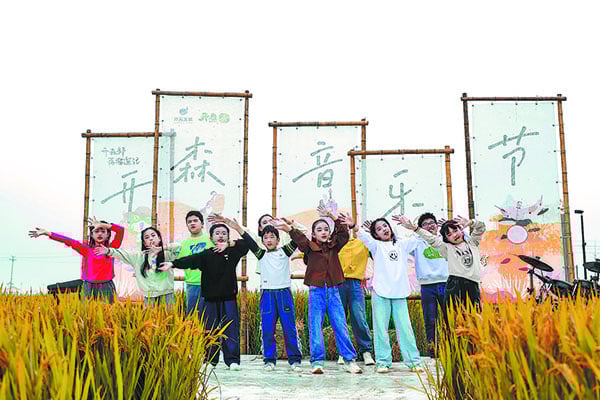
Young visitors participate in a music festival at Kaisen (Happy) Tribe, a popular rural retreat in Wangjiangjing town, Jiaxing city, Zhejiang province. Photo: CND.
This rural retreat in Xiuzhou district, Jiaxing in East China's Zhejiang province, has become a popular escape for urban travelers from the Yangtze River Delta region, especially those from Shanghai, since opening in October last year.
The site blends natural village landscapes with children's play facilities, parent-child camping, agricultural exploration, and environmental education.
The Grand Canal, threading through the heart of the town, has long shaped its identity — a slow, powerful artery that once carried grain, people and stories.
In recent decades, as freight routes shift and industries modernize, old warehouses stand silent, bridges gather moss, and the stories of boatmen and local crafts fade into the background.
As the country places renewed emphasis on the preservation and revitalization of the Grand Canal, local efforts have been made to repurpose the idled resources.
Mo Xiaohua, who is in charge of the operations of Kaisen (Happy) Tribe, says popular attractions now include a reptile museum, unique accommodations like cylindrical concrete pipe rooms, and interactive activities such as rice field tours and animal encounters.
"The core philosophy of our entire tribe is to create a boundless classroom in nature," Mo explains.
He emphasizes the concept of forest-style education and community growth, aligning with Wangjiangjing's broader vision to vigorously develop canal-themed experiential education and leverage nature-based learning and canal cultural tourism to create a new family vacation destination in the region.
From its early planning stages, the project was guided by principles of green development and low-impact construction.
Its goal is to revitalize an abandoned village on the original site by utilizing the area's natural landscape of forests, rice fields and ponds, and transform what was once a single-function space into an ecologically rich environment.
During construction, the designers also took great care to seamlessly integrate diverse areas — playgrounds, fishponds, farms and rice paddies — through thoughtful details and facilities, Mo says.
The effort has paid off, as the tribe manages to attract up to 10,000 visitors on peak days, with high occupancy rates.
It is working to build more hotel rooms featuring distinctive local elements, Mo adds.
The project is the latest addition to the Jiaxing canal culture and tourism resort in Wangjiangjing.
The goal is to make the area feel alive — not an open-air museum or a scenic spot where visitors are not allowed to touch anything, says Shen Tao, an official with the canal resort's administration.
Since its launch in 2018, the resort has pursued a "heritage-first" development model, he notes.
The resort's identity is deeply rooted in its UNESCO-recognized heritage.
The Changhong Bridge, a magnificent stone arch structure dating back to the Ming Dynasty (1368-1644), is part of the Grand Canal's UNESCO World Heritage site designation in 2014.
Complementing this historical backbone are the region's abundant water resources — 11 lakes, each spanning over 66.7 hectares — that epitomize the classic water town landscape in the regions south of the Yangtze River.
This aquatic environment has shaped local traditions, from lotus cultivation to the unique ancient fishermen's celebration.
For instance, a granary complex from the 1960s has been turned into a vibrant cultural space with a speciality cafe, while preserving its distinctive architecture of the '60s. Another granary conversion highlights a digital culture hub featuring VR theaters and avant-garde performances.
A meticulously reconstructed steam locomotive based on relics from the Suzhou-Jiaxing Railway stands as both a visitor center and a patriotic education site, complete with preserved wartime bunkers bearing visible bullet holes.
The railway connected Suzhou of Jiangsu province and Jiaxing for about eight years since its opening in 1936, before being largely dismantled during the Chinese People's War of Resistance Against Japanese Aggression (1931-45).
Those sites have proved especially appealing to younger travelers looking for perfect social media moments, Shen says.
Future plans include expanding night tourism options, enhancing digital integration, and developing a youth soccer training base for regional sports tourism, he adds.
(Chinadaily)
![Hue aims for Net Zero: [5] Building a green and sustainable city](https://t.ex-cdn.com/nongnghiepmoitruong.vn/608w/files/content/2025/12/03/bai-5-anh-6-105459_830-111605.jpg)
(VAN) Hue City continues its efforts to build and maintain a green, sustainable, and environmentally friendly city, joining the Government in pursuing the goal of Net Zero by 2050.

(VAN) After 10 years of operation, Aus4Skills has awarded more than 500 scholarships and enhanced the skills of over 40,000 students, contributing to the strengthening of the strong relationship between the two countries.
![Hue aims for Net Zero: [4] The effectiveness of ERPA payments](https://t.ex-cdn.com/nongnghiepmoitruong.vn/608w/files/content/2025/12/02/bai-4-anh-1-103726_244-093242.jpg)
(VAN) In Hue City, ERPA payments have proven highly effective, serving as a green finance tool that helps reduce carbon and greenhouse-gas emissions and move closer to the Net Zero target.

(VAN) At the TARASA25 Conference, participating countries shared experiences on implementing agroecology and regenerative agriculture, contributing to a sustainable transformation of food and agriculture systems.

(VAN) Green industry is becoming a driving force for the development of Hue City, not only promoting economic growth but also protecting the environment, creating the foundation for the Net Zero goal.

(VAN) As of 2025, the ASEAN region has a total of 69 ASEAN Heritage Parks recognized across its 10 member states. Among them, Viet Nam contributes 15 ASEAN Heritage Parks.

(VAN) Yok Don National Park has high biodiversity with numerous endemic plant and animal species, and it is also the only dipterocarp forest ecosystem conservation area in Viet Nam.
