November 23, 2025 | 22:48 GMT +7
Hotline: 0913.378.918

November 23, 2025 | 22:48 GMT +7
Hotline: 0913.378.918
Scientists have provided a comprehensive, global, and spatially explicit economic assessment of carbon sequestration and storage in these three coastal ecosystems, at both global and national levels. This new approach, based on the specific social cost of carbon, allows for the calculation of each country's contribution and the redistribution of global blue carbon wealth.
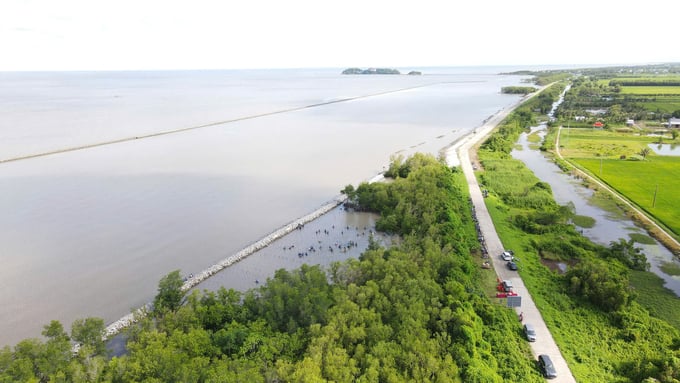
Mangrove forests not only provide economic benefits but also play a crucial role in combating climate change. Photo: Trong Linh.
The process of carbon sequestration and storage in blue carbon ecosystems contributes to the creation of blue carbon wealth, which refers to the value of carbon stored within these ecosystems. This component is particularly relevant to blue carbon wealth (coastal), encompassing all the values of coastal ecosystems.
The use of the global social cost of carbon allows for the assessment of the wealth derived from carbon ecosystems and social costs. The social cost of carbon storage and sequestration reflects an integrated investment approach, considering changes in overall assets while accounting for the damages caused by carbon emissions.
The social cost measures the present value of all global climate damages resulting from the emission of an additional ton of CO₂ into the atmosphere. Different countries contribute to blue carbon wealth in varying degrees, as they differ in their rates of carbon sequestration and storage in coastal ecosystems, as well as the implicit social costs associated with carbon in each country.
However, in aggregated reports, it is not possible to assess the contribution to comprehensive investments arising from the process of carbon sequestration and storage through specific sinks and their spatial models. Global summaries also do not provide sufficient support for decision-making at the national level.
These reports overlook the fact that countries differ in the size of their blue carbon ecosystems and in the valuation of the sequestration and storage potential of these ecosystems. The global social cost of carbon is considered the basis for current global estimates of the contribution of blue carbon sequestration and storage, as well as estimates for specific regions.
Globally, coastal ecosystems contribute an average of 190.000 to 30 billion USD per year to blue carbon wealth. The three countries making the largest net positive contributions to global blue carbon wealth are Australia, Indonesia, and Cuba. Among them, Australia contributes up to two-thirds, with the remaining third coming from other parts of the world, through the sequestration and storage of carbon in coastal ecosystems within its territory.
Coastal ecosystems such as mangrove forests, salt marshes, and seagrass meadows are important global carbon sinks, sequestering and storing carbon at rates significantly higher than terrestrial forests on a per-unit area basis. The recognition of their importance led to the invention of the term “blue carbon” in 2009.
As a result, the conservation and restoration of Blue Carbon Ecosystems (BCEs) are increasingly recognized as a crucial contribution of ocean-based activities to the global effort to mitigate climate change. Their preservation has gained significant attention worldwide.
Nevertheless, there remain substantial uncertainties surrounding the spatial extent of BCEs and the various factors that influence their ability to sequester and store carbon. One of the most pressing challenges for policymakers and decision-makers is the lack of reliable, comprehensive, and quantifiable data on the economic value generated by these ecosystems at the national level.
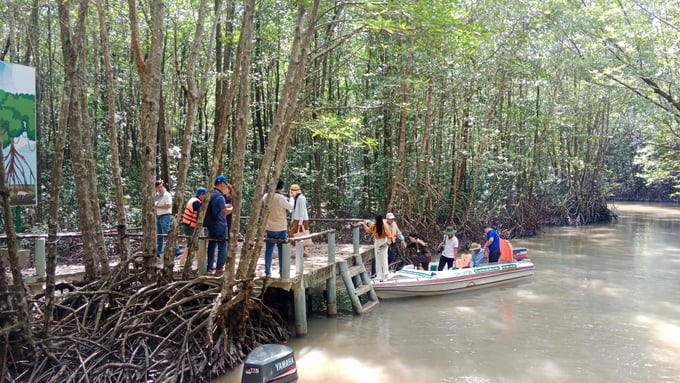
Mangrove forests help prevent coastal erosion, reduce the impact of tidal waves, and protect coastal ecosystems. Photo: Trong Linh.
To evaluate the contribution of Blue Carbon Ecosystems to global and national wealth, the assessment is based on the processes of carbon sequestration and storage, with a focus on how these processes contribute to overall societal well-being. This approach takes into account the various ecological and economic benefits provided by BCEs, including their role in mitigating climate change by absorbing and storing carbon.
Valuation of these ecosystems is grounded in economic theories related to wealth and comprehensive investment. Among the many vital services that coastal ecosystems provide, experts prioritize carbon sequestration and storage services. These services are seen as crucial components of blue carbon wealth
Human actions have increased carbon dioxide concentrations in the atmosphere to levels higher than any measured over the last 160.000 years. Growing concern over the potential severe impacts of climate change is driving research into ways ecosystems can mitigate global warming by storing excess carbon in plants and soil.
It is also critically important to restore mangroves, particularly in deltaic regions, where they can enhance these ecosystems' ability to absorb and store carbon dioxide from the atmosphere. By improving our understanding of how mangroves function under different conditions, we can better safeguard and expand these valuable blue carbon stores.
Translated by Phuong Linh

(VAN) Applying green technology in rural water supply and sanitation helps improve resource efficiency, protect the environment, and enhance community living standards.

(VAN) Developing biosecure livestock production is the key that helps Tuyen Quang form linked chains in livestock production and build its brand in the market.

(VAN) During his bilateral activities in South Africa, Prime Minister Pham Minh Chinh welcomed Vice President of the South African Chamber of Commerce and Industry Neil Pollock.

(VAN) Prof. Dr. Hoang Van Cuong, National Assembly Deputy of the 14th and 15th terms, shares recent pioneering policy decisions.

(VAN) Deputy Minister Tran Thanh Nam directed a comprehensive reform of the agricultural extension system, emphasizing professionalism and connecting farmers with the market.
/2025/11/22/3633-1-072521_760.jpg)
(VAN) The signing ceremony took place under the witness of Prime Minister Pham Minh Chinh and President of the Republic of South Africa Cyril Ramaphosa.

(VAN) Severe flooding in Khanh Hoa Province has caused catastrophic damage estimated at around USD 30 million, with the agriculture and irrigation sectors alone accounting for roughly USD 15.7 million in losses.
