September 1, 2025 | 16:41 GMT +7
Hotline: 0913.378.918

September 1, 2025 | 16:41 GMT +7
Hotline: 0913.378.918
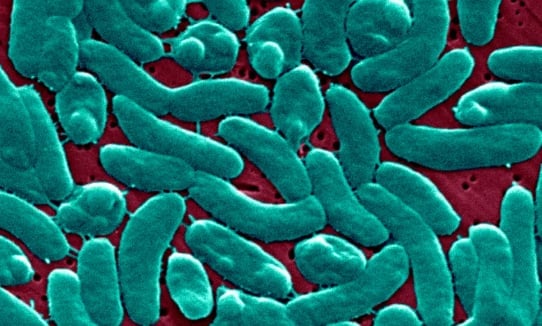
An electron micrograph of Vibrio Vulnificus bacteria. BSIP/Universal Images
This time, he noticed a tiny scratch on his leg – a scratch that nearly cost him his life.
Lyons went about his day but woke up the following morning feeling “delusional.” Feverish and vomiting, he initially thought he had just contracted a stomach bug, but then discovered a series of blackening sores spreading across his left leg.
In what turned out to be a life-saving move, he went straight to his family doctor.
Lyons tells CNN his doctor immediately knew “exactly what it was” and sent him straight to the emergency room. In the “matter of maybe an hour,” Lyons found himself in the hospital’s operating room.
That small scratch on Lyons’ leg became the entryway for Vibrio vulnificus, also known as flesh-eating bacteria. Those black sores on his leg signified necrotizing fasciitis, which “affects the tissue under your skin,” according to the Cleveland Clinic.
These potentially deadly bacteria are naturally found and thrive in coastal waters during the warmer months, especially in brackish waters, where fresh water meets the sea, according to the US Centers for Disease and Control Prevention. Once largely confined to the Gulf Coast, cases have surged along the East Coast, with an 800% increase from 1988 to 2018, according to the CDC.
“Do I have permission to do what I need to do to save your life?” Lyons’ doctor asked.
These were the last words Lyons recalled hearing before surgery. He immediately understood the seriousness of the situation and realized his leg may have to be amputated.
“I was given a 50/50 chance of coming out of the hospital alive at that point,” he said.
His surgeons were able to both cut away the infection and save Lyons’ leg. After three days in the intensive care unit, three weeks in the hospital and various antibiotics, he was “cleared of the bacteria.”
It has been more than three months since he contracted the flesh-eating bacteria, yet his recovery is far from over.
Recovery has not been comfortable for Lyons, who has diabetes; he describes it as a “misery.” Yet, he remains hopeful that a skin graft will be the final step in getting his leg back to “normal.”
Vibrio vulnificus should generally not pose a fatal risk to the average person, Mississippi’s State Health Officer Dr. Daniel Edney tells CNN. People with a weakened immune system have a higher risk of contracting an infection, Edney said.
If you plan to be in coastal water, assume it is contaminated with Vibrio and avoid the water if you have “cuts or wounds that could be potentially infected,” according to Edney.
However, Vibrio infection doesn’t occur only through wound-to-water contact. It can also stem from consuming certain foods.
“CONSUMING RAW OR UNDERCOOKED MEATS, POULTRY, SEAFOOD, SHELLFISH OR EGGS MAY INCREASE YOUR RISK OF FOODBORNE ILLNESS, ESPECIALLY IF YOU HAVE CERTAIN MEDICAL CONDITIONS.”
This warning, often found in small print at the bottom of restaurant menus, may look familiar. In Louisiana, this specific warning must be “clearly visible” at all establishments that sell or serve raw oysters – with few exceptions – according to the Louisiana Department of Health.
Vibriosis can also be contracted by eating raw or undercooked shellfish. Most often it’s a less serious infection from a different type of the bacteria, causing only stomach discomfort, but can occasionally find its way into the bloodstream, according to the CDC.
Oysters get their food by filtering out sea water. When that water is ripe with bacteria, a single oyster could contain as many as a million Vibrio vulnificus cells, according to Dr. Jim Oliver, a professor at the University of North Carolina at Charlotte.
Though it’s rare, “many people with Vibrio vulnificus infection can get seriously ill and need intensive care or limb amputation. About 1 in 5 people with this infection die, sometimes within a day or two of becoming ill,” according to the CDC.
Louisiana was one of the first states to bring attention to this infection this season after it saw a spike in cases.
By the end of July, officials reported 17 hospitalizations and four deaths among Louisiana residents, more than double what they typically see. At least three more cases were reported in August.
This potentially deadly bacteria is not just unique to the Gulf states and is being found farther north as water temperatures rise.
The Massachusetts Department of Public Health identified an “extremely rare” case of Vibrio vulnificus from a resident exposed to coastal water near Martha’s Vineyard. So far this year, Massachusetts has confirmed 71 cases, with a 30% hospitalization rate and no deaths.
Massachusetts, however, is not the only East Coast state reporting increased cases. Virginia Department of Health officials say cases of vibriosis across its residents have been “increasing over the last ten years.”
Cases in North Carolina have increased 620% over the past 10 years, and New York’s have more than tripled.
Scientists link this trend to climate change.
The oceans are getting warmer and sea level is rising because of human-caused climate change, and scientists warn these factors are increasing the risk of Vibrio infections.
Oliver, the UNC Charlotte professor, added that melting glaciers are lowering ocean salinity – another factor that increases the threat. “Open sea salt water has too high of a salinity rate for Vibrio vulnificus,” he explained. But when fresh water dilutes it, the “conditions become more favorable.”
As the climate warms, more bacteria stays alive through the winter, which worsens outbreaks in the summer because we’re starting from an already elevated level.
Dr. Rachel Noble, a professor at the University of North Carolina at Chapel Hill who has studied Vibrio since the early 2000s, told CNN the increased prevalence of this potentially deadly bacterium is being “repeated globally,” indicating a “complexity of issues related to climate change.”
“This isn’t going to be the only pathogen that increases in the face of climate change,” Noble said. “It’s just one example, but one we can really learn from.”
Lyons is encouraging others to learn about Vibrio and hopes local leaders will spread awareness by posting additional signage to warn both residents and visitors. Any wounds, even a tiny scratch, should be thoroughly washed with soap and clean running water, according to the CDC.
“I hope my story helps people understand what to look out for,” Lyons said. It might even “save a life.”
If you develop symptoms, “seek help immediately and get to the emergency room,” Lyons urges. “That’s the best thing. Just go there and hopefully you’ll see someone who will recognize it for what it is, because a misdiagnosis can be a death sentence. It really can be.”
CNN

(VAN) Interview with Máximo Torero on key takeaways from SOFI 2025 report.

(VAN) Researchers have discovered that replacing 50g/kg maize with a 50:50 mix of pineapple and orange peels could offer poultry producers a sustainable feed option.

(VAN) Global rice markets are bracing for turbulence after reports that India, the world’s largest rice exporter, is preparing to release around 20 million tonnes of stockpiled rice in September.
(VAN) FAO, UNICEF, WFP and WHO reiterate call for immediate ceasefire and unhindered humanitarian access to curb deaths from hunger and malnutrition.

(VAN) As wildfires rage in southern Europe and crop losses only set to increase in the coming years, producers are getting creative to beat the heat.
(VAN) A new outbreak of highly pathogenic avian influenza (HPAI) has been confirmed by Argentinian authorities at a layer farm in Buenos Aires, Argentina.
