December 5, 2025 | 15:14 GMT +7
Hotline: 0913.378.918

December 5, 2025 | 15:14 GMT +7
Hotline: 0913.378.918
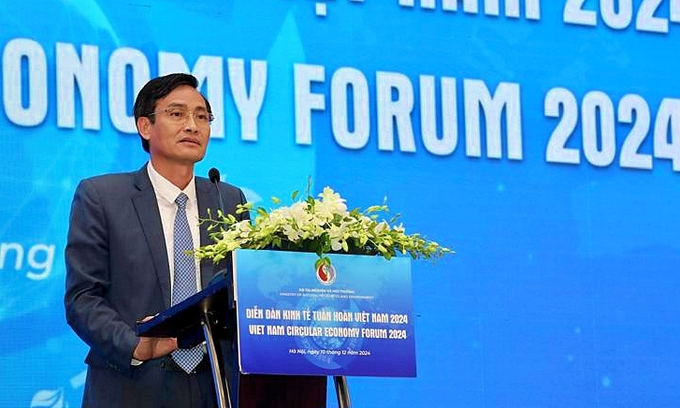
Deputy Minister of Natural Resources and Environment Tran Quy Kien speaks at the forum. Photo: Viet Dung.
At the Vietnam Circular Economy Forum 2024, Associate Professor Dr. Nguyen Dinh Tho, Director of the Institute of Strategy and Policy on Natural Resources and Environment, said that developing a circular economy is of great significance to the world as it can reduce 40% of emissions by 2050 and reduce more than 2 billion tons of solid waste each year.
Decree 08/2022/ND-CP also specifies 3 pillars of the circular economy. These are: efficient use of resources, extending product life cycles and limiting waste generation.
On that basis, the Ministry of Natural Resources and Environment has advised the Government to submit a National Action Plan on the Circular Economy. It has also developed and issued many application, implementation assessments, and operation guidelines, such as data sharing and connection platforms.
The Government, in Decision 687/2022/QD-TTg, also approved the circular economy development project, emphasizing the role of creating momentum for innovation, improving labor productivity, promoting green growth associated with economic restructuring, renewing the growth model, and enhancing competitiveness.
Additionally, increasing the resilience of businesses and supply chains to external shocks, ensuring harmony between economic prosperity and environmental sustainability, social justice, and carbon neutrality by 2050.
Currently, Vietnam is building many circular economy models. For example, in agriculture, there are four popular models: Creating and using gas from livestock and crop waste; Combining crop, livestock, aquaculture, and agroforestry models; Using crop by-products as catalysts; and Moderation model.
Eco-oriented industrial parks were also piloted in Ninh Binh, Da Nang, and Can Tho in the 2015-2019 period and are being implemented in Ho Chi Minh City, Dong Nai, Da Nang, and Hai Phong. Nearly 1,000 energy-saving solutions have been proposed.
"We need to expand such models," said Mr. Tho, emphasizing that participants have many opportunities when green financial capital flows are increasingly strong, pressure to convert from new-generation FTAs, and increasing consumer awareness and demand.
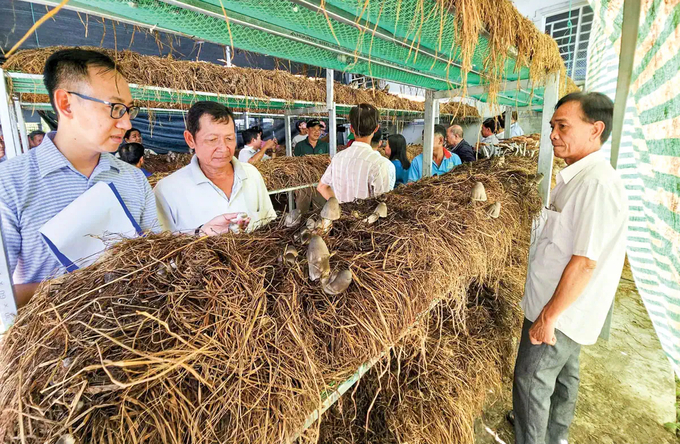
When promoting a circular economy, straw is considered an available material source in Vietnam. Photo: Khanh Trung.
At the forum, Deputy Minister of Natural Resources and Environment Tran Quy Kien acknowledged that Vietnam has been an active and responsible participant in the global fight against climate change.
In addition to the 2020 Law on Environmental Protection, Vietnam has integrated circular economy development into strategies, programs, projects, planning, and development plans of sectors, fields, and localities. Industry associations, business communities, organizations, and individuals support these programs.
Regarding the National Action Plan for Circular Economy Implementation, the Deputy Minister informed that it would institutionalize and specify manufacturers' and distributors' responsibilities while managing projects according to their life cycles and establishing a roadmap for developing and applying environmental standards and regulations.
The plan also proposes a number of options to promote cooperation, helping businesses access financial and technological support to implement the circular economy. Along with that, promote communication to raise awareness and responsibility of the community.
"Realizing the National Action Plan for implementing the circular economy contributes to developing good practices, creating a green culture and lifestyle while promoting green job creation and developing new value chains in the circular economy sector," he said.
The leader of the Ministry of Natural Resources and Environment called for the attention and participation of organizations and individuals, considering this as a driving force for implementing the circular economy, especially the pioneering group of enterprises.
Agreeing with this view, Ramla Khalidi, Resident Representative at UNDP, outlined 4 priorities that Vietnam needs to implement to promote the circular economy.
Firstly, integrating ecological and circular design into policies and including measurable goals in the implementation roadmap.
Second, prioritize key sectors such as agriculture, electronics, plastics, textiles, and construction materials to help Vietnam meet international standards and open up opportunities for sustainable growth.
Third, ensuring effective institutions and sound governance structures that help reduce barriers and promote innovation.
Finally, the transition to a circular economy is a whole-of-society effort that puts people and social equity at the center, while fostering relationships with international partners.
Vietnam is a pioneer country committed to reducing net carbon emissions to zero (Net Zero) by 2050. The commitment demonstrates Vietnam's responsibility to the international community for sustainable economic development. According to the roadmap, the Government aims to pilot the carbon credit exchange market operation by 2025. Therefore, businesses need to adapt to new trends proactively and should be prepared in the process of building and planning strategies to reduce emissions in each stage of production.
Translated by Huong Giang

(VAN) As of 2025, the ASEAN region has a total of 69 ASEAN Heritage Parks recognized across its 10 member states. Among them, Viet Nam contributes 15 ASEAN Heritage Parks.

(VAN) Yok Don National Park has high biodiversity with numerous endemic plant and animal species, and it is also the only dipterocarp forest ecosystem conservation area in Viet Nam.

(VAN) Viet Nam and Brunei signed two important MOUs on fisheries and IUU, expanding cooperation in agriculture, the environment, and Halal exports, aiming to substantively implement joint projects.

(VAN) The Viet Nam Coconut Association worked with the International Finance Corporation (IFC) and businesses to promote the supply chain, enhance competitiveness, and develop the coconut industry sustainably.
![Hue aims for Net Zero: [2] Pioneering low-emission tourism](https://t.ex-cdn.com/nongnghiepmoitruong.vn/608w/files/huytd/2025/12/04/0633-dulichzero-4-095634_236-161125.jpg)
(VAN) The ancient capital of Hue has developed Net Zero tourism products and models, aiming to reduce carbon emissions and pioneer the establishment of Viet Nam's green tourism destination.

(VAN) C.P. Viet Nam has announced the successful completion of its goal to plant 1.5 million trees during the 2021-2025 period, a key milestone within company's long-term ESG strategy and its roadmap for emission reduction.

(VAN) This is an initiative of MAE aimed at creating a unified coordination mechanism to implement agricultural cooperation programs with developing countries.
