November 19, 2025 | 21:03 GMT +7
Hotline: 0913.378.918

November 19, 2025 | 21:03 GMT +7
Hotline: 0913.378.918

Deputy Minister of Agriculture and Rural Development Hoang Trung spoke at the conference. Photo: Le Hoang Vu.
On August 20 in Long An, the Ministry of Agriculture and Rural Development held a conference to summarize crop production in 2024 and deploy the plan for crop production in 2025 in Mekong Delta provinces and cities.
Crop production plays an important role in the Mekong Delta region, contributing to ensuring food security as well as the region's socio-economic development. In 2024, the country's agricultural production in general and the Mekong Delta's crop production industry in particular will face both advantages and challenges.
According to Mr. Le Thanh Tung, Deputy Director of the Department of Crop Production (Ministry of Agriculture and Rural Development), for many years, the Ministry has proactively coordinated with localities to focus on implementing solutions to develop crop production and respond to market fluctuations, weather, and pests. Besides, the Ministry has also organized trade promotion and market openings to promote agricultural product consumption. Thanks to that, the crop production industry still maintains a fairly stable growth rate. Productivity and output of key products increased, ensuring food supply to serve domestic consumption and export needs.
In 2024, rice production in the Mekong Delta is estimated to reach 3.82 million ha, with an output of 24.14 million tons. Fruit trees have also improved in productivity, quality, and efficiency, with the region's fruit tree output reaching over 5.78 million tons.
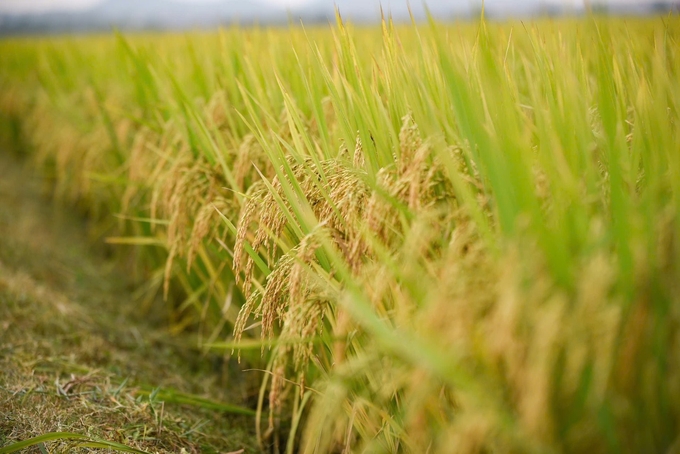
In the first 7 months of the year, the export turnover of agricultural, forestry, and fishery products in the entire agricultural sector reached USD 34.27 billion. Of which, crop products reached USD 18.21 billion, an increase of 23.4% over the same period. Photo: Le Hoang Vu.
In the first 7 months of the year, the export turnover of agricultural, forestry, and fishery products in the entire agricultural sector reached USD 34.27 billion. Of which, crop products reached USD 18.21 billion, an increase of 23.4% over the same period. Many export products have reached over USD 1 billion, such as coffee (USD 3.54 billion), rice (USD 3.27 billion), cashew nuts (USD 2.37 billion), and vegetables and fruits (USD 3.83 billion).
Informing the implementation of the 1 million ha of high-quality rice project in the Mekong Delta (referred to as the Project), Mr. Le Thanh Tung said that up to now, seven models with a total area of 333.5 ha have been deployed in the 2024 summer-autumn crop in five provinces, including Can Tho City, Soc Trang, Tra Vinh, Dong Thap, and Kien Giang.
An Giang province has started sowing for the first Project participating area of 15 ha in Phu Tan district on August 12, 2024. Long An has also sown a model of 20 ha in Tan Hung district and prepared a plan to sow for seven models in the 2024 autumn-winter and 2024-2025 winter-spring crops.
Although Bac Lieu has not yet started implementing the Project, the province has implemented two models with an area of 120.5 ha towards implementing the Project. In addition, many businesses also participate in providing input materials and services for production and purchasing products for farmers in the Project.
Mr. Nguyen Minh Lam, Vice Chairman of the Long An Provincial People's Committee, said that the province has an area of agricultural land of about 310,000 ha. The area of rice farming for 3 crops/year is about 500,000 ha. The output reaches 2.8–2.9 million tons, and in 2023 alone, it reached over 3 million tons. The area of vegetables is about 10,000 ha, dragon fruit is 8,000 ha, and lemon is about 11,500 ha.
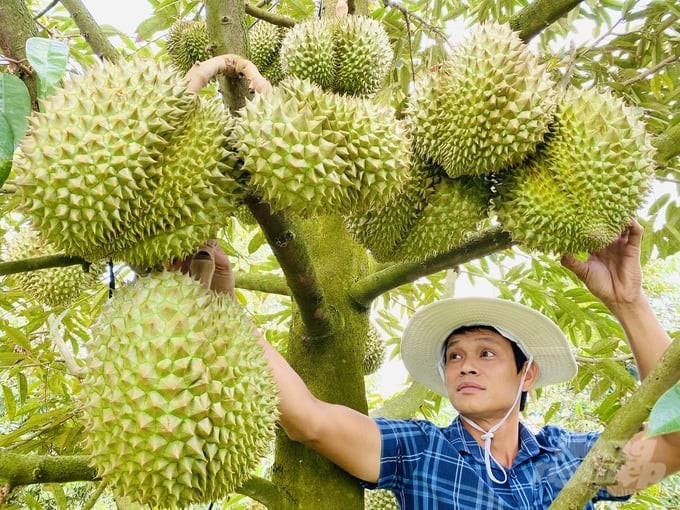
Fruit tree production in the Mekong Delta has grown impressively. Photo: Le Hoang Vu.
In recent times, Long An province has had many policies, programs, and mechanisms to promote the application of technical advances in agricultural production, especially breakthroughs in high-tech agricultural development associated with industry restructuring. As of now, Long An province has 60,000 ha of rice, 2,000 ha of vegetables, 6,000 ha of dragon fruit, and 3,000 ha of lemon that are applied with high technology, and six businesses are recognized as high-tech agricultural businesses.
According to Deputy Minister Hoang Trung, although the crop production industry has achieved many positive results in recent times, it is still facing a number of challenges, requiring the participation of actors in the industry chain for sustainable development.
Rice production in the Mekong Delta faces challenges from climate change, drought, and saltwater intrusion. Ineffective use of agricultural land causes land degradation. Using input materials (seeds, fertilizers, etc.) inappropriately wastes resources and pollutes the environment. The use of water sources and the ability to supply water to crops according to the crop frame still have many shortcomings. Consumption trends and export conditions have changed a lot. Accordingly, the issues of agricultural product quality and food safety must always be given top priority.
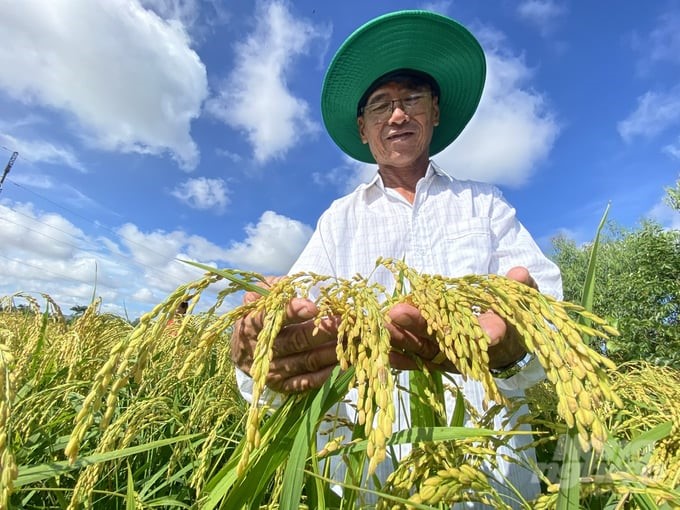
Rice production in the Mekong Delta faces challenges from climate change, drought, and saltwater intrusion. Photo: Le Hoang Vu.
Deputy Minister Hoang Trung required localities to enhance awareness and management capacity for farmers, businesses, and governments at all levels in safe production, construction, issuance, and good management of growing area codes, and ensuring traceability.
Based on identifying the difficulties and challenges of the crop production industry and orienting production in 2025, Deputy Minister Hoang Trung proposed eight focuses to develop the crop production industry in the Mekong Delta.
First, it is necessary to objectively evaluate the work of directing and governing crop production in the past year, focusing on difficulties that need to be resolved. Particularly, technical solutions need to be modified and supplemented to suit reality, and effective models and good practices need to be replicated. It is also essential to pay attention to complying with the crop calendar, avoiding the lesson of sowing outside the recommended crop that caused a loss of 1,662 ha in rice production in 2024.
Second, focus on removing obstacles and difficulties in the management of agricultural materials, growing area codes, and local packaging facilities.
Third, implement the Sustainable Development Project of 1 Million Hectares Specializing in High-Quality and low-emission Rice Cultivation Associated with Green Growth in the Mekong Delta until 2030.
Fourth, improve soil health and plant nutrition.
Fifth, promote joint ventures and linkages, develop the industry chain, and open the market.

The crop production industry is still facing many challenges. Photo: Le Hoang Vu.
Sixth, improve solutions and orientations to prevent drought and saltwater intrusion and adapt to climate change and irrigation solutions in the Mekong Delta to provide water for the development of crop production and living.
Seventh, implement projects and strategies in the crop production field that were approved by the Ministry of Agriculture and Rural Development and the Prime Minister.
Eighth, call on industry associations and businesses to increase participation in production and propose specific issues in the process of producing, trading, and linking with localities within the industry. Of which, focus on a number of products to open the market for export.
"In the coming time, localities need to focus on closely following forecasts of pests, diseases, water, saltwater intrusion, weather, etc. Focus on rice sowing according to the crop calendar recommended by the Department of Crop Production. Avoid the hot development of growing areas of some crops, especially durian and jackfruit. Increase the use of organic fertilizers and biological pesticides. Tighten the management of agricultural materials, inspect, examine, and coordinate with agencies, especially the police and market management, to strictly manage agricultural materials," emphasized Deputy Minister of Agriculture and Rural Development Hoang Trung.
Translated by Thu Huyen

(VAN) On November 18, Deputy Prime Minister Tran Hong Ha chaired the 22nd session of the National Steering Committee on Anti-IUU Fishing.

(VAN) Prime Minister Pham Minh Chinh has issued an official dispatch directing focused response efforts and the swift remediation of damage caused by recent floods in the Central region.

(VAN) Deputy Minister Nguyen Thi Phuong Hoa calls for prioritizing the livelihoods of coastal residents, particularly those impacted by marine economic development projects.

(VAN) People can now submit their land-use right certificates ('red books') via the VNeID application. This marks an essential step toward fully paperless public services in land administration in the near future.

(VAN) Fishermen and authorities in Khanh Hoa province are demonstrating strong resolve in the fight against IUU fishing, aiming to develop a sustainable fisheries sector and remove the European Commission's (EC) ‘yellow card.’

(VAN) Viet Nam has declared that it will develop and implement strong greenhouse gas reduction measures to achieve Net Zero emissions by 2050 and it is following through on that commitment.

(VAN) A comprehensive legal framework, tailored to domestic conditions, serves as the foundation guiding economic sectors toward low-emission development.
