December 7, 2025 | 23:13 GMT +7
Hotline: 0913.378.918

December 7, 2025 | 23:13 GMT +7
Hotline: 0913.378.918
Being a lecturer at a prestigious university in Hanoi, Lai Van Song and his wife suddenly resigned and switched to high-tech organic fruit and vegetable farming.
After just three years of investing and producing, the Song family was able to build up a 1-hectare farm for high-tech organic veggies namely DFARM in Dang Xa commune, Gia Lam district of Hanoi. He also invests in another 3-hectare farm in Quang Tri, specializing in growing many types of organic vegetables. The former in Dang Xa produced 20 tons of organic veggies and fruits annually.
Song said that the idea of growing high-tech organic veggies had been ignited for years. But, no sooner than grabbing favorable conditions, had he persuade his spouse to leave the job and follow their dream.
“From indoor to outdoor work, moving from a job with a stable income to a self-sufficient life is a very difficult decision. If I didn't have a burning passion, I would not have been able to successfully switch to organic vegetables and fruits," said Song.
After being approved by Dang Xa Commune People’s Committee for land leash, Song spent all his savings in addition to a bank loan to purchase all kinds of materials and means of production, transport alluvial soil from Duong River to improve low-lying fields, build a system of greenhouses, net houses, fertilize and water with automatic remote control. Then he started the process of growing organic vegetables.
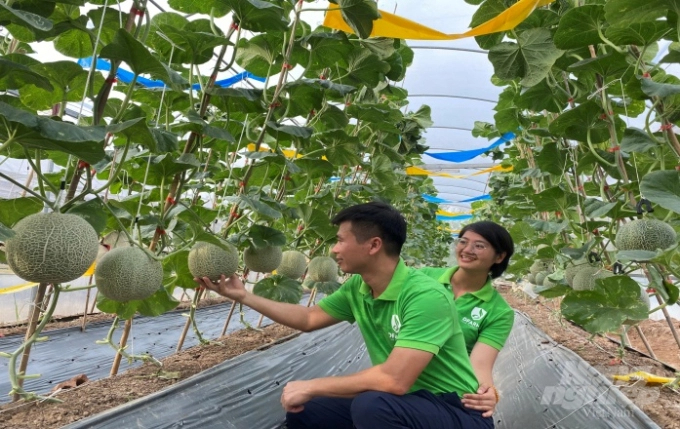
Song and his wife are happy to see organic melon growing successfully beyond expectations. Photo: H.Tien.
Thanks to logical thinking, all farming techniques were programmed in detail suitable for each growth stage of the crop. Therefore, right from the first production, he achieved success beyond expectations. Vegetables and fruits (asparagus, melons, melons, etc.) produced from the farm meet very high-quality standards and are sold by traders at a price three times higher than that of the same types with normal production.
Elaborating on the secret to growing organic veggies, he adds that complying strictly with the 5K regulation is a must, which is no chemical fertilizers, no growth stimulants, no genetically modified varieties, no chemicals pesticides, and no herbicides.
In weed control, it is necessary to use an agricultural mulch to cover the vegetable beds and trenches. Without chemical fertilizers, the productivity, quality, and high organic standards are remained by reputable microbial organic fertilizers and biological products, suitable for each growth stage of the plant variety.
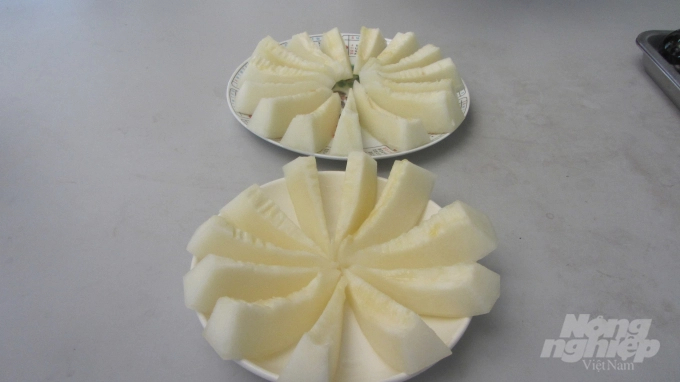
An organic cantaloupe product by Song. Photo: H. Tien.
To control pests and diseases, besides alternative herbal medicines, the prevention of pests and diseases from afar is considered the most basic solution, including Treatment of pathogens for seeds when sowing; Incubate seeds on trays to ensure healthy seedlings and save seeds.
Soil and growing medium must be thoroughly incubated or disinfected before sowing. Timely pruning of weak trees, branches, and yellow leaves, invalid leaves, to create ventilation for the vegetable garden.
Wrapping the fruit with a specialized plastic bag to prevent pests and diseases. Thoroughly clean up plant residues and plastic bags after each harvest. Sanitize and disinfect around and inside greenhouses and net houses. People and production tools must be disinfected before being brought to the farm among others.
Another is not to use lime or lime water in all production processes. Because organic vegetable growers only use microbial organic fertilizers and biological products of all kinds.
Thanks to the above methods, vegetables produced from Song's farm are always sold many times higher than that of vegetables and fruits of the same type produced by traditional methods. As a result, after only 3 years of construction and production, Song has recovered all fixed and working capital in the farm, worth over VND2 billion.
Currently, the 3-hectare DFARM in Quang Tri of Song has completed the construction of infrastructure, mechanizing and automating all organic vegetable production processes.
In the following years, Song will continue to rent land and build a chain of organic fruit and vegetable farms to export to the US and Europe.
It is known that in this spring-summer crop, Song collaborated with Gia Lam Economic Department (Hanoi) to test and successfully build the process of producing Fujisawa melon variety (Netherlands), as a basis to promote the District People's Committee to recommend for mass production.
Song is also very willing to share his experience of organic fruit and vegetable production with farmers nationwide.

(VAN) After three years, Project FST/2020/123 collected approximately 3,000 insect specimens, classified them into about 50 morphological groups, and identified around 40 species, including several new species.
/2025/12/01/0509-2-175427_206.jpg)
(VAN) Emission-reducing coffee areas in Lam Dong have entered the new crop with stable yields, improved quality, and a remarkably enhanced cultivation environment.

(VAN) The Institute of Agricultural Sciences for Southern Vietnam (IAS) marked its 100th anniversary in Ho Chi Minh City, celebrating a century of growth as a leading institute contributing significantly to Viet Nam’s agricultural development.

(VAN) An increasing number of livestock farms are using biogas generators to create a source of renewable electricity, helping to save costs and mitigate environmental pollution.

(VAN) Small changes in rice cultivation, from irrigation methods and straw collection to input management, are paving a new way for Vietnam's agriculture in the journey toward emission reduction.

(VAN) With the project of converting biogas into renewable electricity, Australia is both helping pig farms reduce their energy costs by up to 25% and contributing to environmental protection.
![Hue aims for Net Zero: [1] Initial steps from green transportation](https://t.ex-cdn.com/nongnghiepmoitruong.vn/608w/files/huytd/2025/11/28/0853-anh-6-giao-thong-xanh-hue-094717_940-153724.jpg)
(VAN) For sustainable development, Hue City is implementing many solutions to promote green transportation, which is an important initial step on the journey to building a Net Zero Hue.
