May 30, 2026 | 04:08 GMT +7
Hotline: 0913.378.918

May 30, 2026 | 04:08 GMT +7
Hotline: 0913.378.918
On the afternoon of March 28, within the framework of the first National Conference on Livestock and Veterinary Science and Technology, a panel discussion hosted by the Science and Technology Subcommittee on antimicrobial resistance, food safety, and veterinary issues drew significant attention from experts. The session provided a platform for scientists to exchange insights, share experiences, and take a comprehensive look at the current state of research in the poultry sector.
According to Associate Professor Dr. Hoang Minh Duc, Head of the Department of Public Veterinary Medicine at Viet Nam National University of Agriculture, the studies presented covered a broad scope. These included the isolation and assessment of antimicrobial resistance in common bacteria such as Escherichia coli, Clostridium perfringens, and Salmonella, as well as analyses of certain chemical indicators in raw vegetables and their implications for public health.

Associate Professor Dr. Hoang Minh Duc presented the report of the Science and Technology Subcommittee on antimicrobial resistance, food safety, and veterinary issues at the conference. Photo: Tung Dinh.
One notable study was presented by Dr. Dang Thi Thanh Son from the Viet Nam Institute of Animal and Veterinary Science, focusing on the situation in Thai Binh. The report highlights that livestock waste has become a massive “reservoir” of superbugs.
Specifically, the prevalence of bacteria resistant to Colistin, a last-resort antibiotic for multidrug-resistant infections, reached as high as 60.63% in pig manure from household farms. More concerning, the study identified a direct link to human health: up to 28.2% of hospitalized children in the locality were infected with drug-resistant bacteria (CRE), with resistance spanning 4 to 10 different classes of antibiotics.
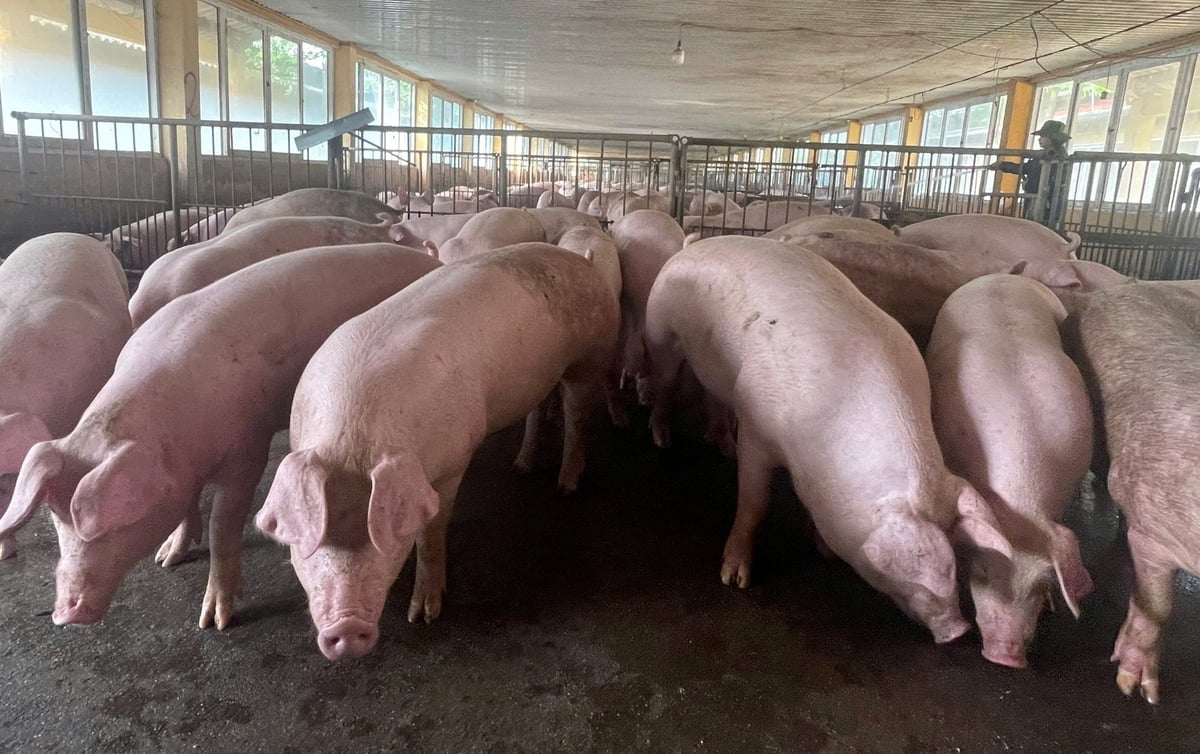
Livestock producers need to gradually reduce their dependence on antibiotics and shift toward treatment based on antimicrobial susceptibility testing (antibiograms). Photo: Quang Linh.
From another perspective, Dr. Luu Quynh Huong warned of food safety risks associated with reusing livestock wastewater treated through biogas systems to irrigate raw vegetables. The findings indicate that current treatment systems do not completely eliminate pathogens: Salmonella was still detected in 58.3% of wastewater samples and 16.7% of raw vegetable samples. This poses a direct threat to consumer health, with the potential to cause severe foodborne illness.
The discussion session also provided deeper insights into the misuse of antibiotics in livestock production at the local level. In Hue, although efforts are being made to conserve indigenous pig breeds, farming practices remain largely extensive or semi-intensive, leading to limitations in veterinary hygiene and vaccination. As a result, farmers tend to rely on antibiotics as a primary solution for both prevention and treatment.
Survey results show that up to 33.3% of households use antibiotics for disease prevention and 71.5% for treatment. Commonly used drugs include Amoxicillin, Colistin, and Enrofloxacin, which inadvertently create selective pressure and accelerate the emergence of multidrug-resistant bacterial strains.
Participants at the discussion session agreed that antimicrobial resistance (AMR) and food safety require a governance mindset at the national level, rather than fragmented, isolated solutions. According to Mr. Nguyen Van Long, Director General of the Department of Science and Technology, in the context where older-generation antibiotics have been largely “neutralized” by bacterial adaptation, a fundamental shift in thinking is needed.
“This is not just about prescribing practices - it is about effectively managing the entire value chain, from tightening control over industrial feed production and processed food manufacturing to establishing a regular antimicrobial resistance surveillance system to accurately assess the effectiveness of intervention measures,” he emphasized.

The reuse of livestock wastewater treated through biogas systems for irrigating raw vegetables may pose multiple potential risks. Illustrative photo.
“With the alarming rates of bacteria resistant to Carbapenem and Colistin, we must ensure comprehensive treatment of waste, from farms to healthcare facilities, through a multi-sectoral One Health approach. At the same time, strong interventions are needed to eliminate Colistin-resistant strains - the last line of defense in medical treatment,” Dr. Son stated.
Drawing from local practice, Mr. Nguyen Van Chao emphasized that changing the livestock production mindset is an urgent requirement. Specifically, farmers need to gradually reduce their reliance on antibiotics and shift toward treatment based on antimicrobial susceptibility testing, while strengthening control measures to effectively prevent cross-transmission from animals to humans.
A major bottleneck identified by participants is the limited level of concern among society and businesses regarding antimicrobial resistance, largely because it does not deliver immediate financial returns. This, experts warned, is both a misguided and dangerous perception. They called on the business community to recognize antimicrobial resistance as a direct threat to public health and the long-term viability of the livestock sector.
Investment in research on antimicrobial control and food safety should not be viewed as a cost, but as an investment in sustainable development. Only with strong and responsible engagement from the private sector, alongside clear governance direction from the State, can a robust “shield” be built against the increasingly complex threat of antimicrobial resistance.
Translated by Phuong Linh

(VAN) The family of Nguyen Duc Son in Cam Ly commune has developed a French pigeon farming model that delivers high income efficiency.
/2026/05/29/4633-1-073610_241.jpg)
(VAN) As the AgriCRF-VN project concludes, more than 7,700 farmers have been trained in climate risk financing management, while nearly 1,540 hectares of rice have participated in pilot agricultural insurance schemes.

(VAN) Digital technology adoption and supply chain integration have emerged as essential drivers for farmers, cooperatives, and enterprises seeking to sharpen their competitive edge and advance toward a modern, sustainable agricultural sector.

(VAN) Dong Thap is expanding water-saving rice models to cut costs and support the Scheme on 1 million hectares of high-quality, low-emission rice.

(VAN) Using freshly caught anchovies and the traditional fermentation techniques of Mr. Tran Van Tuan, Quynh Di fish sauce has earned a 3-star OCOP certification.
![Essence of highland villages: [2] Con Minh arrowroot vermicelli renowned far and wide](https://t.ex-cdn.com/nongnghiepmoitruong.vn/608w/files/huyenvt (e)/2026/05/28/4445-2-nongnghiep-144442.jpg)
(VAN) From a rustic dish in local family meals, Con Minh arrowroot vermicelli has risen to become a well-known product, conquering the European market.

(VAN) An organic guava cultivation model combining digital farm journals at the Yen Bai Agricultural and Forestry Products Trading and Processing Cooperative is yielding encouraging results.
