December 30, 2025 | 13:55 GMT +7
Hotline: 0913.378.918

December 30, 2025 | 13:55 GMT +7
Hotline: 0913.378.918
As of March 31, 2025, more than 2,100 major production facilities across the country will be required to complete their greenhouse gas inventory reports in accordance with government regulations. The list has been issued, the deadline set turning the question “Should we do this?” into an outdated mindset in corporate governance.

Vietnam set a target of achieving Net Zero by 2050. Photo: Illustration.
The greater challenge lies in the fact that greenhouse gas inventory is not a simple administrative form that can be completed in a few days.
It is a complex and prolonged process from defining emission boundaries, collecting and standardizing data on raw materials, energy, and production processes, to applying international emission factors and organizing independent assessments. If not done properly, or not done at all, businesses may face legal risks, lose their standing in global supply chains, or be excluded from green credit packages that are increasingly strict about emissions transparency.
In a world where "green" is no longer a bonus but a default standard, Vietnamese businesses can no longer afford to wait.
To help the business community overcome these initial hurdles, the “For a Green National Environment” Program has launched a nationwide campaign called the “Journey to Net Zero.”
More than just a communication initiative, the program aims to establish a long-term, in-depth support ecosystem that involves the direct participation of central ministries, local authorities, research institutes, financial institutions, and independent experts.
The National Conference on Journey to Net Zero will be held both online and in person, ensuring access for large enterprises in economic hubs as well as small and medium-sized businesses in remote areas.
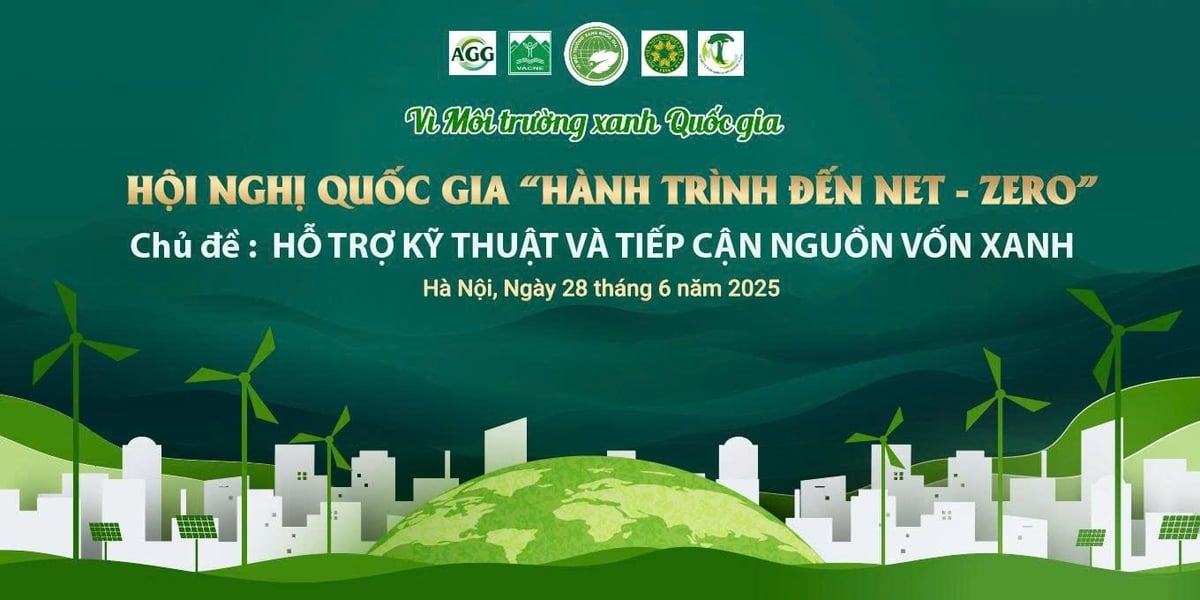
The National Conference, with the participation of central and local government agencies, as well as various organizations and individuals, will take place on Saturday, June 28. Photo: Organizing Committee.
Notably, the conference also features the participation of regulatory bodies and specialized agencies, who stand ready to guide businesses step by step through the greenhouse gas inventory process in accordance with Circular No. 17/2022/TT-BTNMT and the ISO 14068-1 standard.
From identifying emission types, analyzing data, and performing calculations to quality-checking the final reports. Every step will be clarified to ensure businesses can take initiative and avoid being caught off guard when deadlines arrive.
Dr. Hoang Hiep, Director of the Institute for Green Growth Research and Head of the Organizing Committee of the "For a Green National Environment" Program, emphasized: “We don’t want this Program to stop at raising awareness. Our focus is on technical depth and offering the business community practical, actionable support. This is a shared transition journey - a collective effort to pool social resources and promote a circular economy. No one is walking this path alone.”
Early participation not only helps businesses comply with regulations, but also unlocks long-term strategic value. A greenhouse gas inventory serves as a mirror reflecting a company’s internal operational strength. Through emissions data, businesses can identify weaknesses in energy efficiency, pinpoint the most resource-intensive processes, and from there develop targeted plans for improvement and long-term cost savings.
Beyond compliance, the Net Zero journey also opens access to Vietnam’s upcoming domestic carbon credit market, which is expected to launch on a pilot basis in 2027. In this market, each ton of reduced emissions could become a new revenue stream. Businesses that take control of their data and manage emissions effectively will hold a valuable asset in hand.

Green living and environmental protection are being incorporated into awareness campaigns targeting primary school students. Photo: Organizing Committee.
The image of a business that is transparent about its emissions is increasingly gaining trust among global partners. In a world where ESG has become a mandatory selection criterion across many export sectors, demonstrating emission reduction capability is no longer a choice. It is a prerequisite for survival.
That’s why the organizers of the “For a Green National Environment” Program and the “Journey to Net Zero” initiative are committed to ensuring that support is not limited to businesses with modern management systems or ample budgets. It is also directed toward small and medium-sized enterprises, those still grappling with paperwork and forms, and who desperately need clear explanations and hands-on guidance to get started.
At this point, inaction means self-exclusion from the race. Not participating means making the path to green integration harder for yourself. And refusing to connect with available support systems is like choosing to navigate a dense forest of policy alone.
Vietnam has made its commitment. The market is shifting. The door is open. The only question that remains is: What action will your business take and when? And if your answer still feels hesitant or uncertain, there’s a simpler first step you can take.
Join the National Conference “Journey to Net Zero” with the Institute for Green Growth Research on the morning of Saturday, June 28.
Translated by Kieu Chi

(VAN) Applied technologies, water-saving irrigation is a strategic solution to promote climate-resilient agriculture and strengthen water security in the uplands.
/2025/12/29/3936-3-163422_251.jpg)
(VAN) Can Gio mangrove forest in particular and the entire Can Gio Mangrove Biosphere Reserve in general hold great potential for carbon credits.

(VAN) Chu Pah Rubber has announced its products that comply with the EU Deforestation Regulation (EUDR), affirming its commitment to sustainable production and product origin transparency.

(VAN) Deputy Director Nguyen Hoai Nam stated that a digital data platform will be developed with agricultural sector databases, utilizing AI to help farmers make informed decisions on 'watering correctly, sufficiently, and efficiently.’
/2025/12/29/4841-2-134224_777.jpg)
(VAN) From only about 10 individuals in 2009, the wild elephant population in Dong Nai has recovered to nearly 30 animals after more than 10 years.

(VAN) The Bac Hai Van – Son Cha sea area holds significant ecological, economic, and national defense values, underscoring the need to establish a marine protected area to create an 'ecological belt' for the entire region.

(VAN) Amid the salty rhythm of life on the gem island, Co To is embarking on a journey to conserve the sea, protect livelihoods, and build a sustainable future for generations to come.
