December 31, 2025 | 13:03 GMT +7
Hotline: 0913.378.918

December 31, 2025 | 13:03 GMT +7
Hotline: 0913.378.918
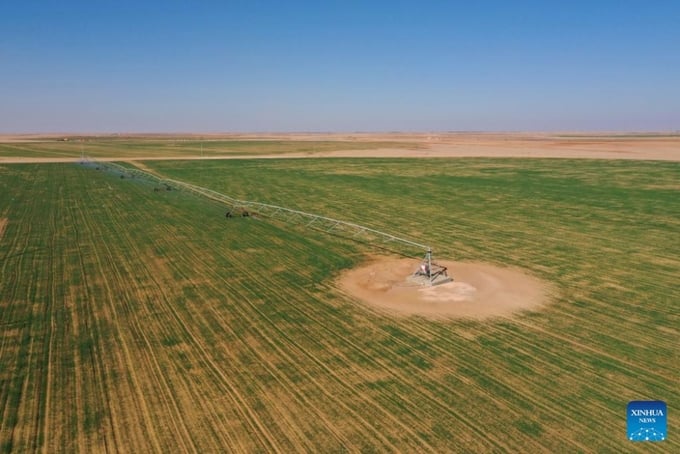
An aerial drone photo taken on Nov 23, 2024 shows farmlands developed after wells were dug by Chinese firm ZPEC in the desert of Aswan province, Egypt.
Against the vast arid landscape, patches of lush green wheat stand in striking contrast.
“Before, this place was an arid desert with no vegetation. Now, with the irrigation of well water, crops such as wheat have grown here, full of vitality and hope,” said Ahmed El-Sadani, beaming as he shared his story.
Sadani, 30 years old, is the deputy manager of the Aswan water well project of ZPEC (China’s Zhongman Petroleum and Natural Gas Group Co Ltd) branch in Egypt, responsible for managing six water well drilling teams on site.
He joined ZPEC in 2018 and has successively served as a mud engineer, water pump test engineer, and field engineer.
“During the past six years, I have accumulated more experience by working in several desert well-drilling projects,” Sadani said.
“Every time we see clear groundwater gushing out of the wellhead, my colleagues and I are very excited, knowing we’ve successfully drilled a new well.”
Egypt, home to over 100 million people, grapples with the daunting task of cultivating more land for agriculture, as only 5 per cent of its territory is currently arable.
To reduce reliance on food imports, the country has accelerated its desert reclamation initiatives since 2015.
In support of these efforts, ZPEC established its Egypt branch in 2016 under the framework of the Belt and Road Initiative (BRI).
Since then, the team, composed of Chinese and Egyptian workers, has tackled harsh desert conditions, drilling more than 540 wells across Egypt — from the Sinai Peninsula to Minya, Matrouh, and Aswan provinces.
Irrigated by underground water, the once barren desert has gradually transformed into fertile land.
At the Kom Ombo site, there are six drilling teams, comprising more than 200 Chinese and Egyptian employees, said Zhao Wutao, general manager of the ZPEC branch in Egypt.
The rigs operate 24 hours a day, with workers rotating in two shifts, he said.
Summer temperatures in Aswan often exceed 40 degrees Celsius, and conditions in the desert are even harsher.
Yet, the team adheres to strict safety protocols, donning full uniforms and protective gear despite the heat.
Amr Mohammed, 28 years old and one of the site engineers, used to work for an Egyptian drilling company and joined ZPEC last year.
“ZPEC is one of the best companies in the field of drilling water wells in Egypt,” said Mohammed, who is responsible for managing the team members and drilling technology.
“This area is yellow now, and it will turn green soon. Our work brings great benefits to the development of agriculture in Egypt,” Mohammed told Xinhua while pointing to the desert beside him.
Drilling wells in the desert is no easy task. Zhao explained that locating well sites required trekking through the trackless desert for hours with GPS devices.
Transportation of drilling equipment is another challenge.
“A piece of large-scale drilling equipment weighs 500 tons and must be dismantled into parts before being transported by 25 vehicles,” Zhao said.
“It takes 10 days to transport here from the work area in central and northern Egypt over 1,000 kilometres away,” he added.
“We are engaged in livelihood projects and contribute our modest efforts to the joint construction of the Belt and Road Initiative between China and Egypt. We are happy to see that the locals can benefit from the well water,” Zhao said.
Looking ahead, Zhao said ZPEC plans to deepen its involvement in Egypt’s agricultural development, creating more job opportunities and contributing further to the nation’s food security.
(Xinhua)

(VAN) Located in three former provinces, Nam Dinh, Thai Binh, and Ninh Binh, and now in two provinces, Ninh Binh and Hung Yen, "Red River Delta" is the name of Vietnam's first interprovincial coastal wetland World Biosphere Reserve.
/2025/12/29/1046-1-210728_624.jpg)
(VAN) In 2025, Viet Nam recorded severe and extreme disasters, breaking multiple historical records and causing heavy losses in lives, property, and infrastructure nationwide.

(VAN) Applied technologies, water-saving irrigation is a strategic solution to promote climate-resilient agriculture and strengthen water security in the uplands.
/2025/12/29/3936-3-163422_251.jpg)
(VAN) Can Gio mangrove forest in particular and the entire Can Gio Mangrove Biosphere Reserve in general hold great potential for carbon credits.

(VAN) Chu Pah Rubber has announced its products that comply with the EU Deforestation Regulation (EUDR), affirming its commitment to sustainable production and product origin transparency.

(VAN) Deputy Director Nguyen Hoai Nam stated that a digital data platform will be developed with agricultural sector databases, utilizing AI to help farmers make informed decisions on 'watering correctly, sufficiently, and efficiently.’
/2025/12/29/4841-2-134224_777.jpg)
(VAN) From only about 10 individuals in 2009, the wild elephant population in Dong Nai has recovered to nearly 30 animals after more than 10 years.
