December 8, 2025 | 05:41 GMT +7
Hotline: 0913.378.918

December 8, 2025 | 05:41 GMT +7
Hotline: 0913.378.918
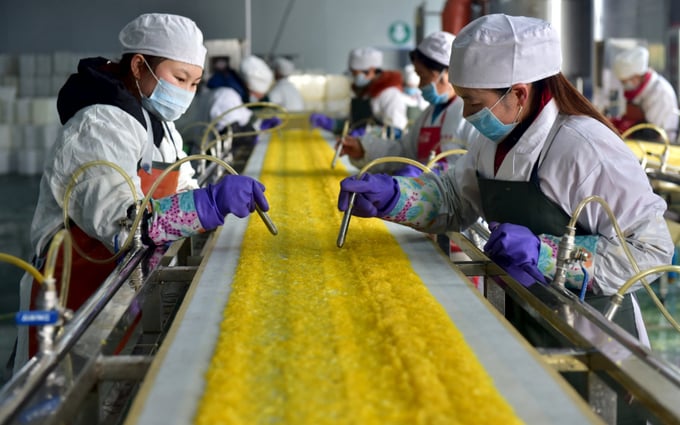
As public awareness of health grows, food safety has increasingly been a red line in society.
Parent oversight commissions should be established to ensure parents' rights to supervise the bidding and procurement of food materials, principals dining on the same food with students, the evaluation of food quality, food safety checks and transparency in expenses and revenues, according to a Ministry of Education document.
Headteachers are the first to be held accountable for campus food safety and the management of related funds, said the document. Schools should appoint food safety officers, with a dedicated food safety director required for cafeterias serving more than 500 individuals, it added.
Schools must conduct a food safety and satisfaction evaluation every semester among teachers and students, and among parents separately, and provide feedback on the results, according to the document.
Last month, parents accused a private middle school in Kunming, Southwest China's Yunnan province, of serving stale meat to students. An official probe found the pork in question was substandard due to improper transportation and storage.
As public awareness of health grows, food safety has increasingly been a red line in society. In response to the Kunming incident, for example, an investigation was launched the same day, with results made public three days later.
More notably, authorities have launched a province-wide campaign to identify and address potential food safety concerns on campus.
Law enforcement has also been intensified. Prosecutors said Wednesday that they had brought more than 24,000 related cases against 41,000 individuals in court between 2019 and 2023.
China has 1,610 national food safety standards, evaluating 340 food categories with 20,000 parameters. There are also more than 100 regional standards.
China prioritizes public health, with food safety at the top of its standards' agenda, Tian Jianxin, an official in charge of food standards, surveillance and assessment at the National Health Commission, said earlier this month.
(Chinadaily)
/2025/12/03/5125-2-204704_295.jpg)
(VAN) As the province with the largest forest area nationwide, Nghe An is standing before a special opportunity to develop the forest carbon credit market.
/2025/12/02/2629-3-141849_60.jpg)
(VAN) Based on its large-scale planted forests, several rubber enterprises have proactively conducted greenhouse gas emission inventories in preparation for entering the forest carbon credit market.

(VAN) MAE is leading in developing a national rare earth strategy, which will be submitted to the competent authorities for promulgation in early 2026.
/2025/12/02/4006-4-092040_652.jpg)
(VAN) The model of converting low-efficiency rice land to aquaculture in many localities has helped increase incomes by 5 to 15 times, improve the environment, and form new fisheries economic zones.

(VAN) Funded by ACIAR, Project FST/2020/123 focuses on measures to prevent harmful alien species, thereby protecting forests from invasive threats.

(VAN) The National Assembly's Supervisory Delegation pointed out solutions for the blue economy, circular economy, environmental protection, and technology application for sustainable marine governance.

(VAN) Lao Cai’s forestry sector is stepping into the spotlight with a series of pioneering initiatives in forest management, monitoring, and sustainable development aimed at generating carbon credits.
