November 27, 2025 | 11:29 GMT +7
Hotline: 0913.378.918

November 27, 2025 | 11:29 GMT +7
Hotline: 0913.378.918
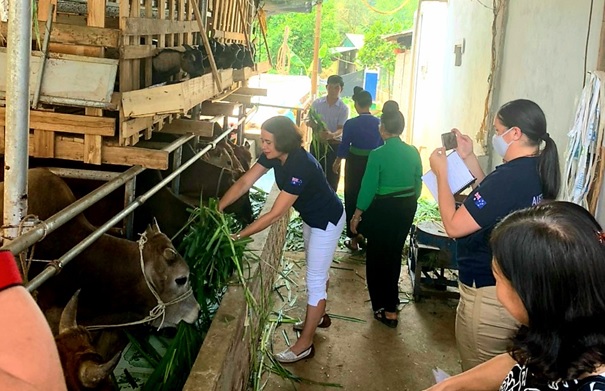
On April 14, Ms. Robyn Mudie, Australian Ambassador to Vietnam, paying a visit to the beef cattle production cooperative. Photo: Pham Van Hung.
On April 14, Ms. Robyn Mudie, Australian Ambassador to Vietnam, visited Tuan Giao Cattle Breeding and Trading Cooperative and the female farmer groups.
Tuan Giao and Dien Bien districts has been chosen as the two sites to participate in the “Intensification of beef cattle production in upland cropping systems in Northwest Vietnam” livestock project (LPS/2015/037) funded by Australian Center for International Agricultural Research (ACIAR).
This project, led by University of Tasmania (Australia), aims to improve the income of smallholder cattle producers through intensification of beef cattle production and increased market linkages in mountainous crop-livestock systems in the Northwest region. The project partners include Vietnam National University of Agriculture (VNUA), National Institute of Animal Sciences (NIAS), and Dien Bien Department of Agriculture and Rural Development.
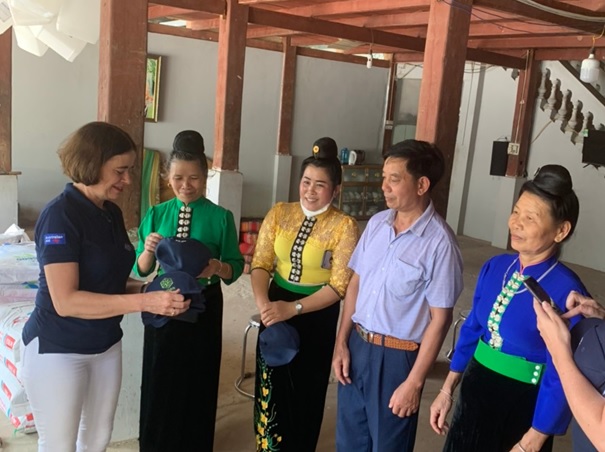
Ms. Robyn Mudie (1st from the left) having a conversation with female cattle farmers in the cooperative. Photo: Pham Van Hung.
Tuan Giao Cattle Breeding and Trading Cooperative used to be Tuan Giao Coffee Cooperative. The coffee model was deemed a failure at that time as farmer members received no benefit from coffee production. ACIAR quickly realized the opportunity of beef cattle production in Dien Bien province thanks to its natural conditions and local farming tradition, but local farmers still truggled due to technical and marketing difficulties.
The current project has helped the cooperative create connection and purchase cattle from local farmers. The cooperative also provides local farmers with cattle breeds through other supporting projects.
For the sustainability of the local production system, the project has taken a step further to organize and support local cattle farmers by establishing ten livestock interest groups (four groups in Dien Bien district, and six groups in Tuan Giao district). The number of members reaches approximately 300 members which comprise of Kinh, Thai, Lao, and H'Mong farmers. They are important stakeholders to work with local cooperatives and other actors in the beef cattle value chain.
Representatives of these interest groups have been trained in forage conservation, beef cattle fattening and breeding techniques. They are also equipped with knowledge of farm accounting and beef cattle value chains. To put their knowledge and skills in practice, the project offered farmers to visit three successful farms and livestock farmers in Son La province. The project has also provided consultation to support interest groups in their regular activities. As a result, farmers’ beef cattle farming practices has experienced significant changes, and Ms. Robyn Mudie is truly impressed.
On the next day (April 15), Ms. Robyn Mudie continued to visit Dien Bien Livestock Cooperative - a beef cattle production and marketing cooperative in Thanh Yen commune, Dien Bien district.
This is the first cooperative specializing in cattle and buffalo production in Dien Bien province. The cooperative has been established by farmers in Thanh Yen commune and the four interest groups supported by the LPS/2015/037 project.
And it comes as a surprise that Mr. Do Duc Thang, the one who lead this new cooperative, is a young man with burning enthusiasm to bring local beef to a larger market.
This cooperative cover a wide range of activities: supplying buffaloes and cattle for fattening and slaughtering; providing technical support and advice on raising cattle as well as chickens and egg production; trading and distributing buffalo and cattle breeds; providing training and guidance on animal husbandry techniques for members; underwriting livestock products.
The cooperative acts as a bridge in directing and guiding husbandry techniques for farmers in the existing cattle interest groups while providing services to minimize production risks for cooperative members.
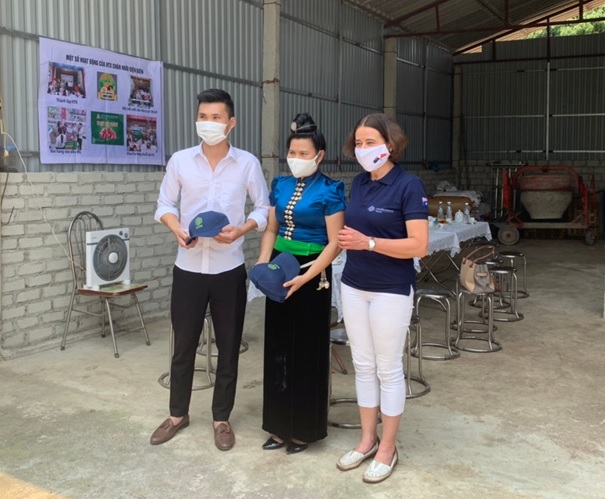
Ms. Robyn Mudie (1st from the right), visited Mr. Do Duc Thang (1st from the left), Director of Dien Bien Livestock Cooperative in Thanh Yen commune, Dien Bien district, Dien Bien province. Photo: Pham Van Hung.
After receiving technical support from the ACIAR’s project, Mr. Thang built up his cattle production experience along with his leadership and management skills. Understanding the young man's ambition, the project guided him on building and testing a modern retail channel at Hoa Ba Supermarket (Dien Bien Phu city). Dien Bien Livestock Cooperative provided beef cattle, used the slaughtering service of a local certified slaughterhouse in Dien Bien Phu city and retailed the products directly at Hoa Ba Supermarket - the biggest retailer in this city. The trial came as a success, and the supermarket showed its willingness to collaborate with the cooperative for future sales.
It was evidence. The consumers had accepted local beef in a higher-class market segment within a modern marketing channel. It was also the first time local beef was presented in a big supermarket. This was truly an interesting, challenging and rewarding experience for Mr. Thang.
/2025/11/26/4909-2-154329_878.jpg)
(VAN) Pearl grouper farming in HDPE cages not only delivers economic efficiency but also contributes to protecting the environment, creating jobs, and promoting marine-based experiential tourism.

(VAN) The model of making a living under the forest canopy through the agroforestry system in Van Son commune, Bac Ninh province, is expected to generate an annual income of approximately VND 30 million/ha.

(VAN) Many enterprises in Can Tho are harnessing natural energy and reducing greenhouse gas emissions in their production processes, thereby contributing to the promotion of a sustainable green transition.
/2025/11/24/3536-2-112800_176.jpg)
(VAN) Dong Nai now has tens of thousands of hectares of forests certified for sustainable management, and this area will continue to be expanded in the coming period.

(VAN) Vinh Ha hamlet (Dai Xuyen commune, Hanoi) is shifting away from small-scale farming as households adopt bioscurity into their breeder chicken models.

(VAN) Heavy rains make aquatic species more vulnerable to disease. Proactive water management and high-tech systems help farmers prevent outbreaks and protect yields.

(VAN) Greenhouses are shifting production mindsets in Binh Lu commune, enabling farmers to ‘weather the sun and rain’ and secure stable vegetable harvests throughout the year.
