December 10, 2025 | 07:21 GMT +7
Hotline: 0913.378.918

December 10, 2025 | 07:21 GMT +7
Hotline: 0913.378.918
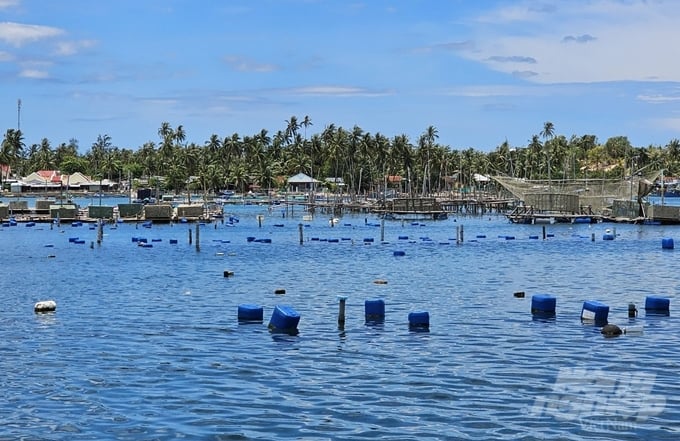
Spontaneous farming cages densely and illegally deployed in Vung Ro Bay, Phu Yen province. Photo: Kim So.
Phu Yen province has implemented various measures since 2020 to relocate spontaneous mariculture cages in an effort to clean its coastal areas, thereby creating a unobstructed water surface area for the local sustainable mariculture project. These spontaneous cages are located in the mariculture areas of Dong Hoa town, Song Cau town, and Tuy An district.
Prior to 2016, only 200 cage mariculture households were reported in Vung Ro Bay. However, the number of farming cages rapidly increased to nearly 17,000 in a short period of time. Consequently, the excessive farming density has reduced the overall mariculture area. Furthermore, untreated waste from the farming cages are discharged directly into the environment, which poses as a potential source for disease outbreaks. These challenges have severely affeted local management efforts.
According to reports, Vung Ro Bay currently houses 391 cage mariculture facilities with 16,852 cages. Notably, local spontaneous fishermen account for 190 mariculture facilities with 9,106 cages. These fishermen spend their weekends and nighttime building or bringing new cages from other areas into Vung Ro Bay in order to avoid the local authorities. Accordingly, the spontaneous cages occupy approximately 400 hectares of water surface area in the bays of Huong, Nhan, Chua, Chinh, Lach, Nga, Lau, Bang, among others.
With the aim of preventing fishermen from building new spontaneous cages, the local authorities have implemented measures to prohibit the gathering of materials and wood in Vung Ro Bay. Seven cases of wood gathering have been fined, and 7.25 cubic meters of wood were seized.
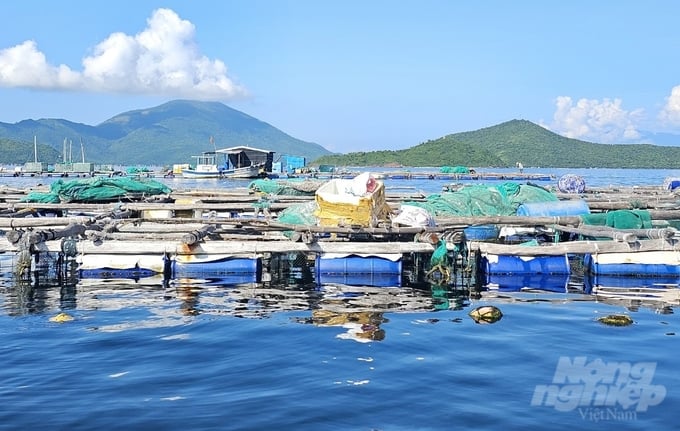
Phu Yen is making an effort to clean up its coastal areas. Photo: Kim So.
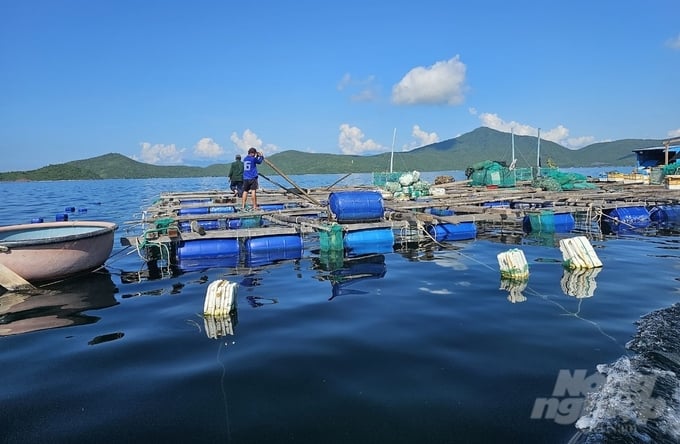
Phu Yen aims to re-organize its to promote sustainable mariculture development. Photo: Kim So.
"The owners of farming cages are not voluntarily relocating from the Vung Ro Bay. Fishermen who bring their cages from outside the bay are also refusing to relocate, despite requests from the patrol and control team of Dong Hoa town. Additionally, farmers release their seeds across multiple batches; and commercial lobsters take at least 18 to 24 months to fully grow. As a result, farmers harvest their lobster yield at different times throughout the year. The release of seeds during the weekends and the transportation of seeds by waterways make it difficult for local authorities to promptly detect and handle violations," stated Mr. Nguyen Van Hong, Vice Chairman of Dong Hoa town.
On the other hand, the organization of mariculture cage in Song Cau town is implemented with a focus on strict management of the quantity of cages, and the environmental conditions of the mariculture areas. Moreover, Song Cau town encourages the application of scientific and technological advancements in mariculture, with a concerted effort to address mariculture violations.
In 2023, Song Cau town implemented a management and organization plan for cage mariculture. Accordingly, the town dismantled rafts and stakes (wood, iron, concrete, etc.) used for oyster and clam farming in Xuan Dai Bay and Cu Mong lagoon. Additionally, they formulated a plan to organize and allocate mariculture surface areas, and established Community mariculture Groups.
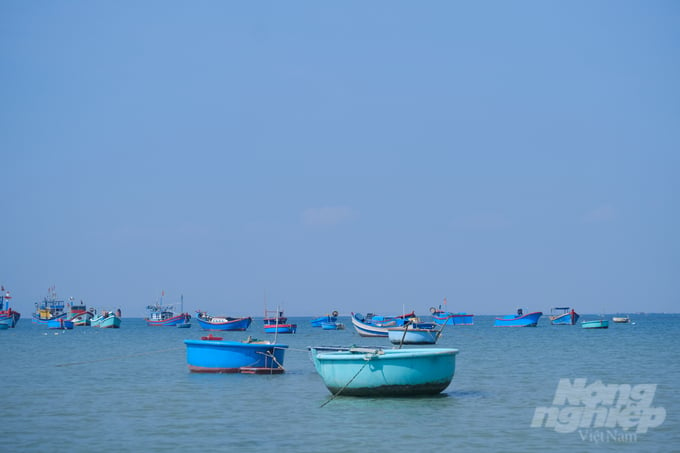
Sustainable mariculture cannot be established with fragmented, makeshift, and spontaneous infrastructure. Conversely, it requires a comprehensive and long-term roadmap. Photo: Kien Trung.
After a review process, Song Cau town identified over 4,000 households eligible for the allocation of mariculture areas; conversely, nearly 1,500 households failed to meet the requirements for the allocation of mariculture areas. These households have been listed and categorized by the People's Committees at the commune and ward levels. Accordingly, Song Cau town developed a plan to allocate mariculture areas in Xuan Dai Bay and Cu Mong lagoon.
Tuy An district implemented strict measures in 2023 to address illegal cage mariculture activities in the scenic water area of Da Dia reef, An Ninh Dong commune. In the marine area of Hon Yen, located within An Hoa Hai commune, various tasks were implemented to protect and preserve coral reefs; field surveys were conducted at mariculture areas to ensure compliance with the following mariculture requirements: an area of 20 hectares, a trajectory towards the southeast of Hon Yen, a depth of over 6 meters, a minimum distance of 400 meters from the shore, and a minimum distance of 200 meters from the coral reef conservation area and Hon Yen relic site.
Surveys were also conducted at other mariculture areas to determine their current status, and formulate plans for the organization and allocation of mariculture areas after the province's official planning for 650 hectares of marine area was proposed.
The Vietnam Union of Science and Technology Associations, in collaboration with the Ninh Thuan province's Sub-Department of Fisheries, organized a workshop on March 26 titled "Promoting community management in protecting fisheries resources in the coastal areas of Binh Thuan province." Representatives from the fishing community associations of Thuan Quy, Tan Thanh, Tan Thuan, Phuoc The, Chi Cong, and Haa Thang communes participated in the event.
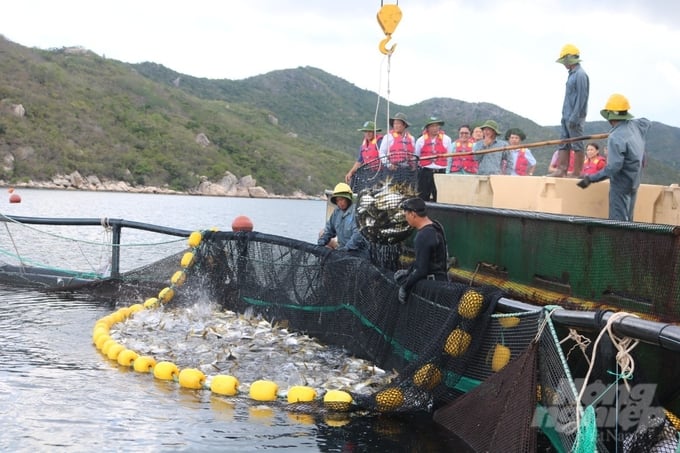
Golden pompano harvesting. Photo: Hoang Anh.
President of the Vietnam Union of Science and Technology Associations Luong Thanh Son, stated: "The conservation, protection, and development of fisheries resources, the restoration of ecosystems, and the improvement of natural habitat for aquatic species must be our priority tasks. As a result, there needs to be a balance between exploitation, mariculture, and conservation of fisheries resources. To achieve this, we must establish a shared responsibility among management agencies, fishing communities, and businesses."
Four community organizations in Binh Thuan province are currently co-managing the protection of fisheries resources, with the participation of 562 households from the communes of Phuoc The, Thuan Quy, Tan Thanh, Tan Thuan. Notably, the communities of Thuan Quy, Tan Thanh, and Tan Thuan have been recognized and granted management authority for the protection of fisheries resources, covering an area of 43.4/12.38 kilometers along the coastline.
Binh Thuan is one of the first provinces in Vietnam to implement the recognition and delegation of management authority for the protection of fisheries resources under the 2017 Law on Fisheries. The co-management process has demonstrated positive changes within the mindset, awareness, and actions of the local communities; accordingly, the responsibility for protecting and developing fisheries resources has been shared by the community and relevant parties at the local level.
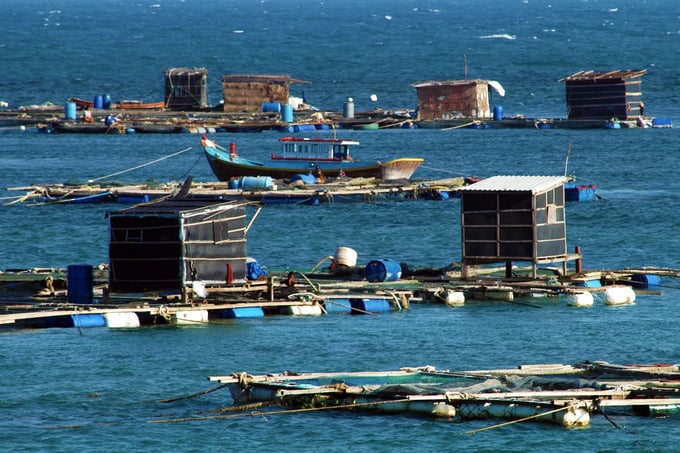
Cage mariculture on Phu Quy Island. Photo: N. Lan.
Representatives from the Fishing Community Associations of Tan Thanh, Tan Thuan, and Thuan Quy outlined the difficulties in implementing their assigned rights and responsibilities; formulating protection and exploitation plans for fisheries resources after being recognized and delegated management authority; achieving full autonomy; among many others.
Binh Thuan province organized a workshop on March 20 titled "Sustainable Mariculture Development Solutions" to solicit inputs from scientists, state management agencies, businesses, and fishing communities, regarding the contents of the "Development Plan for Mariculture in Binh Thuan province until 2030, with a vision towards 2045."
Regarding the development direction of the local mariculture industry, Binh Thuan province advocates for offshore mariculture expansion, with a focus on economically valuable species and organic mariculture. Increased pollution loads in mariculture areas and expanded marine mariculture areas in the future are expected to result in higher pollution levels by 2030, with the most affected areas being Tuy Phong district, Phan Thiet city, and Phu Quy island.
According to simulations of the spread of pollution in southern Tuy Phong, Phan Thiet and Phu Quy holds the highest levels of pollution with regards to mariculture requirements. Mariculture areas must be selected and allocated based on wave and coastal current characteristics referenced against fisheries sector regulations. Environmental monitoring is necessary to track environmental changes during project implementation; appropriate guidelines for feed selection and excess feed management, especially in industrial mariculture areas, are crucial.
A challenging aspect in Phu Yen province is the requirement for the safe handling of illegally operated mariculture cages, in addition to ensuring the safety of aquatic assets (shrimp, fish, etc.). This challenge is caused by the province's lack of suitable locations and conditions for preserving shrimp and fish.
Districts and towns within the province have issued documents to guide the handling of live shrimp and fish during relocation by renting cold storage warehouses. However, cold storage warehouses can potentially lead to the death of shrimp and fish, thereby reducing the asset values of organizations and individuals subject to relocation. Consequently, local governments should hire qualified organizations and individuals to manage the preservation of aquatic assets.
As an immediate solution, Phu Yen province is conducting a census to establish management profiles for mariculture cages in Vung Ro Bay; conducting patrols using flycams to detect and prevent the emergence of new mariculture cages. Non-compliant mariculture cages will be recorded, and relocation will be enforced.
Translated by Nguyen Hai Long
![Unlocking carbon credit potential: [1] Toward a green economy](https://t.ex-cdn.com/nongnghiepmoitruong.vn/608w/files/huyenvt (e)/2025/12/09/1340-2-130237_804.jpg)
(VAN) Thanh Hoa is advancing the development of carbon credits from forests and agriculture, generating sustainable income, improving livelihoods, and moving toward a green and low-emission economy.

(VAN) After three years, Project FST/2020/123 collected approximately 3,000 insect specimens, classified them into about 50 morphological groups, and identified around 40 species, including several new species.
/2025/12/01/0509-2-175427_206.jpg)
(VAN) Emission-reducing coffee areas in Lam Dong have entered the new crop with stable yields, improved quality, and a remarkably enhanced cultivation environment.

(VAN) The Institute of Agricultural Sciences for Southern Vietnam (IAS) marked its 100th anniversary in Ho Chi Minh City, celebrating a century of growth as a leading institute contributing significantly to Viet Nam’s agricultural development.

(VAN) An increasing number of livestock farms are using biogas generators to create a source of renewable electricity, helping to save costs and mitigate environmental pollution.

(VAN) Small changes in rice cultivation, from irrigation methods and straw collection to input management, are paving a new way for Vietnam's agriculture in the journey toward emission reduction.

(VAN) With the project of converting biogas into renewable electricity, Australia is both helping pig farms reduce their energy costs by up to 25% and contributing to environmental protection.
