July 21, 2026 | 21:21 GMT +7
Hotline: 0913.378.918

July 21, 2026 | 21:21 GMT +7
Hotline: 0913.378.918
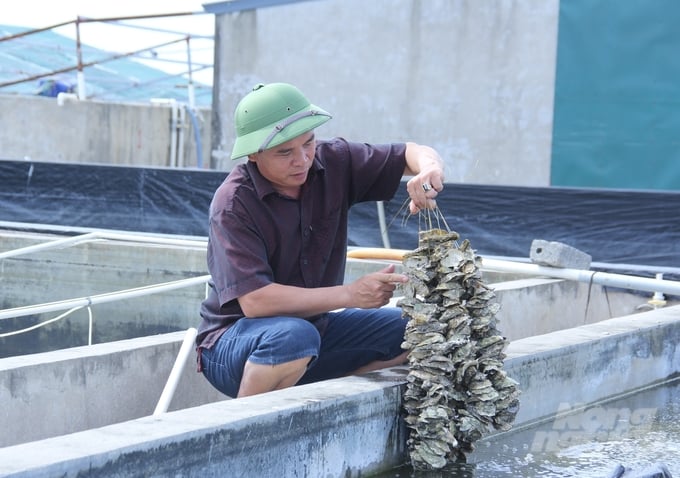
According to Mr. Pham Van Hao, the salinity in water allows households to quickly breed oysters to ensure supply. Photo: Trung Quan.
Leveraging the favorable weather conditions, aquaculture households in Kim Son district (Ninh Binh) are cleaning ponds, treating water, and preparing for the winter shrimp season. They are also intensifying oyster breeding to meet the growing market demand.
Mr. Pham Van Hao shared that the constant rain, coupled with the floodwaters of storm No.3, reduced salinity water level to 0-3%. As a result, breeding oyster households paused production for 2 months. Currently, the salinity level is increasing 20%, and conditions are ideal to resume production.
Moreover, many oyster-farming provinces like Quang Ninh and Hai Phong have suffered heavy losses and face a shortage of larvae for recovery, driving the price of Pacific oyster clusters (each containing 270 larvae) up to VND 175,000-180,000, an increase of VND 35,000-40,000 compared to the same period last year and VND 100,000 pre-typhoon.
Mr. Hao shared that autumn is the most ideal time for breeding oyster larvae, with high market prices prompting all facilities to mobilize resources and operate at full capacity to ensure sufficient supply. Two key factors are the water quality and food for the oysters.
The households, sharing the same water intake and discharge channels, have agreed that each person must take responsibility to protect against risks. Wastewater from ponds must be directed to treatment pits before being discharged into rivers or canals. In terms of food, high-algae content water from whiteleg shrimp ponds or Nanochloropsis algae is used in biomass tanks to provide adequate food for the oysters.
"Conditions are optimal now, and if we don’t act quickly, colder weather will slow the growth of the larvae, increasing costs and labor requirements. Currently, my family is ready to supply over five million larvae to the market" said Mr. Hao.
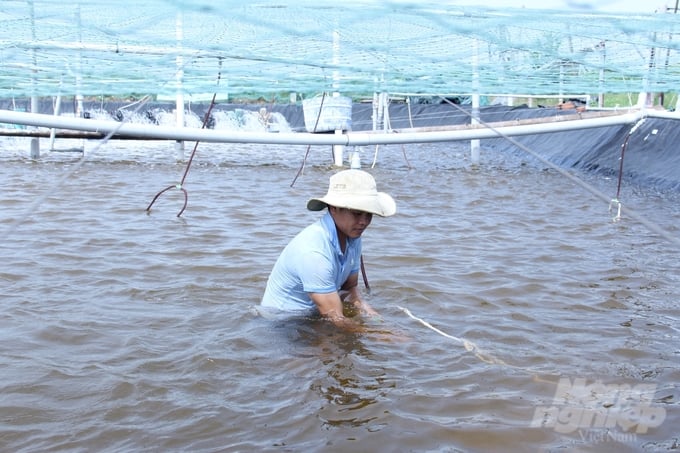
Whiteleg shrimp farmers are also cleaning their ponds one last time before the winter season. Photo: Trung Quan.
Taking advantage of stable salinity levels, shrimp farmers in Kim Dong, Kim Hai (Binh Minh Town) are mobilizing labor to clean ponds, reinforce covers, and prepare for winter shrimp stocking. Mr. Dang Thanh Tan shared that winter shrimp farming (off-season farming) used to be challenging for local farmers, but thanks to the adoption of raised, covered ponds, success rates have increased significantly.
This year, water supply to shrimp ponds has also been interrupted due to unstable salinity. As the situation stabilizes, facilities are stocking shrimp to ensure supply for the Lunar New Year.
"This year, although colder weather is expected, there’s little cause for concern because most facilities are experienced in shrimp care and protection. Moreover, with raised, covered ponds, water quality, food supply, and disease control are manageable, so the supply will surely meet or even exceed previous years," Mr. Tan assessed.
Mr. Nguyen Trung Tien, Deputy Head of the Aquaculture Station (Ninh Binh Fisheries Sub-Department), reported that Kim Son district currently has 300 hectares of intensive whiteleg shrimp farming, including 75 hectares applying advanced technology, with an annual yield of 2,100-2,300 tons, and a winter crop yield of 1,000-1,200 tons.
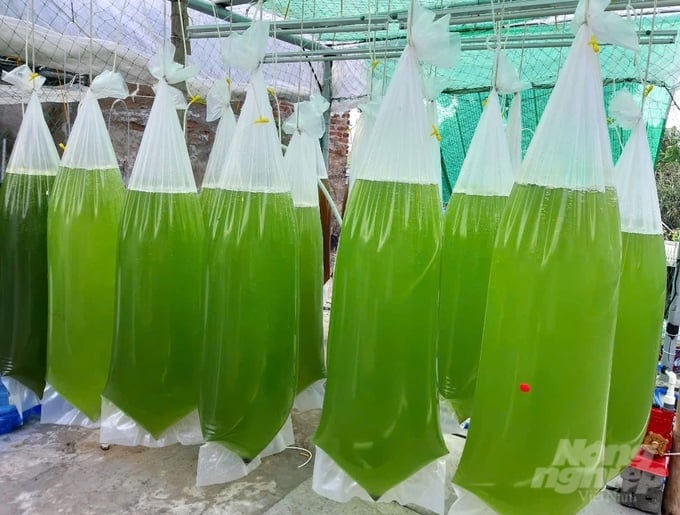
Households actively use algae to ensure food supply for oyster larvae. Photo: Trung Quan.
Kim Son district has about 350 oyster larvae farmings. The main markets for commercial farming are Quang Ninh, Thai Binh, and Hai Phong, and Nha Trang, Khanh Hoa, and Phu Yen for lobster feed. Currently, 100% of farmings have initiated oyster spawning and larval rearing.
To enhance aquaculture efficiency in the area, the Fisheries Sub-Department is coordinating with Kim Son district's Agriculture and Rural Development Office and local communes to strengthen quality control of imported seedlings. The Aquaculture Station is also conducting technical training sessions and introducing new farming techniques to improve productivity and quality for the households.
Translated by Kieu Chi
/2026/07/20/1547-1-180442_204.jpg)
(VAN) A farmer in Can Tho has found the secret to raising giant water bugs that produce intensely aromatic essence, earning annual profits of hundreds of millions of dong.

(VAN) From crop conversion to deep processing, Ba Che Commune in Quang Ninh Province is building a comprehensive cinnamon value chain that creates sustainable livelihoods while strengthening the local forestry economy.

(VAN) The ACIAR-SunRice public-private partnership, rooted in science and sustainable development, is expected to support rice farmers in the Mekong Delta.

(VAN) Linking the shrimp, rice, and coffee sectors through a circular economy model is opening up a new pathway for Viet Nam's agriculture.

(VAN) HCMC is accelerating the transition to circular industry by transforming industrial parks into eco-industrial zones, fostering industrial symbiosis, and expanding international partnerships for green manufacturing.
(VAN) The digital map of raw material zones is expected to resolve overlapping investments, ensure production transparency, and accelerate deep processing in the coconut industry.
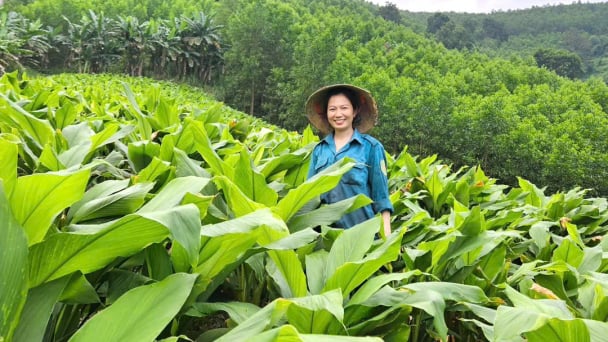
(VAN) Transforming barren hills once dedicated only to acacia and cassava, the Anh Mai Medicinal Plant Cooperative has found a new direction with red turmeric, opening up sustainable livelihoods for local residents.
