December 18, 2025 | 11:35 GMT +7
Hotline: 0913.378.918

December 18, 2025 | 11:35 GMT +7
Hotline: 0913.378.918
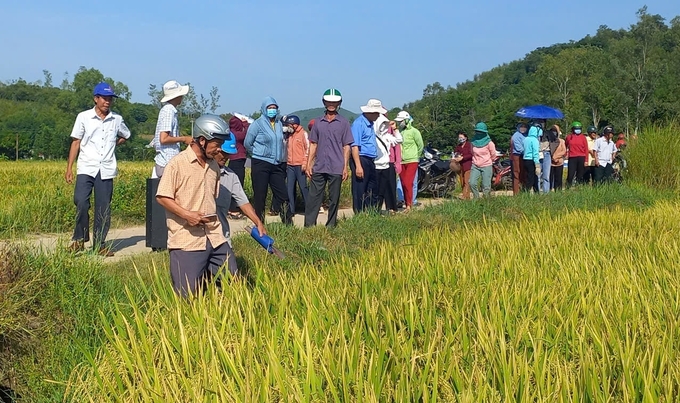
Applying IPHM on rice crops helps farmers reduce costs, increase yields and improve product quality. Photo: KS.
During the summer-autumn season of 2024, the Phu Yen Crop Production and Plant Protection Sub-department, in collaboration with relevant agencies, organizations and localities, organized 13 training courses for farmers to implement Integrated Pest and Health Management (IPHM) practices on rice fields.
In these training sessions, farmers were not only taught the theory and principles behind IPHM by instructors, but they also received practical, hands-on guidance in the fields. This included step-by-step assistance on the ground, starting from the sowing process to the final stages of harvesting.
Recently, the Phu Yen Department of Crop Production and Plant Protection conducted a review meeting to assess the progress of the plan aimed at promoting the use of IPHM on rice crops during the 2024 summer-autumn season.
Mr. Nguyen Van Minh, Head of the Crop Production and Plant Protection Sub-department in Phu Yen Province, shared that the model fields used for the Integrated Plant Health Management (IPHM) training program for local farmers have demonstrated significant economic benefits. These benefits are attributed to the reduction in production costs and the higher yield compared to traditional farming practices.
Specifically, the fields that applied IPHM techniques only required sowing 4 to 6 kilograms per sao (500 m²), which is more than half the amount compared to conventional farming methods. Despite the reduction in seed usage, the profit increased by an average of 250 USD per hectare compared to the control fields. Notably, the model field in Son Giang Commune (Song Hinh District) achieved a profit of nearly 400 USD per hectare over the control field.
According to Mr. Minh, applying IPHM on rice crops not only leads to higher economic efficiency but also provides significant environmental benefits. It helps protect natural predators, which are essential for controlling pests and maintains a balanced ecosystem in the rice fields. Additionally, the use of IPHM reduces pollution by minimizing the reliance on chemical pesticides.
"By limiting the use of pesticides, IPHM enhances the quality of the rice products. It ensures that no pesticide residues remain on the crops, which is a crucial factor in protecting consumer health", Mr. Minh emphasized.
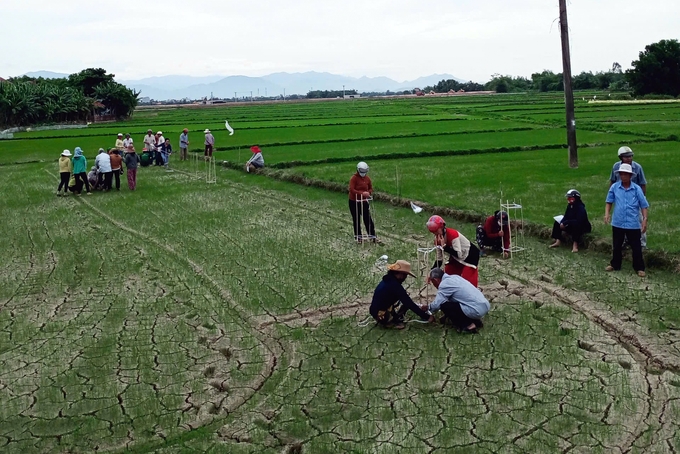
Farmers are eager to learn about IPHM on rice fields. Photo: KS.
Additionally, through the training sessions, farmers have been encouraged to adopt environmentally friendly practices, such as properly collecting and disposing of pesticide packaging after use.
Furthermore, the training approach used in the IPHM program has helped foster a deeper connection between the trainers (technical staff) and the farmers, as well as between the farmers and their fields. By providing farmers with essential knowledge on advanced farming techniques, the program not only empowers them to become experts but also encourages them to engage in critical thinking and creative problem-solving. This has led them to make more informed decisions about the specific farming methods that should be applied to their land. This process also creates opportunities for farmers to enhance their spirit of cooperation, exchange ideas and learn from each other's experiences during the production process.
After the completion of the training sessions for farmers at the units implementing IPHM methods on rice crops, Mr. Dang Minh Nghia, Director of Hoa An Tay General Agricultural Cooperative in Phu Hoa District, shared that the program has successfully helped farmers change their traditional farming practices. He highlighted that most farmers are excited about the benefits of applying IPHM to rice cultivation, which include reduced input costs, increased yield and higher profits.
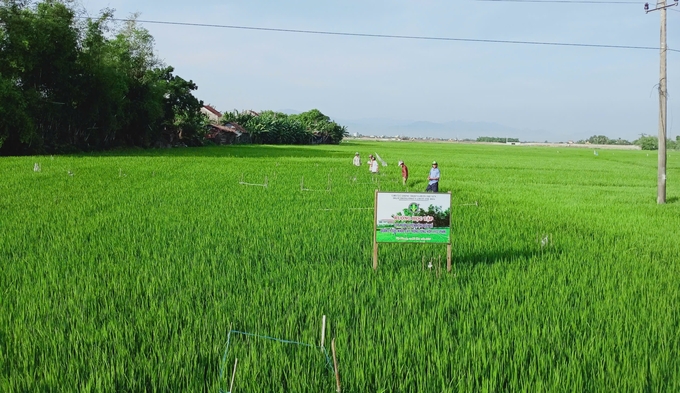
After receiving the training, the cooperatives will expand the IPHM model on rice cultivation. Photo: KS.
"Recently, the actual rice yield in the model reached 7.6 tons per hectare, while the control fields only yielded 7.4 tons per hectare", said Mr. Nghia, adding that the 30 farmers from 8 production teams at the Cooperative who attended the IPHM training were able to fully understand the rice cultivation process and successfully apply it in their production.
As a result, the Cooperative plans to use these 30 farmers as key figures to help expand the IPHM rice cultivation model in the near future. Furthermore, during the upcoming 2024-2025 winter-spring season, the Cooperative will allocate funds from the agricultural extension fund to continue inviting experts to train farmers on how to implement the IPHM program.
In addition, Mr. Phan Van Hung, Director of Xuan Quang 3 Agricultural Production and Service Cooperative (Dong Xuan District), stated that after the training sessions for farmers under the IPHM program, the members of the Cooperative recognized the advantages of reducing seed usage, fertilizers and pesticides while still achieving satisfactory yields. This has given farmers greater confidence in applying the techniques to their own rice fields in the coming winter-spring season.
"We have observed that implementing IPHM significantly improves the health of the rice plants, helps control pests and diseases, and reduces the number of pesticide applications by more than 50%, while still maintaining high product quality. Considering the benefits it has brought, we plan to continue promoting and conducting training sessions to ensure that farmers can access the latest agricultural techniques. We aim to gradually expand the IPHM model across rice farming practices in the future", shared Mr. Hung.
According to the Phu Yen Department of Crop Production and Plant Protection, in 2025, they will work in partnership with various organizations and local authorities to host 26 training sessions for farmers on IPHM in rice cultivation. These will take place in both the winter-spring and summer-autumn seasons, spread across several districts, towns and cities within the province. The initiative is expected to train approximately 780 farmers in applying IPHM to improve their rice production techniques.
Translated by Phuong Linh

(VAN) Patrol Team No. 15 has been executing patrol, inspection, and control duties in the Southwest waters, a region identified as having a high risk of violations.

(VAN) UNICEF, IOM, and the U.S. Department of State have worked together to ensure the justice system becomes a protective shield for children and other vulnerable groups.

(VAN) As a key driving force of green transition, the circular economy is being identified as a strategic pillar of Viet Nam's new growth model.

(VAN) UNICEF and IOM receive this aid and provide essential services to assist families affected by recent storms and floods.

(VAN) Circular economy is regarded as a suitable pathway for Viet Nam’s fisheries sector, helping to improve production efficiency, optimize resources, and reduce environmental pressure.

(VAN) Vietnam and the UK are promoting cooperation in agriculture, environment, renewable energy, and green transition, with the goal of achieving Net Zero.

(VAN) Switzerland highly values carbon credit cooperation potential with Viet Nam and hopes to begin negotiations under Article 6 of the Paris Agreement.
