December 17, 2025 | 02:07 GMT +7
Hotline: 0913.378.918

December 17, 2025 | 02:07 GMT +7
Hotline: 0913.378.918
The new toad species named Brother Toothed Toad (scientific name: Oreolalax adelphos) was discovered by researchers from the Asian Turtle Program (ATP) of the Indo-Myanmar Conservation (IMC) Organization, the National Museum of Australia, and the Zoological Society of London. Researchers discovered it at an altitude of over 2,900 m at the top of Po Ma Lung mountain in the Hoang Lien Son range. The research was just published in the Zootaxa journal in early October.
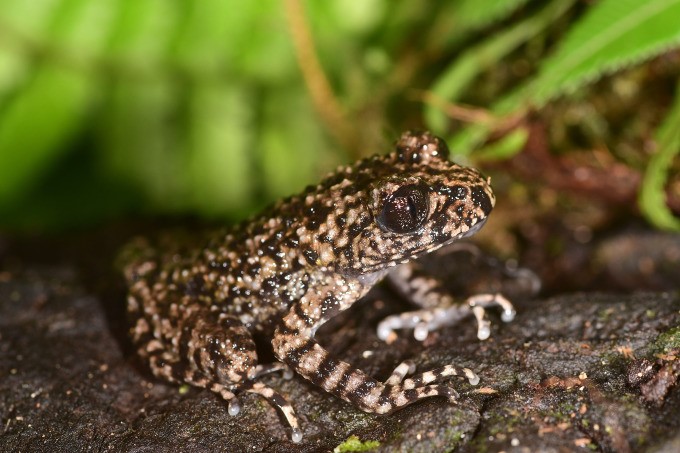
The brother toothed toad species was discovered on Po Ma Lung mountain in Lai Châu. Photo: Thanh Luan.
According to MSc Nguyen Thanh Luan, leading the research team, there are currently 20 species of toads in the genus Oreolalax recorded. Most of them are endemic in China. Only one species, the Sterling toothed toad (scientific name: Oreolalax sterlingae), has been recorded in Vietnam and is only found in the Hoang Lien Son mountain range. This species is also ranked endangered according to the World Red List (IUCN).
The new species was discovered by MSc Luan and his colleagues during the field investigation process on amphibian diversity at Po Ma Lung Mountain in August 2023. The group collected specimens belonging to the species Oreolalax sterlingae, and some specimens had morphological characteristics different from previous species in the genus Oreolalax. Results of analysis of external morphology and genetic sequence show that this is a new species.
The Mount Po Ma Lung toothed toad has a body length of less than 4 cm, of which the body size is about 38mm in males and 26.2mm in females. They have prominent features such as thighs and shins with dark brown horizontal streaks; the hips with gray or creamy white spots; and the eyes in two different colors on the upper and lower halves. The brother toothed toad has a poorly developed swimming membrane between the hind toes. The ventral surface is gray with alternating white spots. The head and body have round and even warts.
Currently, scientists only find this species at the top of Po Ma Lung mountain, and it has the same habitat as the species Oreolalax sterlingae. Both species are likely distributed in Jinping, Yunnan, China. As of now, this is the second species of the genus Oreolalax discovered in Vietnam.
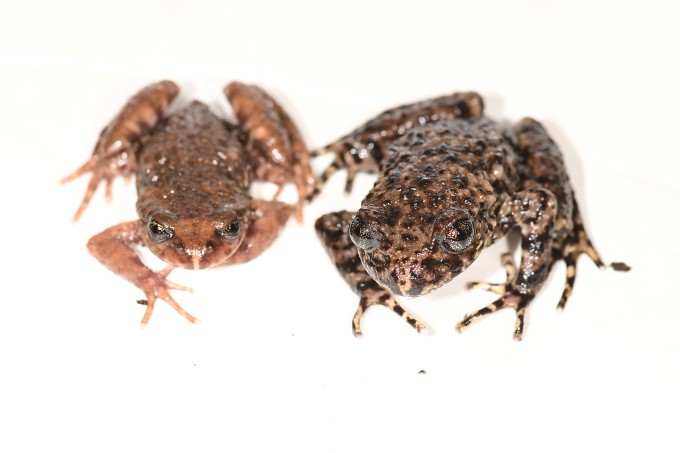
Sterling Toothed Toad (left) and Brother Toothed Toad (right) show differences when encountered in the same habitat. Photo: Thanh Luan.
The research is within the framework of the Project on Amphibian and Reptile Conservation in the Hoang Lien Son Mountain Range. Over the past 10 years, scientists have newly discovered six species of amphibians and one species of snake here. The discovery of new species in the North of Hoang Lien Son range shows the necessity of investigation and research activities in high mountain areas.
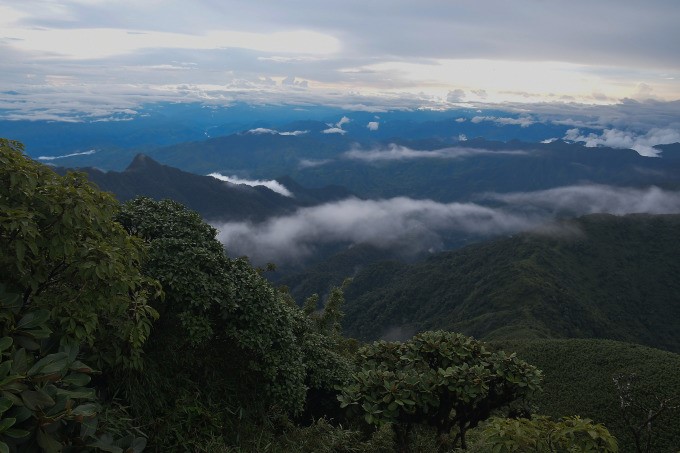
Habitat of Po Ma Lung Peak. Photo: Thanh Luan.
Po Ma Lung Mountain and the high mountains in the North are all famous climbing destinations. Therefore, in parallel with searching, discovering, and naming new species for science, researchers said they continue to carry out species conservation activities through strengthening local management and raising awareness among residents and tourists about environmental protection and biodiversity conservation.
Translated by Thu Huyen

(VAN) UNICEF and IOM receive this aid and provide essential services to assist families affected by recent storms and floods.

(VAN) Circular economy is regarded as a suitable pathway for Viet Nam’s fisheries sector, helping to improve production efficiency, optimize resources, and reduce environmental pressure.

(VAN) Vietnam and the UK are promoting cooperation in agriculture, environment, renewable energy, and green transition, with the goal of achieving Net Zero.

(VAN) Switzerland highly values carbon credit cooperation potential with Viet Nam and hopes to begin negotiations under Article 6 of the Paris Agreement.

(VAN) Northwestern women not only preserve traditional weaving but also leverage their cultural identity to create livelihoods, while spreading it to tourists through authentic experiences.

(VAN) Based on research results and production practices, the international scientific community evaluates UNI 126 as one of the world's best Panama disease-resistant banana varieties.

(VAN) More than 10,000 hectares of Cavendish bananas (Philippines), once abandoned due to the Panama Fusarium wilt Tropical Race 4 (TR4) disease, have now been brought back into production by switching to the Formosana variety.
