January 2, 2026 | 08:10 GMT +7
Hotline: 0913.378.918

January 2, 2026 | 08:10 GMT +7
Hotline: 0913.378.918
Vietnam Business Forum Magazine (under the Vietnam Chamber of Commerce and Industry - VCCI) organized the Agriculture Forum 2025: Promoting the Circular Economy in Agriculture in Hanoi on the afternoon of July 16.
Mr. Hoang Quang Phong, Vice President of the Vietnam Chamber of Commerce and Industry (VCCI), launched the Agriculture Forum 2025 by asserting that circular agriculture is a mandatory requirement and a driving force in the pursuit of a green, low-cost agricultural sector. This sector will be characterized by the expansion of value chains, the modification of outdated farming practices, the restriction of resource use, the reduction of greenhouse gas emissions, and the reduction of environmental pollution.
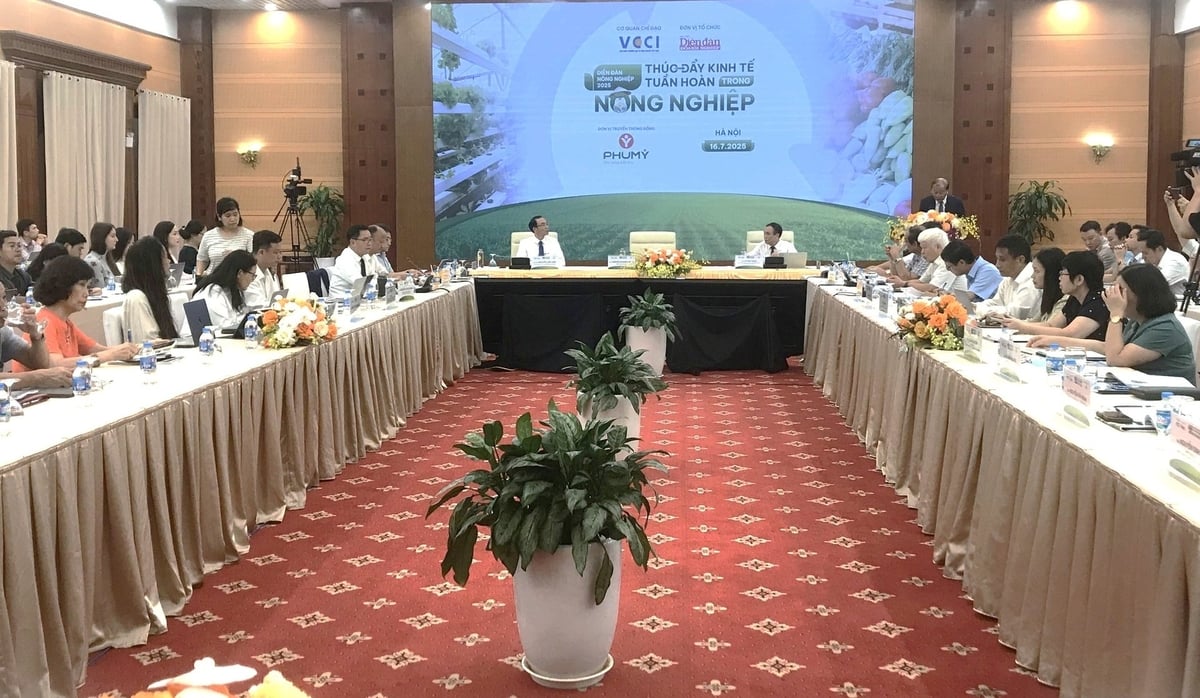
Agriculture Forum 2025 with the theme "Promoting circular economy in agriculture". Photo: Trung Dung.
He emphasized that the agricultural sector is currently implementing solutions to shift from a production mindset to an economic mindset and from a linear economic mindset to a circular economic mindset. The objective is to achieve a green economy and a green environment.
The transition to a circular economic framework in agriculture is still confronted with obstacles related to land and capital, according to Mr. Hoang Quang Phong. These obstacles must be promptly resolved. In particular, businesses and cooperatives face numerous constraints when it comes to acquiring land and organizing their operations and production. Additionally, collateral requirements and credit access procedures continue to be intricate. Credit utilization throughout the agricultural value chain is not yet widespread, credit risk management capabilities are inadequate, and credit is not yet related to agricultural insurance.
Furthermore, the small-scale production model acts as a "barrier" to applying closed, concentrated production methods with large cultivated areas. Consumers do not entirely trust organic products, and the level and capacity to access science and technology remain limited.
At the Forum, Mr. Le Duc Thinh, Director of the Department of Cooperative Economy and Rural Development, Ministry of Agriculture and Environment, underscored the critical role of agriculture in promoting sustainable development and food security in rural Vietnam.
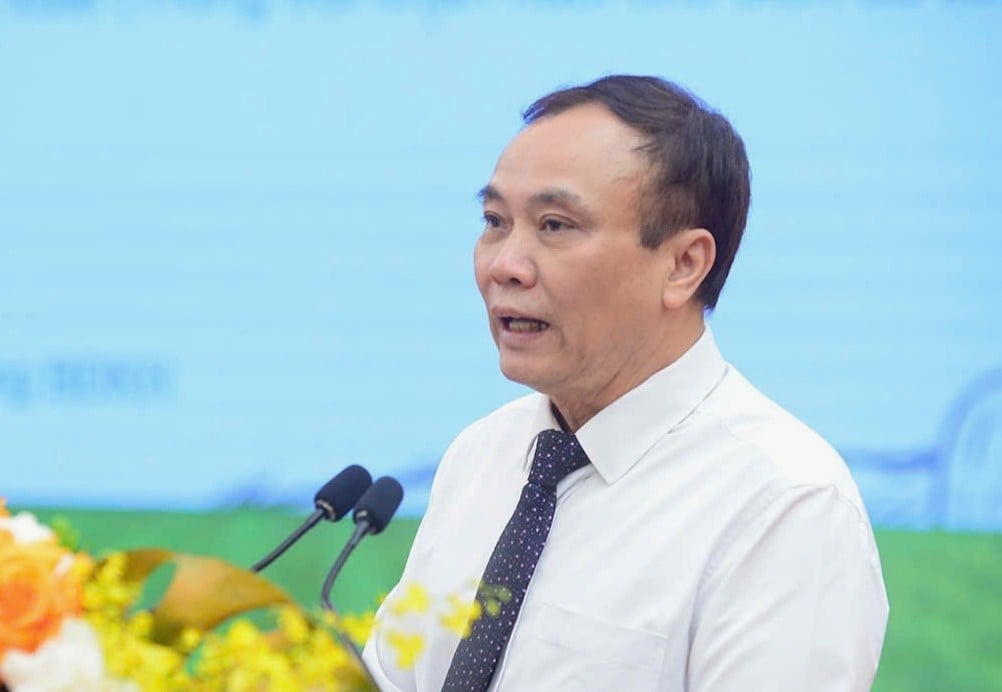
Mr. Le Duc Thinh, Director of the Department of Economic Cooperation and Rural Development, Ministry of Agriculture and Environment. Photo: Trung Dung.
Mr. Thinh asserts that Vietnam's agricultural sector is known for its distinctive circular production models, including VAC (Garden - Pond - Livestock) and VACR (Garden - Pond - Livestock - Forest), which ensure food security and promote agricultural and rural development.
As he explained, the circular economy in agriculture is a production organization model that operates in a closed cycle, maximizing resource reuse, minimizing emissions and losses, and increasing the value from by-products, waste, and renewable energy across the entire agricultural value chain.
Mr. Thinh stated that the main goal in the overall orientation for circular economy development until 2030, with a vision to 2050, is to optimize input resource utilization, circulate by-products and waste, reduce greenhouse gas emissions, and increase the recycling and reuse rate of agricultural by-products (to over 70%, double the current rate) in strong production sectors such as rice, coffee, and livestock.
The development of a circular economy in agriculture presents an opportunity for Vietnam to progressively realize its green growth strategy, sustainable development, and deep integration into the global value chain. For this to become a reality, synchronized efforts are required from the central to local levels, and from businesses to producers.
Translated by Linh Linh

(VAN) Located in three former provinces, Nam Dinh, Thai Binh, and Ninh Binh, and now in two provinces, Ninh Binh and Hung Yen, "Red River Delta" is the name of Vietnam's first interprovincial coastal wetland World Biosphere Reserve.
/2025/12/29/1046-1-210728_624.jpg)
(VAN) In 2025, Viet Nam recorded severe and extreme disasters, breaking multiple historical records and causing heavy losses in lives, property, and infrastructure nationwide.

(VAN) Applied technologies, water-saving irrigation is a strategic solution to promote climate-resilient agriculture and strengthen water security in the uplands.
/2025/12/29/3936-3-163422_251.jpg)
(VAN) Can Gio mangrove forest in particular and the entire Can Gio Mangrove Biosphere Reserve in general hold great potential for carbon credits.

(VAN) Chu Pah Rubber has announced its products that comply with the EU Deforestation Regulation (EUDR), affirming its commitment to sustainable production and product origin transparency.

(VAN) Deputy Director Nguyen Hoai Nam stated that a digital data platform will be developed with agricultural sector databases, utilizing AI to help farmers make informed decisions on 'watering correctly, sufficiently, and efficiently.’
/2025/12/29/4841-2-134224_777.jpg)
(VAN) From only about 10 individuals in 2009, the wild elephant population in Dong Nai has recovered to nearly 30 animals after more than 10 years.
