December 16, 2025 | 21:56 GMT +7
Hotline: 0913.378.918

December 16, 2025 | 21:56 GMT +7
Hotline: 0913.378.918
To help restore and protect peat swamp forest ecosystem from degradation and loss due to climate change and forest fires, tens of thousands of green trees have been newly planted at U Minh Thuong National Park.
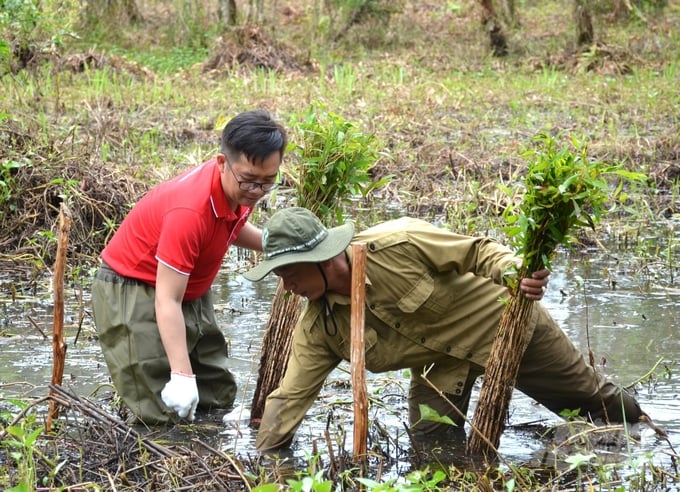
Tens of thousands of native melaleuca trees have been newly planted over a 1-hectare area to improve forest quality in U Minh Thuong National Park. Photo: Trung Chanh.
In Phase 1, the Center for Natural Resources and Environment Communication (MOET), in collaboration with J&T Express Vietnam and U Minh Thuong National Park, has planted 1 hectare of melaleuca forest on acidic soil with 15,000 native melaleuca trees. Over the next three years, the involved parties will continue to monitor and care for the newly planted melaleuca forest area to ensure healthy growth and development.
This initiative is part of the broader activities supporting the “One billion trees for a green Vietnam” program, organized by the Center for Natural Resources and Environment Communication and related organizations. It contributes to fulfilling the commitment made by the Prime Minister at COP 26 to achieve net-zero emissions by 2050.
According to Mr. Doan Truong Giang, Deputy Director of the Center for Natural Resources and Environment Communication, climate change impacts ecosystems, biodiversity, and the environment, directly affecting people's lives. To combat climate change, various approaches are necessary, including tree planting to protect the environment and special ecosystems like U Minh Thuong National Park.
Dr. Tran Van Thang, Deputy Director of U Minh Thuong National Park, stated that forest protection, development, and biodiversity conservation have always been prioritized. U Minh Thuong National Park has now completed the design plans for planting 280 hectares of special-use forest on degraded peat soil, over 10.6 hectares of protective forest, and regenerating 450 hectares of natural forest. Additionally, 40,000 native trees have been grown for planting on 70 hectares of special-use forest.
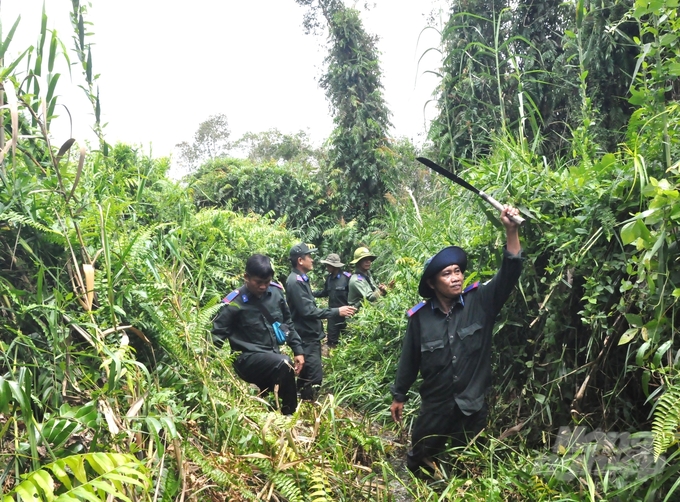
The U Minh Thuong National Park rangers clear patrol paths to protect the forest and monitor the biodiversity of the flooded melaleuca forest ecosystem. Photo: Trung Chanh.
Besides state-funded forest development and environmental protection efforts, U Minh Thuong National Park has also mobilized international organizations to provide non-refundable aid for two projects (2024-2027) with a total budget of over VND 11 billion. These projects include biodiversity inventory, water regulation procedures, endangered species monitoring, and training workshops to improve capacity for wetland ecosystem and environmental protection.
Additionally, the park strengthens outreach and education efforts to raise awareness, consciousness, and responsibility among local communities in the buffer zone for forest protection. It also promotes the involvement and cooperation of local authorities, communities, and mass media in forest management and protection. The SMART (Spatial Monitoring and Reporting Tool) software is being applied to all patrols, forest violation control, and biodiversity monitoring activities.
Translated by Kieu Chi

(VAN) UNICEF and IOM receive this aid and provide essential services to assist families affected by recent storms and floods.

(VAN) Circular economy is regarded as a suitable pathway for Viet Nam’s fisheries sector, helping to improve production efficiency, optimize resources, and reduce environmental pressure.

(VAN) Vietnam and the UK are promoting cooperation in agriculture, environment, renewable energy, and green transition, with the goal of achieving Net Zero.

(VAN) Switzerland highly values carbon credit cooperation potential with Viet Nam and hopes to begin negotiations under Article 6 of the Paris Agreement.

(VAN) Northwestern women not only preserve traditional weaving but also leverage their cultural identity to create livelihoods, while spreading it to tourists through authentic experiences.

(VAN) Based on research results and production practices, the international scientific community evaluates UNI 126 as one of the world's best Panama disease-resistant banana varieties.

(VAN) More than 10,000 hectares of Cavendish bananas (Philippines), once abandoned due to the Panama Fusarium wilt Tropical Race 4 (TR4) disease, have now been brought back into production by switching to the Formosana variety.
