December 7, 2025 | 23:47 GMT +7
Hotline: 0913.378.918

December 7, 2025 | 23:47 GMT +7
Hotline: 0913.378.918
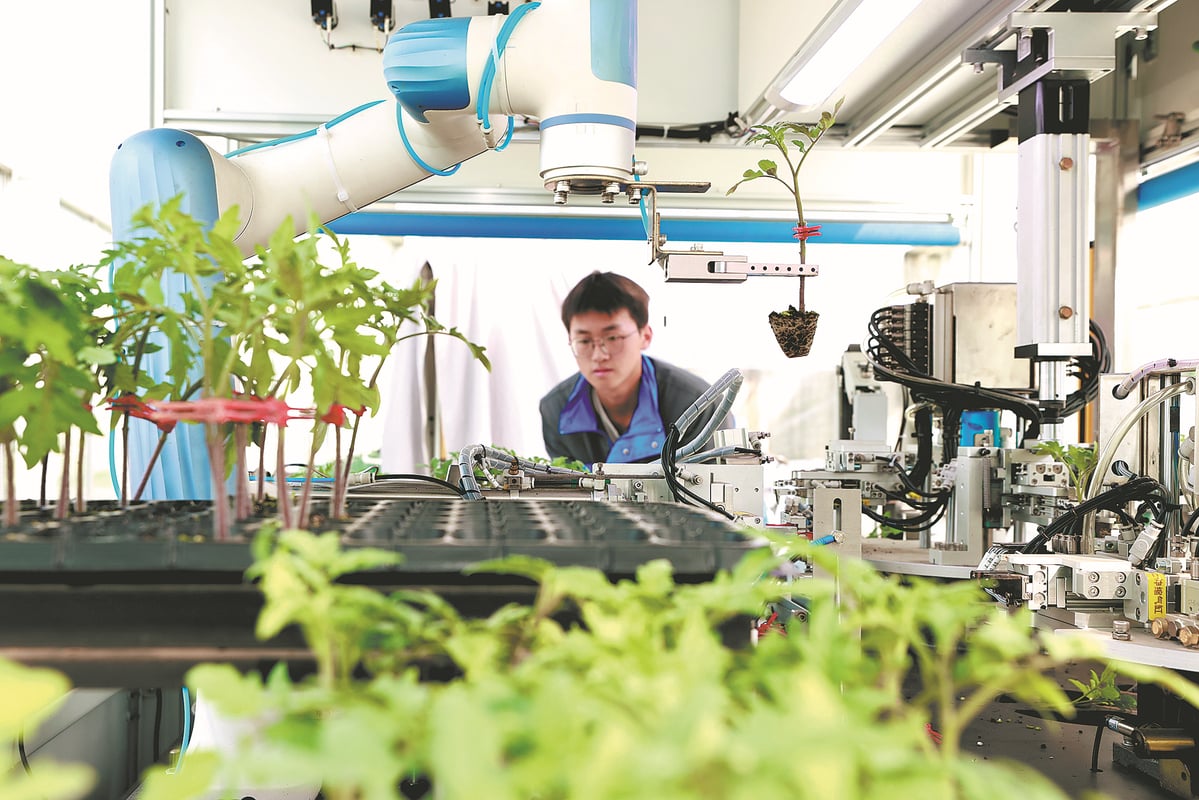
An automated robot grafts tomato seedlings in a digital seedling farm in Tongxiang, Zhejiang province, on Feb 19. The process only takes three seconds for each seedling, with a survival rate of 99 percent. Photo: Wang Jianlong/Zhejiang Daily.
Premier Li Qiang's Government Work Report, delivered on March 5 at the opening of the third session of the 14th National People's Congress, emphasized efforts to revitalize the seed industry and expand the large-scale application of agricultural science and technology.
Yan Jianbing, a member of the National Committee of the Chinese People's Political Consultative Conference, who is also the president of Huazhong Agricultural University in Wuhan, Hubei province, said that while China has made significant advances in agricultural technology, with a contribution rate surpassing 63 percent, more needs to be done to translate research into real-world productivity.
Yan and his team have been developing high-protein corn varieties that serve as both an energy source and a protein supplement for animal feed, aiming to reduce China's reliance on soybean imports. Collaborating with enterprises, they have developed multiple new corn varieties with protein content exceeding 10 percent, which are being grown on more than 666,660 hectares.
"If China's annual corn production of 290 million (metric) tons saw just a 1 percentage point increase in protein content, that would mean an additional 2.9 million tons of protein, potentially reducing soybean imports by 7 to 8 million tons," Yan told reporters on March 4.
"Every percentage point matters in enhancing food security," he said.
A recent breakthrough by Yan's team identified a key gene that reduces corn kernel moisture, allowing faster drying at harvest time and improving mechanized harvesting efficiency. The new corn varieties are expected to combine multiple desirable traits, including high yields, high protein content and ease of harvest, he said.
However, commercialization has faced obstacles due to mixed cultivation and processing with conventional varieties, which dilutes the market value of high-protein corn.
During the two sessions, Yan called for establishing an integrated, standardized industrial chain for high-protein corn, covering cultivation, storage and processing, to accelerate the adoption of advanced agricultural technologies.
"Our goal is to develop solutions while simultaneously deploying them, leveraging the entire supply chain to facilitate technological breakthroughs and their large-scale application," he said.
Beyond technological advancements, China needs more young talent in agriculture, driven not only by interest but also by a sense of duty, Yan said.
He highlighted "Science and Technology Courtyards", an initiative that immerses students and researchers in real-world production challenges to identify industry-related problems and solutions.
Zhong Denghua, a CPPCC National Committee member and Party secretary of China Agricultural University in Beijing, also underscored the importance of these courtyards in transforming scientific research into productivity.
Originating in Quzhou, Hebei province, the courtyards have played a key role in boosting agricultural productivity, alleviating poverty and promoting green development over the past 16 years.
"It has become a benchmark for combining education and science with agricultural advancement," Zhong said.
By moving classrooms to the fields and adopting a "learning by doing" approach, the initiative cultivates a new generation of agricultural talent who are both knowledgeable and practical. It has helped farmers tackle production challenges, improve efficiency and better withstand market risks.
Zhong said the courtyards link schools and rural areas, theory and practice, and problems and solutions, forming an integrated model of talent cultivation, technological innovation and social service. The initiative was highlighted in this year's No 1 Central Document as a model for integrating academic research with rural development.
Despite its success, Zhong said inadequate coordination between education, agriculture and financial departments has hindered the large-scale application of agricultural technology and extension services.
He suggested that agriculture and education authorities develop a joint action plan aligned with national agricultural science and technology initiatives, such as new variety cultivation and soil quality improvement.
Central and local governments should also invest in courtyards focused on food security and rural development, helping them commercialize technology and attract talent, he said.
Additionally, Zhong proposed establishing a nationwide alliance to coordinate efforts among universities, agricultural extension services, enterprises and research institutions.
Chinadaily
/2025/12/03/5125-2-204704_295.jpg)
(VAN) As the province with the largest forest area nationwide, Nghe An is standing before a special opportunity to develop the forest carbon credit market.
/2025/12/02/2629-3-141849_60.jpg)
(VAN) Based on its large-scale planted forests, several rubber enterprises have proactively conducted greenhouse gas emission inventories in preparation for entering the forest carbon credit market.

(VAN) MAE is leading in developing a national rare earth strategy, which will be submitted to the competent authorities for promulgation in early 2026.
/2025/12/02/4006-4-092040_652.jpg)
(VAN) The model of converting low-efficiency rice land to aquaculture in many localities has helped increase incomes by 5 to 15 times, improve the environment, and form new fisheries economic zones.

(VAN) Funded by ACIAR, Project FST/2020/123 focuses on measures to prevent harmful alien species, thereby protecting forests from invasive threats.

(VAN) The National Assembly's Supervisory Delegation pointed out solutions for the blue economy, circular economy, environmental protection, and technology application for sustainable marine governance.

(VAN) Lao Cai’s forestry sector is stepping into the spotlight with a series of pioneering initiatives in forest management, monitoring, and sustainable development aimed at generating carbon credits.
