December 8, 2025 | 02:07 GMT +7
Hotline: 0913.378.918

December 8, 2025 | 02:07 GMT +7
Hotline: 0913.378.918
Agricultural trade cooperation between Vietnam and the United States continues to thrive, bolstered by close collaboration between the Vietnamese Ministry of Agriculture and Rural Development (MARD) and the United States Department of Agriculture (USDA).
To explore the prospects for agricultural trade between the two nations, Vietnam Agriculture Newspaper conducted an interview with Agricultural Attaché Benjamin Henderson from USDA's Foreign Agricultural Service in Vietnam.

US Agricultural Attaché to Vietnam, Benjamin Henderson, analyzes trade cooperation prospects in 2025. Photo: Duc Minh.
VAN: For many years, the United States has always been in Vietnam's top 3 largest importers of agricultural, forestry and fishery products. What is your opinion on this?
Attaché Henderson: First of all, I believe this is a testament to the strong and growing relationship between the U.S. and Vietnam. Last year, the two countries celebrated the first anniversary of upgrading their relationship to a Comprehensive Strategic Partnership, moving towards the 30th anniversary of establishing diplomatic relations in 2025.
Increased agricultural trade leads to many mutual benefits. For example, consumers in both countries have more diverse choices of agricultural, forestry and fishery products at lower prices. For producers, although there is competition, there are opportunities to access more open markets.
In particular, forestry and fishery products now account for the majority of bilateral trade.
As Vietnam’s economy grows more prosperous, high-value agricultural products increasingly dominate the market. Accordingly, there are also more investment opportunities in the field of deep processing, serving the high-end market segment.
VAN: What are the biggest challenges that need to be addressed to continue promoting trade between Vietnam and the United States?
Attaché Henderson: Regulations, standards and quarantine requirements for commercial goods are always significant barriers for any country.
In the case of the U.S. and Vietnam, the biggest challenges come from both tariff and non-tariff barriers. These are complex issues, so we work closely with the MARD almost on a daily basis. Together, the two agencies have made progress in their work, something that not every country could claim.
In 2024, peaches and nectarines from the United States will be allowed to be imported into Vietnam, a big win. At the same time, Vietnam is also about to be licensed to export passion fruit, which will become the ninth Vietnamese fruit to enter the U.S. market.
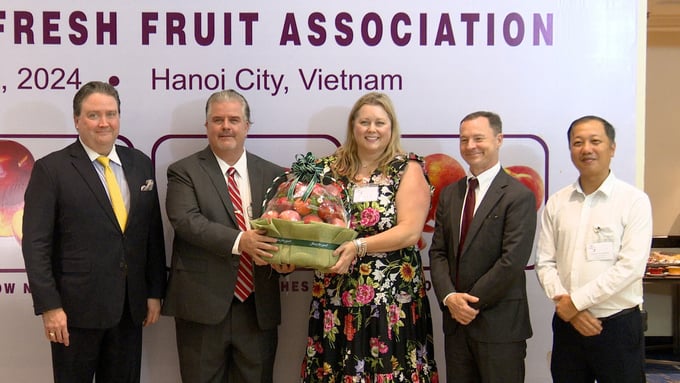
Representatives of the U.S. and the MARD at the event to celebrate the import of American peaches and nectarines into Vietnam. Photo: Thanh Thuy.
VAN: In the context of increasingly intense climate change, how can the U.S. and Vietnam cooperate to promote low-emission and environmentally friendly agriculture globally?
Attaché Henderson: We have a number of cooperative initiatives between the United States and Vietnam. A good example is the Fertilize Right initiative. The core idea is that if farmers apply the right type of fertilizer, in the right amount, at the right time, and in the right place, they will get three main benefits: lower input costs, higher yields, and improved soil health.
USDA hopes to support Vietnam in improving agricultural sustainability by reducing the amount of fertilizers that accumulate in soil and pollute water sources, environmental problems that affect farmers in many developing countries.
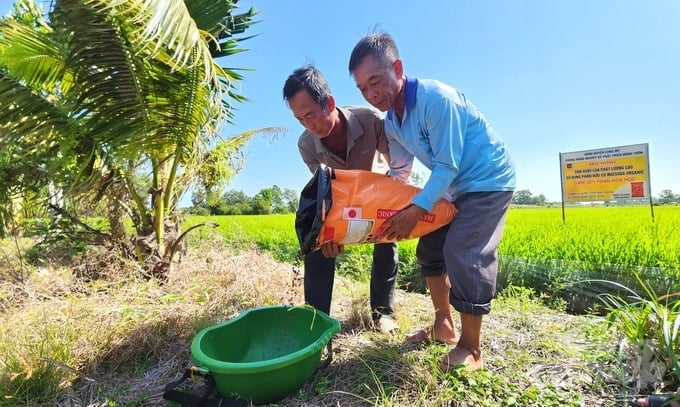
The Fertilize Right initiative aims to improve fertilizer efficiency, increase farmers' income, and reduce greenhouse gas emissions in rice cultivation. Photo: Kim Anh.
Admittedly, although advanced US technology solutions are always of interest, they are difficult to transfer immediately to Vietnam. We have expensive machinery suitable for large-scale farms, but not suitable for Vietnam’s agricultural reality.
But we are pleased to announce that USDA has recently approved a grant to support Vietnam in digital transformation in animal feed management. The project has been successful in the United States, demonstrating its effectiveness in quantifying optimal feed for livestock on farms across the country.
USDA believes that this is an affordable and practical tool that will bring significant benefits to farmers in Vietnam. The program is expected to be officially implemented in Vietnam in January 2025.
In the immediate future, USDA has worked closely with the University of California - Davis to adapt the software to the needs of Vietnamese farmers. Even farmers with little experience or technical resources can use the software effectively.
It is important to emphasize that high-tech solutions also require knowledge transfer. We recently had a scholarship focusing on African swine fever. Through the USDA scholarship program with the Animal and Plant Health Inspection Service (APHIS), we hope that the United States can support Vietnam in training the next generation of veterinarians.
Finally, we cannot discuss sustainability without mentioning biotechnology. The U.S. focuses on biotechnology research and development. In the face of global climate change, this field plays an important role in increasing productivity.

The United States wants to introduce premium products to Vietnamese consumers. Photo: Tung Dinh.
VAN: What recommendations do you have for Vietnamese and U.S. businesses that want to expand exports and explore markets?
Attaché Henderson: Whenever we talk to Vietnamese businesses, they are always interested in exporting to other markets, including the United States. The best answer comes from my own experience working with U.S. businesses that want to export to Vietnam.
The process often starts with a conversation. When a U.S. business wants to export to Vietnam but faces barriers, such as lack of market access, they often contact USDA for information or assistance.
That initial conversation helps us gather the information we need from the Vietnamese government and link that information to the priorities of the U.S. government and other stakeholders, which helps us shape a roadmap for the business.
For Vietnamese businesses looking to increase exports to the United States, I recommend a similar approach: Contact the Vietnamese Agricultural Counselor in the United States. From there, the Ministry of Agriculture and Rural Development will guide businesses on a roadmap, based on Vietnam's priorities for different markets.
Looking ahead, I believe the coming year will provide a wonderful opportunity to reflect on how far we have come over the past 30 years. On behalf of USDA, I would like to express my gratitude to the Government and people of Vietnam, especially for your warm welcome during my first term in Vietnam.
VAN: Thank you!
Translated by Quynh Chi

(VAN) At the TARASA25 Conference, participating countries shared experiences on implementing agroecology and regenerative agriculture, contributing to a sustainable transformation of food and agriculture systems.

(VAN) Green industry is becoming a driving force for the development of Hue City, not only promoting economic growth but also protecting the environment, creating the foundation for the Net Zero goal.

(VAN) As of 2025, the ASEAN region has a total of 69 ASEAN Heritage Parks recognized across its 10 member states. Among them, Viet Nam contributes 15 ASEAN Heritage Parks.

(VAN) Yok Don National Park has high biodiversity with numerous endemic plant and animal species, and it is also the only dipterocarp forest ecosystem conservation area in Viet Nam.

(VAN) Viet Nam and Brunei signed two important MOUs on fisheries and IUU, expanding cooperation in agriculture, the environment, and Halal exports, aiming to substantively implement joint projects.

(VAN) The Viet Nam Coconut Association worked with the International Finance Corporation (IFC) and businesses to promote the supply chain, enhance competitiveness, and develop the coconut industry sustainably.
![Hue aims for Net Zero: [2] Pioneering low-emission tourism](https://t.ex-cdn.com/nongnghiepmoitruong.vn/608w/files/huytd/2025/12/04/0633-dulichzero-4-095634_236-161125.jpg)
(VAN) The ancient capital of Hue has developed Net Zero tourism products and models, aiming to reduce carbon emissions and pioneer the establishment of Viet Nam's green tourism destination.
