December 7, 2025 | 22:34 GMT +7
Hotline: 0913.378.918

December 7, 2025 | 22:34 GMT +7
Hotline: 0913.378.918
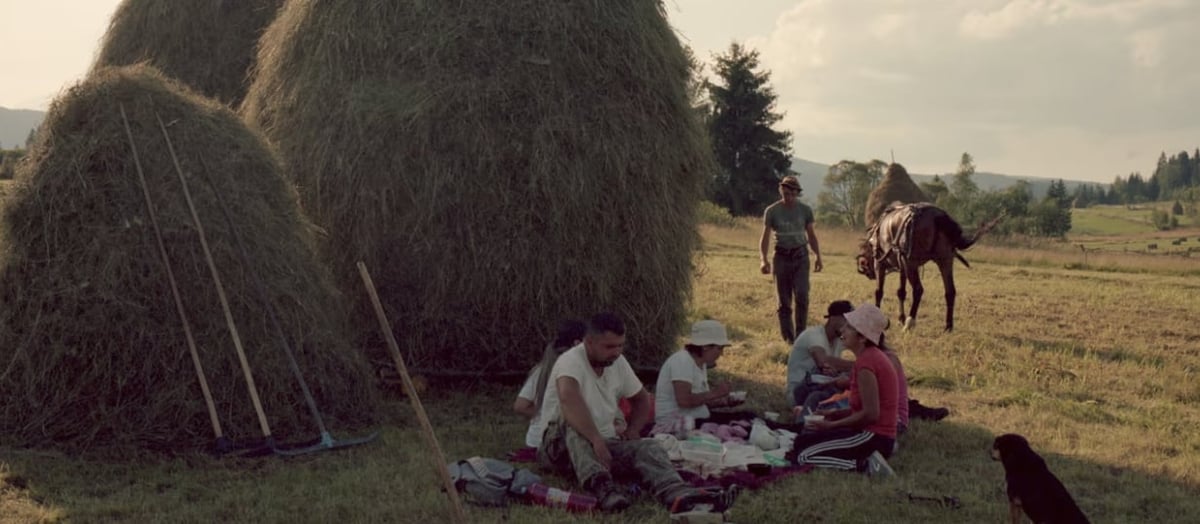
The disappearance of the hay meadows will be a huge loss for wildlife.
Golden haystacks shaped like teardrops have been a symbol of rural life in Romania for hundreds of years. The 3-metre-high (10ft) stacks are the culmination of days of hard work by families, from children up to grandparents, in the height of summer.
Together they cut waist-high grass, leave it to dry in the hot sun and stack it up to be stored over the winter, combing the hay downwards to protect it from harsh winds, heavy rain and snow. Throughout winter, clumps of it are removed from the haystacks and fed to livestock.
The work is labour-intensive and communal, and it benefits far more species than just humans and their livestock. Research shows these meadows are among the most biodiverse terrestrial ecosystems anywhere, full of grasshoppers, butterflies and spiders, as well as more than 100 species of grasses and flowers, including grass vetchling, hedge bedstraw and field scabious.
It is human activity that makes these habitats so rich for wildlife: hundreds of species of plant, bird and insect have adapted alongside centuries of cultivating and harvesting meadows, their life cycles becoming intertwined with farming.
Studies have found that Romania’s traditional hay meadows can be richer in wildlife than meadows managed as nature reserves. From May to July, before the hay is cut, they are awash with wildflowers and insects.
Romania is home to some of the largest grasslands in Europe still managed by traditional methods. But as modern agriculture creeps in, the haystacks are becoming a symbol of a vanishing way of life.
Sarig Attila, a farmer from Ghimeş-Făget, a small mountain village in the eastern Carpathians, says: “I love the place where I grew up. I see the huge value in what our ancestors created – their gentle touch on nature, their respect for it, and how they work the fields, creating such rich biodiversity.” His family has lived in the village for at least four generations.
Ghimeş-Făget is home to 5,000 people, whose farms were largely self-sustaining for 400 years, with a mixture of sheep, cows, wheat and other grains. Many villagers can name more than 120 plant species, ethnoecologists have found.
In most of western Europe, the advent of artificial fertilisers has put an end to the wildlife-rich hay meadows that would once have carpeted the countryside. The UK has lost 97% of its wildflower meadows since the 1930s. Things are rapidly changing in Romania too: as young people leave the villages looking for work elsewhere in Europe, humans and horses are being replaced by machines and fertiliser.
Over the past 15 years, small machines to cut grass and put it into lines have arrived in Ghimeş-Făget, and bigger tractors are also being used. Attila says: “There was almost no change in 300 or 400 years, and now, in the past 30 years, everything is changing extremely fast. In the last few years it’s been changing like lightning.”
There are now only a few families making hay completely in the traditional way. As many young people have left, Attila cannot pay someone to help him, so it is cheaper for him to use a machine.
“People are getting tractors because they are stronger than horses and can do many jobs,” says Attila, who is worried that a centuries-long connection to the land is being lost.
Many people are working to ensure the golden haystacks do not become relics of the past.
Nat Page is director of Fundația Adept, a biodiversity conservation and rural development organisation based in Romania that works with farmers on how best to manage grasslands profitably. It helps farmers access funding for protecting biodiversity and create markets for their products.
Its work covers 30,000 hectares (74,000 acres) of grasslands south of Sighișoara in south-east Transylvania, which is managed by about 5,000 small-scale farmers.
“You can walk for days through hay meadows,” says Page. “Transylvania is the last European country with great, large-scale traditional farming landscapes. We’re keen to give small-scale farmers an incentive to stay.”
However, on the ground, the destruction of Romania’s traditional methods continues unabated, with half of hay meadows left unmown in some areas.
The loss of these traditional hay meadows is “happening everywhere”, says Attila, and with no human management, biodiversity declines. “There are not enough people to do the job – younger people are abandoning the village.
“For me, it’s sad,” he says. “I see a huge value in this, but the new generation doesn’t.”
The Guardian

(VAN) Newly designated initiatives in Australia, Canada and South Africa represent science-based and inclusive examples of ecosystem restoration.

(VAN) Rice-based food has been selected as Japan's 'Dish of the Year' for 2025, reflecting public interest in the stable supply of the country's staple food amid a recent rice shortage.

(VAN) A research project in Sweden explored how valuable substances can be extracted from organic waste, such as food waste and animal manure, and how this loop can be closed by producing animal feed.

(VAN) Average retail fertilizer prices continued to be mostly higher during the fourth week of November 2025, according to sellers surveyed by DTN.

(VAN) Inaugural Appeal focuses on cost-effective agricultural solutions that link urgent needs with long-term resilience.

(VAN) Landmark SOLAW 2025 report reminds us that resources for food are not infinite.

(VAN) Climate change is a growing concern for agricultural productivity and several studies have focused on how climate variations can impact crop yields.
