December 6, 2025 | 11:45 GMT +7
Hotline: 0913.378.918

December 6, 2025 | 11:45 GMT +7
Hotline: 0913.378.918
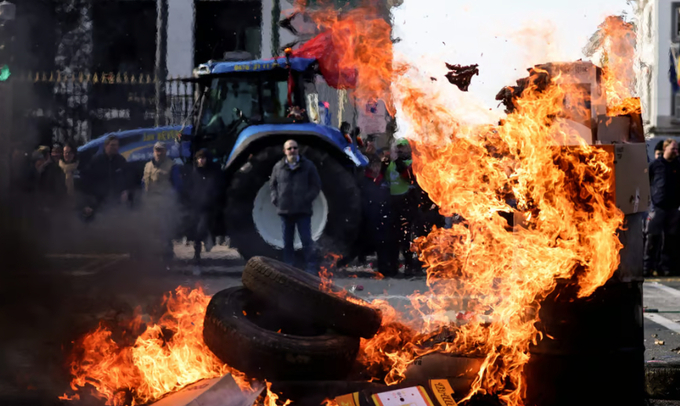
The planned cuts unfairly place a heavier burden on agriculture than industry, claim farming unions.
Convoys of tractors brought traffic in Brussels to a standstill Friday, as thousands of Belgian farmers protested the Flemish regional government’s plans to limit nitrogen emissions from agriculture.
Some 2,700 tractors rolled into Brussels from the Flanders region, according to police estimates, filling the streets with a cacophony of honks as farmers vented their anger over the planned cuts, which they say threaten to put many of them out of business.
“It’s an economic and social catastrophe,” said Nele Kempeneers, a spokesperson for Belgian farmers' association Boerenbond, one of the unions that organized the protest. “A lot of farms will have to limit the amount of animals that they keep, or simply close down.”
Some protestors plastered signs to the front of their tractors, voicing their opposition. “No farmers, no food,” read one. “Don’t forget who takes care of your food,” read another.
Others started a fire and set off firecrackers on Rue de la Loi, in the heart of the European quarter. But this was a different group capitalizing on the protest — not farmers, a member of Boerenbond told POLITICO.
Last year, the Flemish government put forward a package of measures to cut nitrate pollution. An initial agreement unraveled following a public consultation period over the summer. The parties making up the ruling coalition returned to the negotiating table this week but were unable to strike a deal.
The planned cuts unfairly place a heavier burden on agriculture than industry, claim farming unions, who have the support of the Flemish Christian Democrats.
“There’s no future for us, we cannot go on like this,” Ruben Bauwens, a 30-year-old dairy farmer, told POLITICO.
Similar protests took place last year in the Netherlands after the Dutch government approved an agreement that aimed to slash nitrogen emissions by up to 70 percent in some regions.
Intensive livestock farming and the use of fertilizers in both the Netherlands and Belgium have contributed to levels of nitrogen pollution in the soil and water that exceed thresholds on emissions set by the EU in a bid to reduce environmental damage.
“Here in Belgium, we have the know-how, we have the cows and the genetics and we have the [land],” said Marjan van den Eynde, another dairy farmer. “So let us do what we are good at.”
Farmers are more aware than anyone about the impacts of environmental damage, she added. "We are the first to feel the effects."
(Politico)

(VAN) Landmark SOLAW 2025 report reminds us that resources for food are not infinite.

(VAN) Climate change is a growing concern for agricultural productivity and several studies have focused on how climate variations can impact crop yields.

(VAN) In today's fast-paced society, with people busy with their work and social lives, many dream about quitting the rat race to experience a slower pace of life, which they imagine as being more poetic.

(VAN) Mindanao’s durian industry is reaping the benefits of rising global demand, with farmers now enjoying improved market access, better farmgate prices, and stronger profitability, the Department of Agriculture in Davao Region (DA-11) reported.

(VAN) Iraq is currently grappling with one of the most severe agricultural and livestock crises in its modern history.

(VAN) The Mediterranean and the Black Sea: Fisheries sustainability concerns remain, but overfishing drops to its lowest level in a decade, while aquaculture feeds more people.

(VAN) Cargill Inc has no plans to close its U.S. beef processing plants, days after meatpacker Tyson Foods l opens new tab announced it would shutter a Nebraska facility as industry grapples with cattle supplies.
