December 7, 2025 | 17:03 GMT +7
Hotline: 0913.378.918

December 7, 2025 | 17:03 GMT +7
Hotline: 0913.378.918
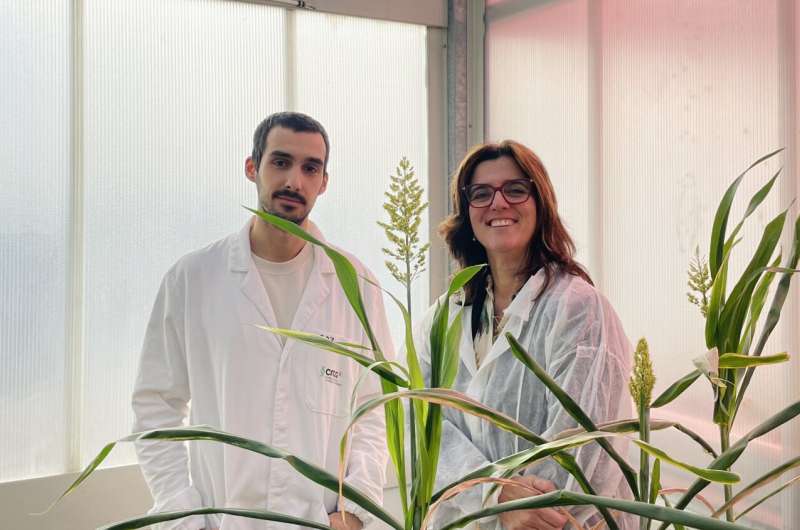
On the left Andrés Rico, first author of the study, and on the right Ana I. Caño-Delgado, who led the study. Credit: CRAG.
In a series of three recent studies, a team led by CSIC researcher at CRAG Ana I. Caño-Delgado has made significant progress in understanding the molecular mechanisms and improving the breeding of sorghum, the world's fifth most cultivated cereal, which is particularly important in arid and semi-arid regions. The importance of this cereal lies in its role in the future of human and animal nutrition, providing a sustainable alternative for areas facing water scarcity.
Sorghum is increasingly recognized as a staple food in many parts of the world, including outside Africa, where it has been cultivated for centuries, due to its multiple nutritional benefits and resistance to adverse climatic conditions. In Europe, sorghum cultivation is on the rise and is being promoted as an alternative for crop rotation, especially in regions prone to water scarcity.
The European Union is actively promoting sorghum cultivation as a climate-resilient crop, with a 57% increase in total sorghum production during the last decade. France, in particular, is at the forefront of this trend with 103,000 hectares dedicated to grain sorghum cultivation last year. Meanwhile, Spain is a major importer of sorghum in Europe, mainly for animal feed but with prospects for human food in the future.
In 2020, 158,000 tonnes were imported into Spain, so an increase in its cultivation on the territory could reduce dependence on imports. For reference, Spain imported 303,000 tonnes of barley in the last six months, making it the third most imported crop.
CRAG's research efforts are at the vanguard of advancing sorghum science, focusing on improving, even further, its adaptability to stress conditions and enhancing its handling in the laboratory for future breeding processes. For the last 20 years, the research group led by Ana I. Caño-Delgado has been dedicated to the study of this cereal and has received numerous grants, including an ERC PoC from the European Research Council (ERC). In the last six months, the group has published three scientific articles of great importance to the sector.
In the first of these three studies, published in the Plant Biotechnology Journal, the research team identified that mutations in the protein Sorghum bicolor brassinosteroid receptor, SbBRI1, confer drought tolerance by altering phenylpropanoid metabolism. This finding highlights a molecular mechanism for enhancing drought resistance in sorghum, a critical trait for climate-resilient agriculture.
A second work, published in The Plant Journal, detailed a significant advancement in sorghum biotechnology: an efficient sorghum transformation method using a ternary vector system combined with morphogenic regulators. Previous tools and methods were not effective enough for studying certain varieties of sorghum, posing a significant challenge for scientists and breeders. This new protocol solves this problem by allowing for highly efficient transformation using Agrobacterium tumefaciens and enables the application of new breeding techniques like gene editing to accelerate crop improvement.
This technology provides a useful tool for creating and studying mutants of interest with a very high efficiency in the transformation of recalcitrant sorghum (varieties that are resistant to genetic transformation), reaching a two-fold increase in the transformation efficiency.
Juan B. Fontanet-Manzaneque, lead author of both studies, underscored the significance of these breakthroughs in sorghum cultivation: "Our goal was to equip the sorghum community with not only cutting-edge molecular tools to accelerate sorghum breeding but also some key target genes essential for developing drought-resistant crops."
The third study, published in the journal New Phytologist, characterizes the role of SbBRI1 in root development, specifically in the meristem region, linking BRI1 to cell wall metabolism and demonstrating that the sorghum SbBRI1 protein plays functionally conserved roles in plant growth and development. Root development is crucial for the overall growth and health of the plant and plays a role in how the plant responds to environmental stressors.
Andrés Rico-Medina, first author of the study, highlighted the implemented technique: "We adapted the staining and imaging protocols that are used in model plants like Arabidopsis to be useful for studies in Sorghum."
He also noted, "This adaptation serves to bridge the gap between laboratory-based drought studies and a more agronomic context, thereby facilitating the practical application of these scientific advancements."
Sorghum is increasingly considered as a crucial crop for climate change adaptation due to its tolerance to high temperatures and drought, especially compared to maize, which is the most widely cultivated cereal in Europe and is highly susceptible to water stress. Studies show that the importance of sorghum in Europe is expected to increase because of climate change.
Also, the expansion of sorghum cultivation in Spain could create new economic opportunities for farmers, reducing dependence on imports and boosting local agricultural production. In Catalonia, more than 100,000 tonnes of sorghum were produced in 2023, more than 90% of which was destined for animal feed.
Furthermore, sorghum is a naturally gluten-free cereal, a particularly relevant characteristic in the food industry. Its adaptability and high nutritional value make it a key crop for improving food security. The rising demand for sorghum for human consumption, with an increase by around 6% in demand in 2024, highlights its potential to improve nutrition, especially when research is leading to new varieties of sorghum.
Ana I. Caño-Delgado, leader of the group, said, "This research represents a significant opportunity for CRAG to establish technology transfer projects, to encourage public-private collaboration, and to highlight the excellent work of our researchers"
These three scientific advancements by CRAG's researchers not only pave the way for more sustainable and productive sorghum cultivation but also mark a critical step forward in addressing global food security and nutrition challenges. Moreover, this finding is relevant for other essential crops such as maize, wheat and rice, because they also contain brassinosteroid signaling pathways. This creates an opportunity for climate-smart agriculture, with more resilient and sustainable varieties.
(Phys.org)

(VAN) Rice-based food has been selected as Japan's 'Dish of the Year' for 2025, reflecting public interest in the stable supply of the country's staple food amid a recent rice shortage.

(VAN) A research project in Sweden explored how valuable substances can be extracted from organic waste, such as food waste and animal manure, and how this loop can be closed by producing animal feed.

(VAN) Average retail fertilizer prices continued to be mostly higher during the fourth week of November 2025, according to sellers surveyed by DTN.

(VAN) Inaugural Appeal focuses on cost-effective agricultural solutions that link urgent needs with long-term resilience.

(VAN) Landmark SOLAW 2025 report reminds us that resources for food are not infinite.

(VAN) Climate change is a growing concern for agricultural productivity and several studies have focused on how climate variations can impact crop yields.

(VAN) In today's fast-paced society, with people busy with their work and social lives, many dream about quitting the rat race to experience a slower pace of life, which they imagine as being more poetic.
